Vermont Maple Sugar on Snow: The New England Sugaring-Off Tradition with Donuts and Pickles
July 19, 2026
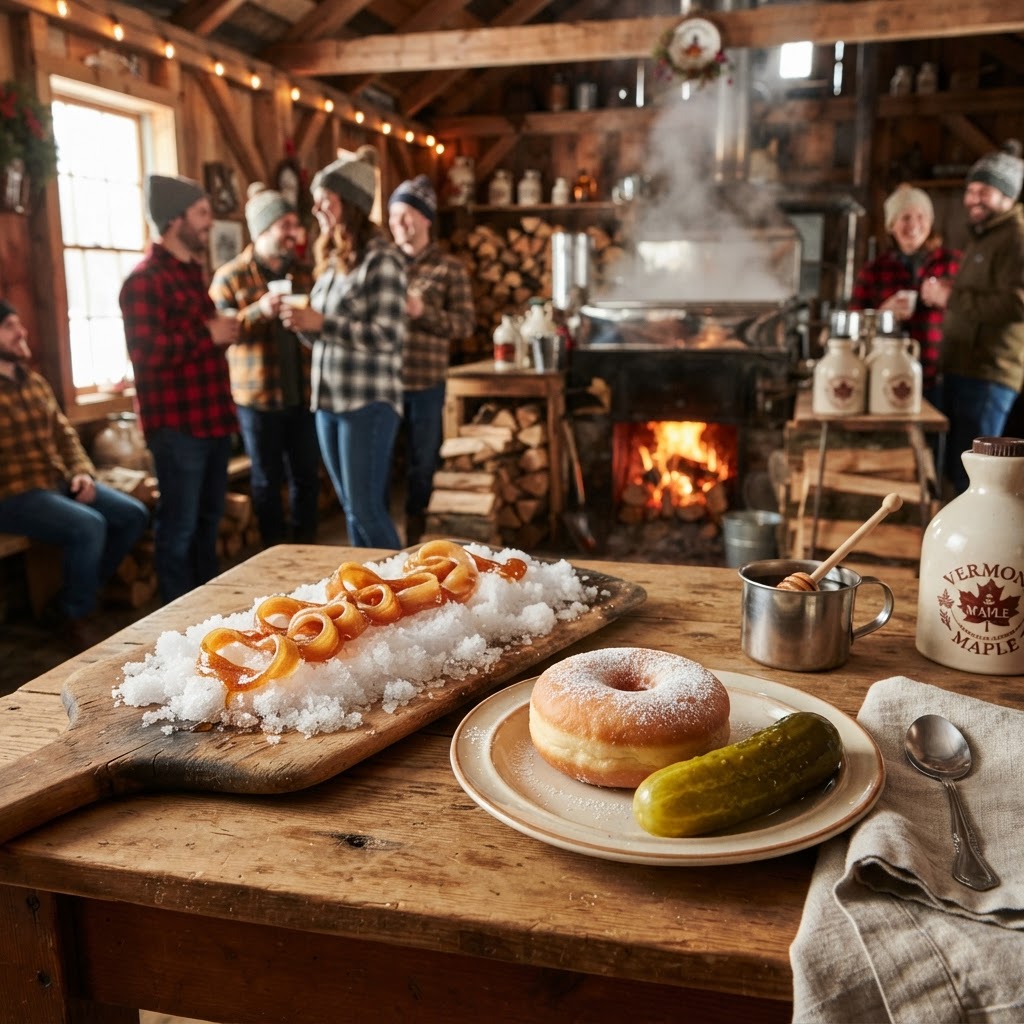
Sugar on snow is the great winter brunch tradition of Vermont — hot maple syrup, boiled to the soft-ball stage and poured in ribbons over packed snow, where it hardens into a chewy, amber taffy that is wound onto forks and eaten alongside a plain raised donut and a sour pickle, a combination so strange and so perfect that it has been the centerpiece of the Vermont "sugaring-off" party for over two centuries. According to Edible Vermont, sugar on snow is the traditional centerpiece of a Vermont sugar-on-snow banquet, made by pouring hot maple syrup over snow, and "pickles and buttermilk donuts often accompany sugar on snow to balance out the sweetness of the maple" — the pickle and the donut are not optional garnishes but essential parts of the tradition, because the sour pickle cuts the intense sweetness of the maple taffy and resets the palate, and the donut provides a neutral, bready contrast. The sugaring-off tradition is the Vermont maple syrup harvest itself: each March, when the snow begins to melt and the sap starts to flow, sugar shacks across the state boil the sap into syrup and host sugaring-off parties where neighbors gather around the evaporator to eat sugar on snow, donuts, and pickles — the oldest and most authentic Vermont brunch tradition.
The genius of sugar on snow is the science: when maple syrup is heated to about 234°F (the soft-ball stage in candy-making) and poured over snow, the sudden temperature drop causes the sugar to crystallize into a chewy, pliable taffy rather than a hard candy — the texture is somewhere between taffy and fudge, warm and melting, and it is unlike anything else in American cooking. Eaten with a sour pickle between bites (the acidity resets the sweetness so you can taste it fresh each time) and a plain raised donut (a neutral, yeasty counter to the intense maple), it is a brunch that could exist nowhere but in the maple country of New England.
About the Ingredients
Pure maple syrup — genuine Vermont pure maple syrup, preferably dark amber or grade B (the darker, more intensely flavored grades); the syrup must be real, not pancake syrup, because only pure maple syrup has the sugar concentration to form taffy.
Snow — clean, packed snow (or finely shaved ice if snow is unavailable); the snow must be cold enough to rapidly chill the hot syrup into taffy.
Raised donuts — plain, yeast-raised donuts (not cake donuts); the neutral, bready texture is the counterpoint to the intense maple.
Sour pickles — sour dill pickles (not sweet pickles); the sharp acidity cuts the sweetness and resets the palate, which is why the pickle is essential rather than optional.
Ingredients (serves 6): - 1 quart pure Vermont maple syrup (dark amber or grade B) - Clean, packed snow (or finely shaved ice) - 6 plain raised (yeast) donuts - 6 sour dill pickles
Instructions: Pack the snow into shallow pans or plates to a depth of 2–3 inches. Keep the snow cold (refrigerate the pans if preparing ahead).
In a large, deep saucepan, bring the maple syrup to a boil over medium-high heat. Insert a candy thermometer and boil the syrup to 234°F (the soft-ball stage), about 10–15 minutes. Watch carefully; the syrup can boil over and burn.
Remove from the heat. Working quickly, pour the hot syrup in ribbons over the packed snow — long, thin lines rather than a pool. The syrup will harden into chewy taffy on contact with the snow.
To eat: wind the taffy onto a fork (like winding spaghetti), lift it from the snow, and eat it warm and chewy. Between bites, take a bite of donut and a bite of sour pickle to balance the sweetness.
Serve immediately; the taffy melts if it sits.
The Mimosa Pairing Logic: The intense maple sweetness and the sour pickle want a bright, dry drink that echoes the maple and refreshes the palate. A classic Champagne mimosa is the natural choice — the citrus acidity balances the intense maple and the bubbles lift the heavy sweetness. A fig honey champagne mimosa is equally lovely, its honey echoing the maple and its gentle fruit a beautiful counter to the taffy. This pairing is, in its way, the brunch equivalent of sugar on snow and a cup of strong Vermont coffee — a sparkling toast to the March sugaring-off and the maple shacks of the Green Mountain State.
Reference Links: - Sugar on Snow (Vermont sugaring-off tradition, pickles and donuts): Edible Vermont
Make-Ahead: The snow can be packed into pans and held in the freezer until ready. The donuts and pickles are bought, not made. The syrup must be boiled and poured at the last minute; the taffy is the point and it melts if it sits. Have everything else ready before you boil the syrup. The syrup can be boiled to temperature and held warm briefly, but pour it over the snow the moment you are ready to serve.
Pro Tips: Use genuine Vermont pure maple syrup; pancake syrup (which is corn syrup with artificial flavor) will not form taffy and will taste of nothing. Use a candy thermometer; the temperature matters, and too-hot syrup makes a hard, brittle candy while too-cool syrup stays liquid on the snow. Watch the boiling syrup carefully; it boils over easily and sugar burns are severe. Do not skip the pickle; the sour bite is what lets you taste the sweetness fresh with every bite, and without it the maple becomes cloying after the second forkful. Use raised (yeast) donuts, not cake donuts; the yeasty, bready texture is the right neutral counter to the maple. This is a brunch to eat standing up, around the sugar shack, in the March snow.
Rate this recipe
Be the first to rate this recipe
to submit your rating.
Recent Posts

Couscous Royale: North Africa's Grand Platter of Lamb, Chicken, and Merguez
October 14, 2026

Seattle Cream Cheese Dog Bites: Hadley Long's 1989 Pioneer Square Invention
October 14, 2026

Khao Soi: Chiang Mai's Northern Thai Coconut Curry Noodles
October 13, 2026

Korean Bibimbap: Jeonju's Joseon Dynasty Mixed Rice
October 11, 2026

Spaghetti alla Carbonara: Rome's World War II Pasta of Eggs, Guanciale, and Pecorino
October 9, 2026