Torta della Nonna al Prosecco
January 16, 2026
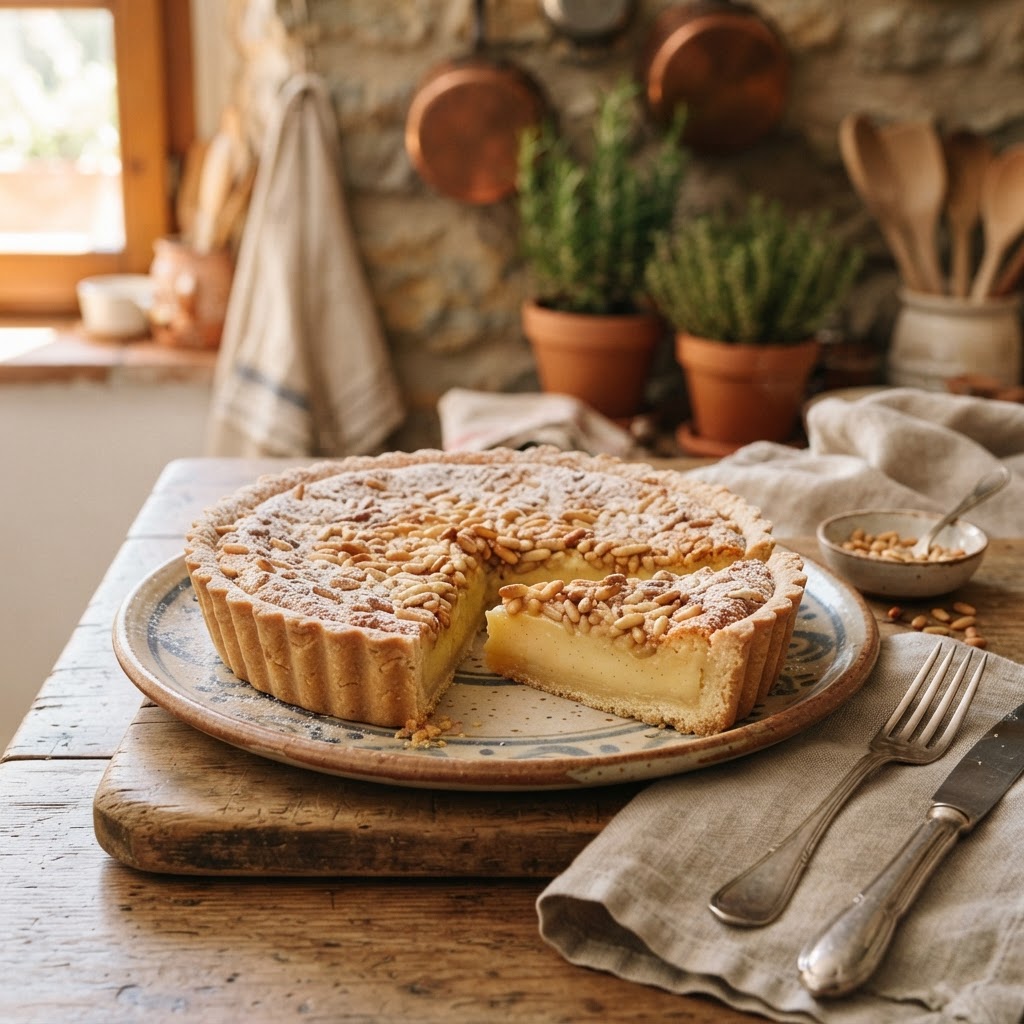
There is something profoundly comforting about Torta della Nonna — "Grandmother's Cake." It's the dessert you order at a trattoria in Florence when you're too full for anything elaborate but somehow not too full for custard. A buttery shortcrust pastry shell, filled with silky crème pâtissière, blanketed under a thick layer of toasted pine nuts and a snowfall of powdered sugar. It's rustic and refined simultaneously, which is the essence of Tuscan baking.
The cake is widely attributed to Guido Samorini, a Florentine chef and restaurateur who ran Trattoria San Lorenzo near the present-day San Lorenzo market in Florence. The story goes that in the mid-twentieth century, Samorini created the dessert for a bet — or, in another version, to answer criticism that his restaurant's dessert menu was too limited. He took the humble ingredients of Tuscan farmhouse cooking — flour, eggs, sugar, pine nuts — and elevated them into something that has become one of the most popular cakes in all of Italy. Whether or not Samorini truly invented it or simply popularized an existing recipe, the dessert is now found in every pasticceria in Tuscany and beyond.
Our Mimosavated version infuses the custard with a generous splash of Prosecco di Valdobbiadene. The Prosecco doesn't make the custard taste like sparkling wine — it lightens it, adds a faint floral brightness that cuts through the richness of the egg yolks and makes the whole tart feel more alive. The pine nuts are toasted in a bit of butter until golden before being scattered across the top, because untoasted pine nuts are a waste of everyone's time.
Ingredients (serves 10–12):
The Pasta Frolla (Sweet Shortcrust): - 10.6 oz tipo 00 flour, plus extra for dusting - 5 ¼ oz cold unsalted butter, cubed - 3 ½ oz granulated sugar - 2 large egg yolks - Zest of 1 lemon (organic, unwaxed) - A pinch of salt - 2–3 tablespoons cold water (only if needed)
The Prosecco Custard (Crema Pasticciera): - 2 ⅛ cups whole milk - 4 large egg yolks - 3 ½ oz granulated sugar - 1 ⅓ oz cornstarch (maizena) - ⅓ cup Prosecco di Valdobbiadene (brut or extra dry) - 1 vanilla pod, split and scraped (or 1 teaspoon vanilla extract) - Zest of 1 lemon (organic, unwaxed)
The Topping: - 3 ½ oz pine nuts, toasted - 1 oz unsalted butter (for toasting pine nuts) - Powdered sugar, for dusting
Making the Pasta Frolla: In a food processor or by hand, combine the flour, sugar, salt, and lemon zest. Add the cold cubed butter and pulse or rub with your fingertips until the mixture resembles coarse breadcrumbs. Add the egg yolks and pulse until the dough just comes together — if it's too dry, add cold water one tablespoon at a time. Form into a disc, wrap in plastic, and refrigerate for at least 1 hour. This dough can also be made a day ahead.
Making the Prosecco Custard: Warm the milk with the vanilla pod and lemon zest in a saucepan until just below boiling. In a heatproof bowl, whisk together the egg yolks, sugar, and cornstarch until thick and pale. Slowly pour the warm milk into the egg mixture, whisking constantly, to temper. Return the mixture to the saucepan and cook over medium-low heat, whisking constantly, until it thickens to a custard — about 4–5 minutes. Do not let it boil or the eggs will scramble.
Remove from heat, remove the vanilla pod, and whisk in the Prosecco. The custard should be silky and pourable. Transfer to a bowl, press plastic wrap directly onto the surface to prevent a skin from forming, and cool to room temperature, then refrigerate until needed.
Assembly and Baking: Preheat the oven to 356°F (350°F). Divide the pasta frolla into two pieces — roughly two-thirds and one-third. Roll out the larger piece on a floured surface and line a 10 ¼ in (10-inch) tart tin with a removable base, trimming the edges. Prick the base with a fork. Pour in the cooled Prosecco custard and spread evenly.
Roll out the remaining dough and either lay it over the top as a lid (trimming and crimping the edges to seal) or cut it into lattice strips. Alternatively, you can skip the top crust entirely and just top with pine nuts — both versions exist in Tuscany. If using a lid, cut a few small slits to allow steam to escape.
Toast the pine nuts in butter in a small pan over medium heat until golden — about 3 minutes. Scatter them evenly over the top of the tart (if using a lid, scatter them after baking while the surface is still warm so they adhere).
Bake for 35–40 minutes, until the crust is deep golden. Let cool completely in the tin before removing. Just before serving, dust generously with powdered sugar.
The Mimosa Pairing Logic: Since the torta contains Prosecco, pair with a classic Prosecco mimosa — orange juice and Prosecco. The citrus will echo the lemon zest in both the pastry and the custard. For a more adventurous pairing, a lavender elderflower mimosa brings out the floral notes of the Prosecco custard beautifully. Avoid heavy or sweet mimosas — the tart is rich and nutty, and you need something bright and refreshing to balance it.
Reference Links: - Torta della Nonna history and Samorini: Wikipedia - Traditional Tuscan Torta della Nonna recipe: Dream of Italy - Prosecco di Valdobbiadene: Wikipedia - Pine nuts in Italian cooking: Italian Kiwi - Crema pasticciera technique: Serious Eats
Make-Ahead: The pasta frolla can be made up to 2 days ahead and refrigerated. The custard can be made a day ahead and refrigerated with plastic wrap on the surface. The assembled tart keeps for 2–3 days at room temperature in an airtight container. Do not refrigerate the baked tart — the pastry will lose its crispness and become soggy.
Pro Tips: Keep the butter and eggs for the pasta frolla as cold as possible — warm ingredients make the dough tough and shrink during baking. Toasting the pine nuts is not optional; raw pine nuts have a resinous, slightly metallic taste that ruins the tart. If you're using a lid, make sure to seal the edges well or the custard will bubble out during baking. The custard must be completely cool before you pour it into the pastry shell — warm custard will melt the butter in the pastry and make the base soggy.
Rate this recipe
Be the first to rate this recipe
to submit your rating.
Recent Posts

Couscous Royale: North Africa's Grand Platter of Lamb, Chicken, and Merguez
October 14, 2026

Seattle Cream Cheese Dog Bites: Hadley Long's 1989 Pioneer Square Invention
October 14, 2026

Khao Soi: Chiang Mai's Northern Thai Coconut Curry Noodles
October 13, 2026

Korean Bibimbap: Jeonju's Joseon Dynasty Mixed Rice
October 11, 2026

Spaghetti alla Carbonara: Rome's World War II Pasta of Eggs, Guanciale, and Pecorino
October 9, 2026