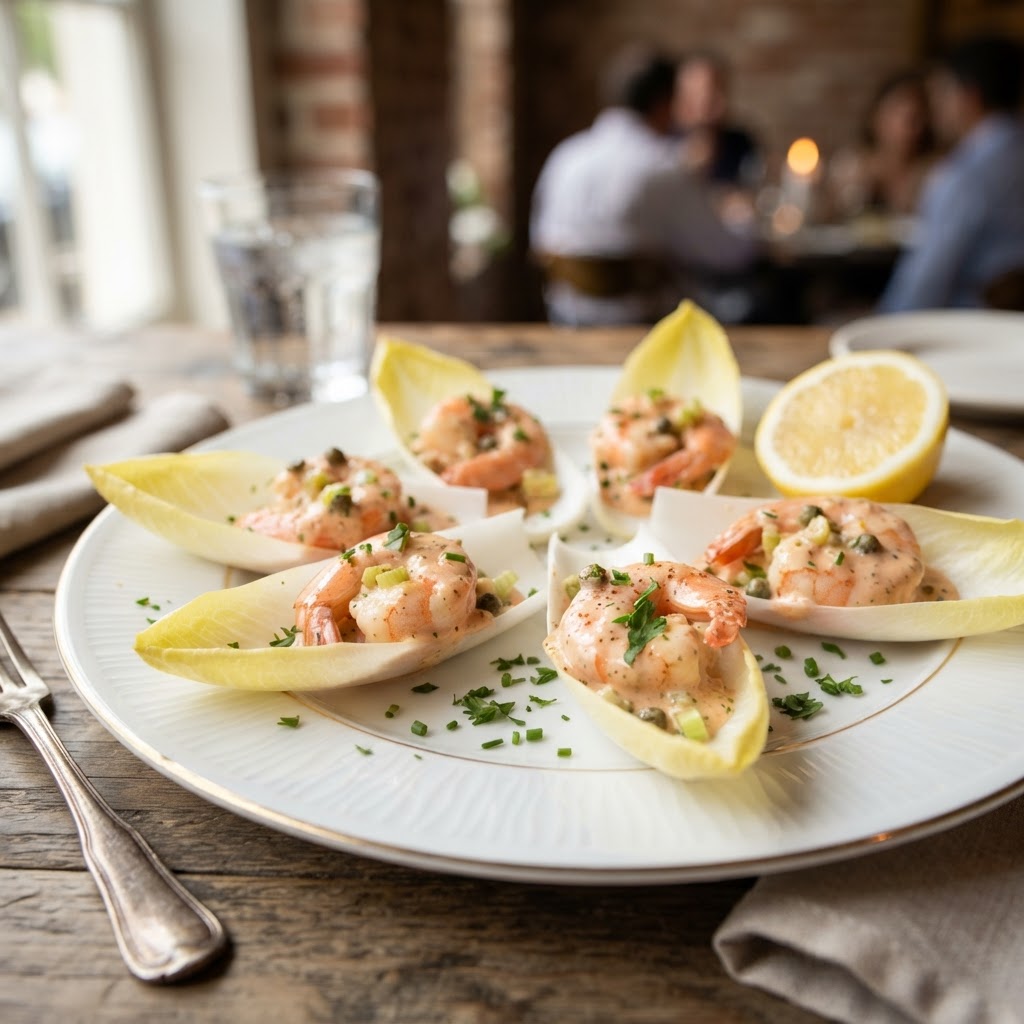
Shrimp Remoulade on Belgian Endive Leaves
June 18, 2026
Shrimp remoulade is one of New Orleans' most storied appetizers, created in the early 1800s by Count Arnaud Cazenave at his legendary French Quarter restaurant, Arnaud's, which remains one of the city's grand dining institutions. The Creole remoulade sauce — distinct from the French mustard-based original — is a complex, tangy, slightly spicy emulsion of mustard, mayonnaise, paprika, cayenne, Worcestershire, horseradish, and lemon, with a distinctive pink-orange hue from the paprika and cayenne. Served over chilled boiled shrimp, it is one of the most popular dishes in the New Orleans culinary canon.
The traditional presentation is a simple salad — shrimp tossed in remoulade, served on a bed of shredded lettuce. The canapé version, served on Belgian endive leaves, is a more elegant, modern interpretation that is ideal for cocktail parties: the endive's crisp, slightly bitter boat provides the perfect vessel for the saucy shrimp and adds a refreshing crunch that balances the richness of the sauce. The endive also eliminates the need for a fork — each leaf is a self-contained bite.
Ingredients (makes 24 endive boats, serves 8–10): - 1 lb 2 oz large shrimp (16/20 or 21/25 count), peeled and deveined - 3 Belgian endives, outer leaves separated (save inner leaves for salads)
Creole Remoulade Sauce: - 7 oz good-quality mayonnaise (Duke's or Hellmann's) - 2 tablespoons Creole or Dijon mustard - 1 tablespoon whole grain mustard - 1 tablespoon prepared horseradish (drained) - 1 tablespoon fresh lemon juice - 1 teaspoon Worcestershire sauce - 1 teaspoon hot sauce (Crystal is the New Orleans classic; Tabasco works) - 1 teaspoon paprika (preferably smoked or sweet Hungarian) - ½ teaspoon cayenne pepper - 1 small garlic clove, grated to a paste - 1 teaspoon capers, minced - 2 tablespoons fresh parsley, finely chopped - 2 tablespoons scallion (green parts), finely sliced - Salt and white pepper
Garnish: - Fresh parsley, finely chopped - Lemon zest - Paprika - Lemon wedges
Boiling the Shrimp: Bring a large pot of well-salted water to a boil (it should taste like the sea — add 2 tablespoons salt per litre). Add the juice of 1 lemon, a bay leaf, and 1 tablespoon black peppercorns. Add shrimp, reduce heat to medium, and poach 2–3 minutes until the shrimp are just pink and curled into a "C" shape — do not overcook. Drain and immediately transfer to a bowl of ice water to stop the cooking. Once cool, drain and pat dry. Cut each shrimp in half horizontally (so each half is a thinner, flatter piece that fits in the endive boat).
Creole Remoulade Sauce: In a bowl, whisk together mayonnaise, both mustards, horseradish, lemon juice, Worcestershire, hot sauce, paprika, cayenne, garlic, capers, parsley, and scallions. Season with salt and white pepper. Taste — the sauce should be tangy, slightly spicy, and complex. It should be a distinctive pink-orange color. (Can be made 3 days ahead; refrigerate. The flavor improves significantly after a day.)
Assembling the Endive Boats: Separate the outer leaves of the endive — you need 24 intact boat-shaped leaves. Trim the base of each leaf so it sits flat. Spoon a generous teaspoon of remoulade sauce into each endive leaf. Top with 2 halves of shrimp, arranged attractively. Garnish with a sprinkle of parsley, a grating of lemon zest, and a dust of paprika.
Service: Arrange on a white platter. Serve within 30 minutes of assembly — the endive will weep and soften under the sauce over time. Provide cocktail napkins.
The Mimosa Pairing Logic: The tangy, spicy, Creole character of shrimp remoulade calls for a mimosa with bright citrus that complements the New Orleans flavors. A classic orange mimosa is the most natural pairing — the citrus echoes the lemon in the remoulade and the champagne cuts through the richness of the mayonnaise. A blood orange mimosa is exceptional — the slight bitterness of the blood orange complements the endive's bitterness and the sauce's spice. A grapefruit rosemary mimosa is inspired — the grapefruit's gentle bitterness balances the richness while the rosemary adds an aromatic dimension. For a more adventurous pairing, a spicy jalapeño mimosa creates a beautiful heat-on-heat resonance with the Creole spice.
Reference Links: - Shrimp remoulade history and recipe: Sweet Daddy D - Arnaud's restaurant history: Arnaud's - Shrimp remoulade two ways: No Menu - Creole vs. French remoulade: The Spruce Eats
Make-Ahead: Remoulade sauce (3 days, refrigerated — the flavor improves significantly after a day). Boiled shrimp (1 day, refrigerated). Endive leaves can be separated, washed, and dried 4 hours ahead (wrap in damp paper towels and refrigerate). Assemble no more than 30 minutes before service — the endive will soften under the sauce.
Pro Tips: The poaching liquid should be well-seasoned — shrimp boiled in plain water taste flat and watery. The shrimp must be immediately shocked in ice water after boiling — residual heat continues to cook the shrimp and turns them rubbery. The remoulade sauce should be made at least a day ahead — the flavors meld and deepen significantly overnight. Belgian endive is the ideal vessel because its leaves are naturally boat-shaped, crisp, and slightly bitter — the bitterness provides a refreshing counterpoint to the rich, tangy sauce. When separating endive leaves, cut a cone-shaped piece from the base to release them without tearing. Do not use the innermost leaves — they are too small and too bitter.
Rate this recipe
Be the first to rate this recipe
to submit your rating.
Recent Posts

Couscous Royale: North Africa's Grand Platter of Lamb, Chicken, and Merguez
October 14, 2026

Seattle Cream Cheese Dog Bites: Hadley Long's 1989 Pioneer Square Invention
October 14, 2026

Khao Soi: Chiang Mai's Northern Thai Coconut Curry Noodles
October 13, 2026

Korean Bibimbap: Jeonju's Joseon Dynasty Mixed Rice
October 11, 2026

Spaghetti alla Carbonara: Rome's World War II Pasta of Eggs, Guanciale, and Pecorino
October 9, 2026