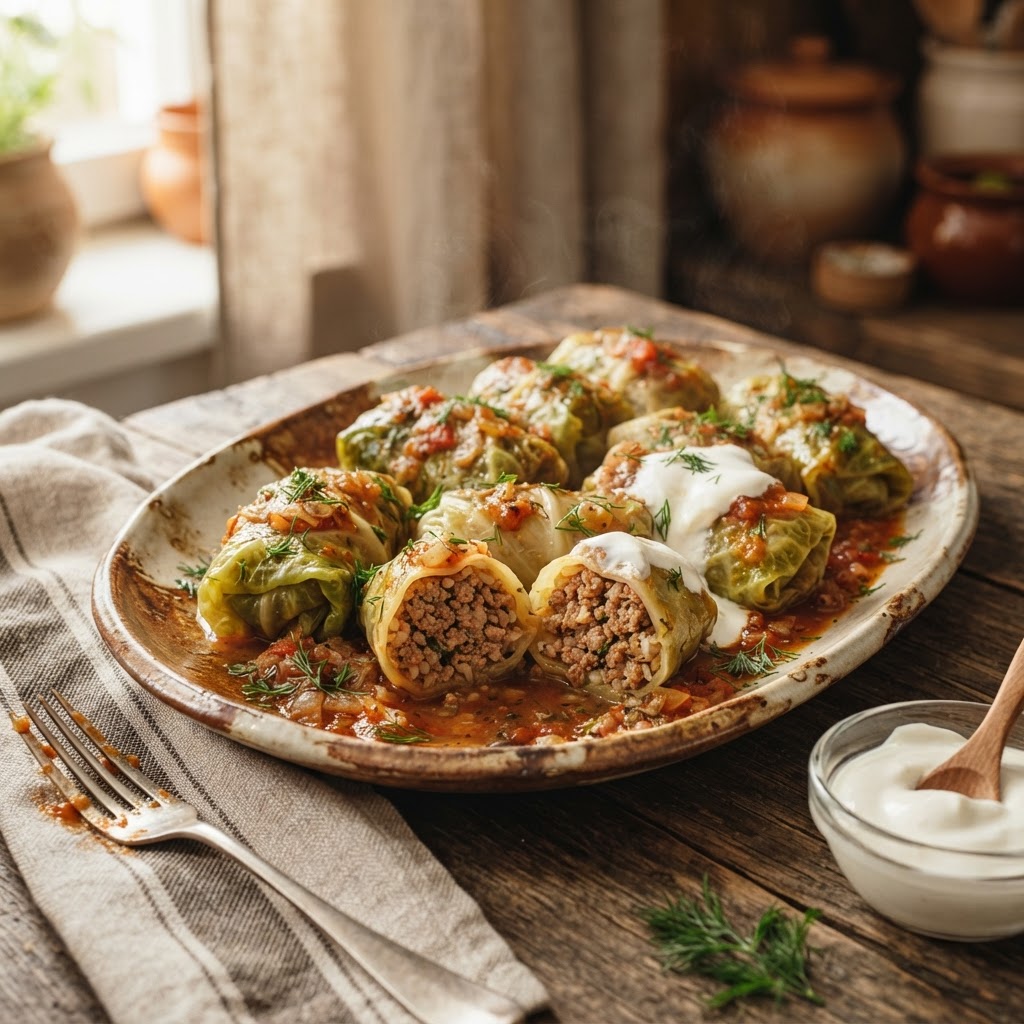
Polish Gołąbki Stuffed Cabbage Bites
July 7, 2026
Gołąbki — pronounced "gaw-WOHMP-kee" and translating charmingly to "little pigeons" — are the great stuffed cabbage rolls of Poland: blanched cabbage leaves wrapped around a filling of ground meat, rice, and onions, then simmered in a sweet-savory tomato sauce until the cabbage turns meltingly tender and the whole becomes a dish of deep, rustic comfort. The name is said to come from the way the plump rolls resemble small trussed birds. The dish's history in Poland reaches back to the nineteenth century, with roots in the eastern borderlands and an influence from the Ukrainian "hołubci"; some food historians trace the broader family of stuffed cabbage rolls even further back, to Jewish holishkes or to the Ottoman Turks who carried a version of the dish across Central Europe. Whatever the exact lineage, gołąbki became a Polish household staple — the kind of dish made in enormous batches, served on Sundays, and reheated all week.
For a party, gołąbki becomes a bite: small, cocktail-sized cabbage rolls, baked in a shallow dish in tomato sauce, each one a perfect two-bite portion of the classic comfort food.
Ingredients (makes about 24 small rolls, serves 8–12):
The Cabbage: - 2 large heads of green cabbage (you will use the largest, most intact leaves)
The Filling: - 1 pound ground pork (or a pork-beef blend) - ½ pound ground beef - 1 cup cooked white rice (long-grain, cooked and cooled) - 1 large onion, finely diced and softened in 1 tablespoon butter - 1 egg, beaten - 1 teaspoon kosher salt - ½ teaspoon black pepper - ½ teaspoon ground allspice (a gentle Polish touch) - 2 tablespoons fresh parsley, chopped
The Tomato Sauce: - 2 cups crushed tomatoes (San Marzano preferred) - 1 cup tomato sauce - 1 small onion, finely diced - 1 tablespoon brown sugar or honey (balances the tomato's acidity) - 1 tablespoon apple cider vinegar (the sweet-sour Polish note) - 1 teaspoon paprika - 1 teaspoon salt, plus more to taste - ½ teaspoon black pepper - 1 bay leaf - 1 tablespoon fresh dill, chopped (for finishing)
Preparing the Cabbage: Bring a large pot of salted water to a boil. Core the cabbages and carefully lower them in, head-first. As the outer leaves soften (3–4 minutes), use tongs to peel them off one at a time; continue until you have 24 large, intact, pliable leaves. Shock the leaves in ice water, then drain and pat dry. Trim the thick central rib of each leaf flat with a paring knife so the leaf rolls easily without cracking. Reserve the small inner leaves to line the baking dish.
Making the Filling: In a large bowl, combine the ground meats, cooked rice, softened onion, egg, salt, pepper, allspice, and parsley. Mix with your hands just until combined — do not overwork, or the filling will be dense. Divide into 24 small portions.
Making the Sauce: In a bowl, whisk together the crushed tomatoes, tomato sauce, onion, brown sugar, vinegar, paprika, salt, pepper, and bay leaf. Set aside.
Rolling the Gołąbki: Preheat oven to 350°F. Line a 9x13 baking dish with the small reserved cabbage leaves. Lay a large cabbage leaf flat, stem end toward you. Place a portion of filling near the stem. Fold the sides in over the filling, then roll up from the stem to form a neat, tight little parcel, seam side down. Place in the baking dish, packed snugly in a single layer. Repeat with the remaining rolls. Pour the tomato sauce evenly over the top (reserve a little to serve alongside, if you like). Cover tightly with foil.
Baking: Bake covered 1 hour, until the cabbage is very tender and the filling is cooked through. Remove the foil and bake 10–15 minutes more, until the sauce thickens slightly and the tops of the rolls take on a little color. Rest 10 minutes before serving.
Service: Spoon the small rolls onto a platter, each one sauced. Finish with a sprinkle of fresh dill and a dollop of sour cream alongside — the cool, tangy cream is the traditional Polish accompaniment and cuts the richness beautifully. Eat with a small fork, or, at a casual party, with toothpicks.
The Mimosa Pairing Logic: The meaty, rice-rich, tomato-sweet character of gołąbki calls for a mimosa with bright acidity to cut the richness and a fruit profile that complements the tomato. A classic orange mimosa is the most natural pairing — the orange's acid echoes the tomato and the vinegar in the sauce, and the champagne's bubbles lift the hearty dish. A pomegranate mimosa is exceptional — the pomegranate's tart-sweet, ruby character resonates with the tomato sauce and the allspice. For a more aromatic, Eastern-European-appropriate pairing, a honeyed chamomile lemon prosecco mimosa brings a gentle, fragrant sweetness that pairs beautifully with the comfort-food quality of the dish. Avoid heavy, oaky mimosas — they fight with the tomato's bright acidity.
Reference Links: - Gołąbki — Polish stuffed cabbage: Wikipedia - Gołąbki! The history of Polish stuffed cabbage: Polana
Make-Ahead: Gołąbki is one of the great make-ahead dishes — assemble completely (rolled, sauced, covered) and refrigerate up to 2 days, then bake; or freeze unbaked up to 1 month and bake from frozen, covered, adding 20 minutes. Like many cabbage dishes, the flavor deepens overnight, so it is genuinely better made a day ahead. Baked gołąbki reheats gently in a 325°F oven covered, in 20–25 minutes. The cabbage leaves can be blanched and drained 1 day ahead, refrigerated between paper towels.
Pro Tips: Blanching the cabbage leaves fully is the key to tender, rollable gołąbki — under-blanching makes the leaves crack and the rolls spring open in the oven; over-blanching makes them disintegrate. Trimming the thick central rib flat is essential — a domed rib prevents a tight roll and leaves a gap inside. The filling should be gently mixed, not packed, so it stays tender; overworked meat becomes a dense meatball. The sweet-sour balance of the sauce (brown sugar and vinegar) is the Polish signature — taste and adjust so neither the sweetness nor the acidity dominates. And cook the rolls covered until the very end — uncovered cabbage dries and toughens, while covered, it turns into the melting, silky texture that characterizes a great gołąbki.
Rate this recipe
Be the first to rate this recipe
to submit your rating.
Recent Posts

Couscous Royale: North Africa's Grand Platter of Lamb, Chicken, and Merguez
October 14, 2026

Seattle Cream Cheese Dog Bites: Hadley Long's 1989 Pioneer Square Invention
October 14, 2026

Khao Soi: Chiang Mai's Northern Thai Coconut Curry Noodles
October 13, 2026

Korean Bibimbap: Jeonju's Joseon Dynasty Mixed Rice
October 11, 2026

Spaghetti alla Carbonara: Rome's World War II Pasta of Eggs, Guanciale, and Pecorino
October 9, 2026