Pennsylvania Dutch Funnel Cake: The Amish Fried Dough of the American Carnival
April 5, 2026
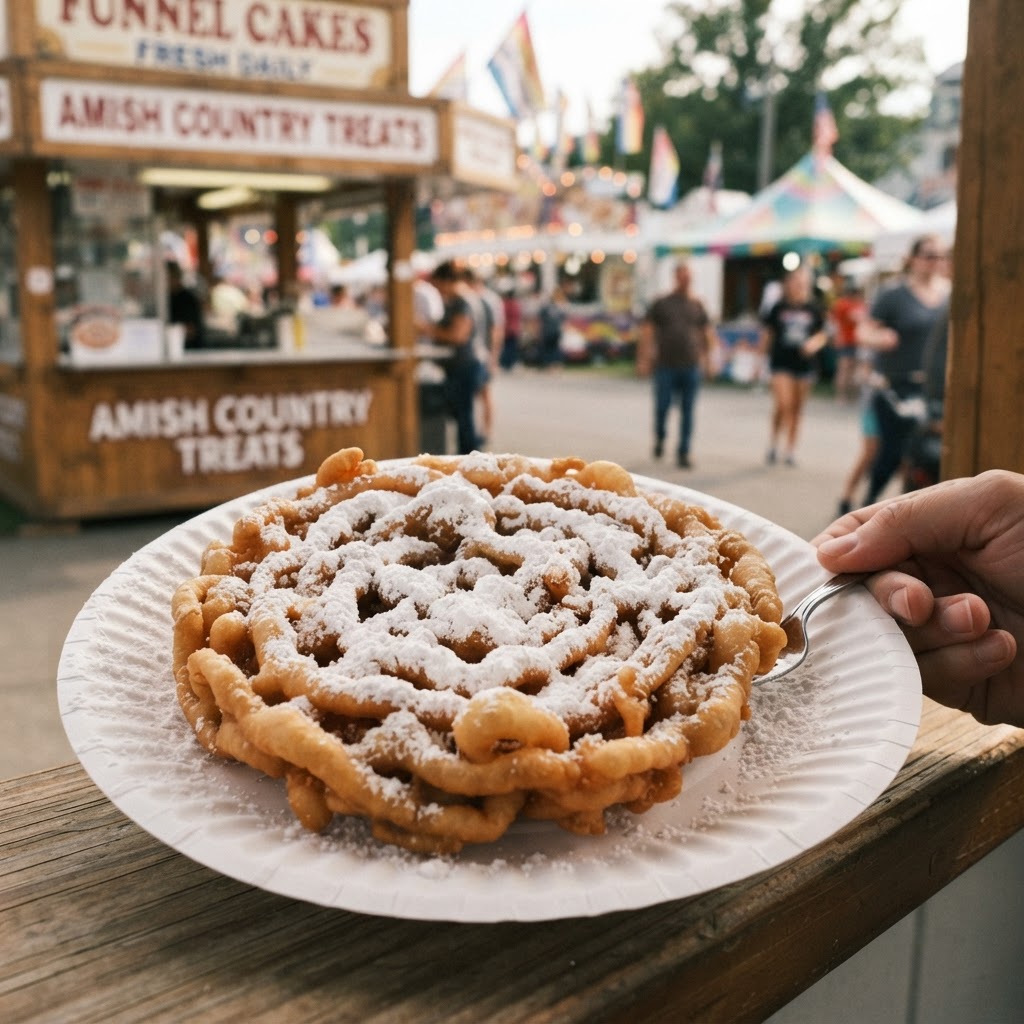
The funnel cake is the great fried dough of America — a free-form tangle of thin, crisp batter, drizzled in a spiral into hot oil and fried until golden, then lifted out and buried under a blizzard of powdered sugar, a confection brought to the New World by the Pennsylvania Dutch and now inseparable from the American county fair and the boardwalk. According to Wikipedia, in the United States funnel cakes were originally associated with the Pennsylvania Dutch Country, and it is one of the first North American fried foods; the dough is made by pouring batter through a funnel in a circular pattern into hot cooking oil and frying until golden, then serving with powdered sugar, fruit, or other toppings. Uncultured Palate traces the funnel cake to the Pennsylvania Dutch immigrants and their *drechderkuche*, noting that in 1879 they adjusted to a baking-powder-leavened version, and that the confection evolved from a home-and-church-supper treat into the famous carnival food of the 20th century.
The genius of the funnel cake is the batter and the drizzle: a thin, pourable batter of flour, milk, eggs, sugar, and a little baking powder is poured through a funnel in a free-form spiral into hot oil, where it puffs and crisps instantly into a golden, crisp-edged, tender-centered tangle. The irregular shape — no two funnel cakes are alike — is part of the charm, and the powdered sugar, which melts slightly into the hot, crisp dough, is non-negotiable.
About the Ingredients
Flour — all-purpose flour, the base of the thin batter.
Milk — whole milk for a tender, rich dough; the batter should be thin enough to drizzle through a funnel.
Eggs — eggs for richness and structure.
Sugar and baking powder — a little sugar for a faint sweetness, and baking powder for the lift that puffs the dough in the oil.
Vanilla and salt — vanilla for flavor, salt to balance.
Oil — a neutral oil (canola or vegetable) for deep-frying; the oil must be hot (375°F) so the batter crisps instantly rather than soaking up grease.
Powdered sugar — a generous drift of powdered sugar, sifted over the hot funnel cake; the sugar melts slightly into the crisp dough and is the defining finish.
Ingredients (makes 4 funnel cakes): - 2 cups all-purpose flour - 1 tsp baking powder - 1/2 tsp salt - 2 tbsp granulated sugar - 2 large eggs - 1 1/4 cups milk - 1 tsp vanilla extract - Neutral oil, for frying - Powdered sugar, for dusting
Instructions: In a bowl, whisk the flour, baking powder, salt, and sugar. In another bowl, whisk the eggs, milk, and vanilla. Stir the wet into the dry until smooth; the batter should be thin enough to pour through a funnel — add a little more milk if it is too thick.
Heat 1 inch of oil in a deep, heavy skillet to 375°F. Pour about 1/3 cup of batter into a funnel (cover the spout with your finger), hold the funnel over the oil, and release your finger, moving the funnel in a free-form spiral to drizzle the batter into a tangle. Fry 1–2 minutes per side until deep golden and crisp, flipping once. Lift out with tongs or a spider and drain briefly on paper towels.
Sift powdered sugar generously over the hot funnel cake and serve at once. Repeat with the remaining batter.
The Mimosa Pairing Logic: The hot, crisp, sweet fried dough wants a bright, fruit-driven drink that cuts the richness and echoes the county-fair morning. A classic Champagne mimosa is the natural choice — the citrus acidity balances the fried dough and the bubbles lift the powdered sugar. A strawberry mimosa is equally lovely, its soft fruit a bright, sweet counter to the crisp, hot cake. This is the brunch equivalent of a funnel cake and a cup of fairground lemonade — a sparkling toast to the Pennsylvania Dutch and the carnival dough of America.
Reference Links: - Funnel cake (Pennsylvania Dutch, *drechderkuche*, first North American fried foods): Wikipedia - This Food in History: Funnel Cake (Pennsylvania Dutch immigrants, *drechderkuche*, 1879): Uncultured Palate
Make-Ahead: The batter can be made an hour ahead and held at room temperature; thin with a little milk if it thickens on standing. Funnel cakes must be fried to order — they lose their crispness within minutes and reheat poorly, and a cold funnel cake is a sad, greasy thing. The powdered sugar must be sifted over the hot cake; on a cold cake it sits inert, and on a hot cake it melts into the dough. Have everything ready before you fry; the frying is fast and the cakes must be served immediately.
Pro Tips: Heat the oil to a true 375°F; too cool and the batter soaks up grease and is heavy and greasy, too hot and the outside burns before the inside cooks. Use a funnel or a squeeze bottle to drizzle the batter; a pour gives an even, controlled spiral, and a spoonful dumped in makes a heavy, doughy cake. Drizzle in a free-form tangle, not a disc; the irregular shape is what gives the crisp, lacy texture, and a flat cake is dense. Do not crowd the pan; fry one cake at a time so the oil temperature stays high. Sift the powdered sugar generously while the cake is hot; the sugar should melt slightly into the crisp dough. Eat immediately; a funnel cake waits for no one, and a five-minute-old cake is a shadow of a fresh one.
Rate this recipe
Be the first to rate this recipe
to submit your rating.
Recent Posts

Couscous Royale: North Africa's Grand Platter of Lamb, Chicken, and Merguez
October 14, 2026

Seattle Cream Cheese Dog Bites: Hadley Long's 1989 Pioneer Square Invention
October 14, 2026

Khao Soi: Chiang Mai's Northern Thai Coconut Curry Noodles
October 13, 2026

Korean Bibimbap: Jeonju's Joseon Dynasty Mixed Rice
October 11, 2026

Spaghetti alla Carbonara: Rome's World War II Pasta of Eggs, Guanciale, and Pecorino
October 9, 2026