Pastiera Napoletana al Moscato
February 2, 2026
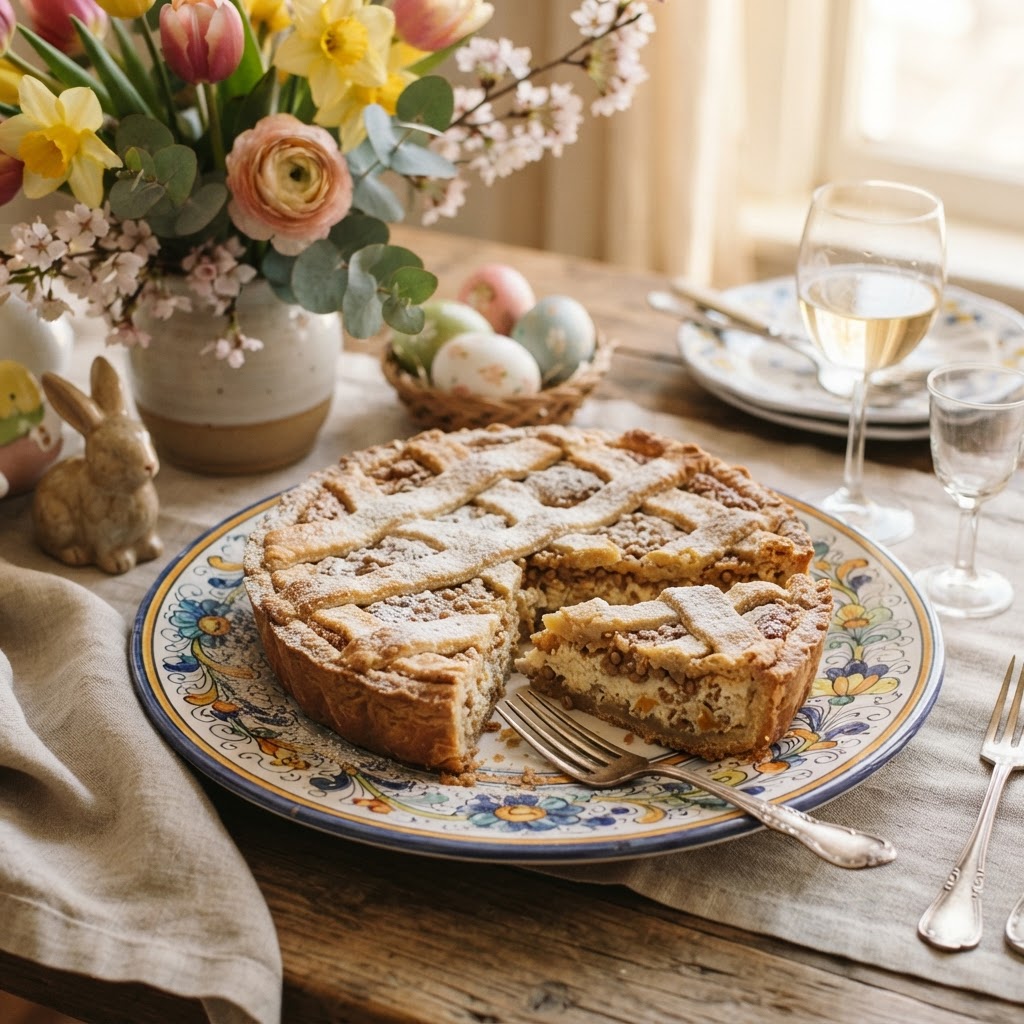
Pastiera Napoletana is the scent of Easter in Naples. If you walk through the Spanish Quarter or along Via Toledo in the weeks before Easter Sunday, every pasticceria is perfumed with the baking of pastiera — a heady mixture of ricotta, cooked wheat, eggs, sugar, candied orange peel, and orange blossom water. It is one of the oldest desserts in the Italian canon, and one of the most distinctive.
The modern pastiera was most likely invented in a Neapolitan convent. The most widely cited story credits the cloistered nuns of the Convent of San Gregorio Armeno in downtown Naples, who in the 17th century adapted an ancient pagan celebration associated with the siren Parthenope. According to lore, the people of Naples offered the siren flour, ricotta, eggs, wheat, orange blossom, and spices as gifts of gratitude. The nuns of San Gregorio Armeno are said to have perfected the recipe to celebrate the resurrection of Christ at Easter, incorporating each ingredient as a symbol of renewal and rebirth.
The key ingredient — beyond ricotta — is grano cotto, cooked wheat berries. These are soaked, cooked until soft, then combined with ricotta, eggs, sugar, candied citrus, and orange blossom water. The wheat gives the filling a distinctive, slightly chewy, almost rustic texture that sets pastiera apart from any other Italian tart. The orange blossom water is what makes it unmistakably Neapolitan — it's the scent of the city in spring.
Our Mimosavated version adds a generous pour of Moscato d'Asti to the wheat as it cooks, infusing it with a delicate peach-and-orange-blossom sweetness that amplifies the orange blossom water already in the recipe. The Moscato doesn't dominate — it deepens and extends the floral notes that are already there.
Ingredients (serves 12):
The Pasta Frolla (Sweet Crust): - 14 ⅛ oz tipo 00 flour - 7 oz granulated sugar - 7 oz cold unsalted butter, cubed - 3 large eggs - Grated zest of 1 organic lemon - A pinch of salt
The Filling: - 8 ⅞ oz cooked wheat (grano cotto — available in jars at Italian delis, or use hulled wheat berries soaked overnight and boiled) - ⅞ cup whole milk - 1 ¾ oz unsalted butter - ⅓ cup Moscato d'Asti - Zest of 1 organic lemon (grated) - 1 lb 2 oz sheep's milk ricotta (ricotta di pecora — if unavailable, use best-quality cow's milk ricotta, drained overnight) - 10.6 oz granulated sugar - 5 large eggs + 2 egg yolks - 3 ½ oz candied orange peel, diced - 1 teaspoon orange blossom water (acqua di fiori d'arancio) - 1 teaspoon vanilla extract - A pinch of cinnamon (optional, traditional)
Preparing the Wheat: If using jarred grano cotto, drain and rinse it. In a saucepan, combine the wheat, milk, butter, and Moscato d'Asti. Cook over low heat, stirring frequently, for about 30 minutes until the wheat has absorbed most of the liquid and become creamy. Remove from heat, stir in the lemon zest, and let cool completely. This step can be done a day ahead.
Making the Pasta Frolla: Combine flour, sugar, and salt in a bowl. Cut in the cold butter until the mixture resembles coarse sand. Add the eggs and lemon zest, mixing until the dough just comes together. Form into a disc, wrap, and refrigerate for at least 2 hours. Neapolitan pasta frolla is typically softer and sweeter than northern Italian versions.
Making the Filling: In a large bowl, beat the ricotta until smooth. Add the sugar and beat until creamy. Add the eggs and yolks one at a time, beating well after each addition. Stir in the cooled wheat mixture, candied orange peel, orange blossom water, vanilla, and cinnamon. The filling should be pourable but not watery.
Assembly and Baking: Preheat the oven to 356°F (350°F). Roll out about two-thirds of the pasta frolla and line a 11 in (11-inch) springform pan, letting the edges hang over. Pour in the filling. Roll out the remaining dough and cut into strips to create a lattice top, or lay as a full lid with slits. Crimp the edges decoratively.
Bake for 60–70 minutes, until the top is deep golden and the filling is set but still has a slight wobble in the center. Turn off the oven and leave the pastiera inside with the door cracked open for 30 minutes — this prevents the filling from cracking. Let cool completely at room temperature before unmolding.
Pastiera is always better the next day. In fact, in Naples, it's traditionally baked on Good Friday and eaten on Easter Sunday — three days later. The flavors need time to meld and deepen.
The Mimosa Pairing Logic: The Moscato in the wheat calls for a Moscato-based mimosa, but a peach bellini mimosa is the most natural pairing here — the peach echoes the floral, peachy notes of the Moscato and the orange blossom water, while the Prosecco adds sparkle. A blood orange mimosa is also inspired, as it picks up the candied orange peel. Avoid anything too dry or bitter — pastiera is a sweet, floral dessert that demands a gentle companion.
Reference Links: - Pastiera Napoletana true story and convent history: La Cucina Italiana - Pastiera on Wikipedia: Wikipedia - History of the convent of San Gregorio Armeno: Through Eternity - Traditional Pastiera recipe: Inside the Rustic Kitchen - Moscato d'Asti wine guide: Wine Folly
Make-Ahead: Pastiera must be made at least 1 day ahead and can be refrigerated for up to 5 days. In fact, it improves significantly on day two and day three. The wheat mixture can be prepared up to 3 days ahead and refrigerated. The pasta frolla can be made 2 days ahead. Bring to room temperature before serving.
Pro Tips: Drain the ricotta overnight in a cheesecloth-lined colander — excess moisture will make the filling watery and prevent it from setting. Sheep's milk ricotta (ricotta di pecora) is traditional and vastly superior in flavor to cow's milk; seek it out at an Italian deli if possible. Don't skip the orange blossom water — it is the defining flavor of pastiera, and without it, you've made a ricotta pie, not a pastiera. If the filling cracks during baking, don't panic — pastiera is a rustic dessert, and a crack is a sign of character, not failure.
Rate this recipe
Be the first to rate this recipe
to submit your rating.
Recent Posts

Couscous Royale: North Africa's Grand Platter of Lamb, Chicken, and Merguez
October 14, 2026

Seattle Cream Cheese Dog Bites: Hadley Long's 1989 Pioneer Square Invention
October 14, 2026

Khao Soi: Chiang Mai's Northern Thai Coconut Curry Noodles
October 13, 2026

Korean Bibimbap: Jeonju's Joseon Dynasty Mixed Rice
October 11, 2026

Spaghetti alla Carbonara: Rome's World War II Pasta of Eggs, Guanciale, and Pecorino
October 9, 2026