Msemen: Morocco's Flaky Layered Flatbread Breakfast with Honey and Mint Tea
June 20, 2026
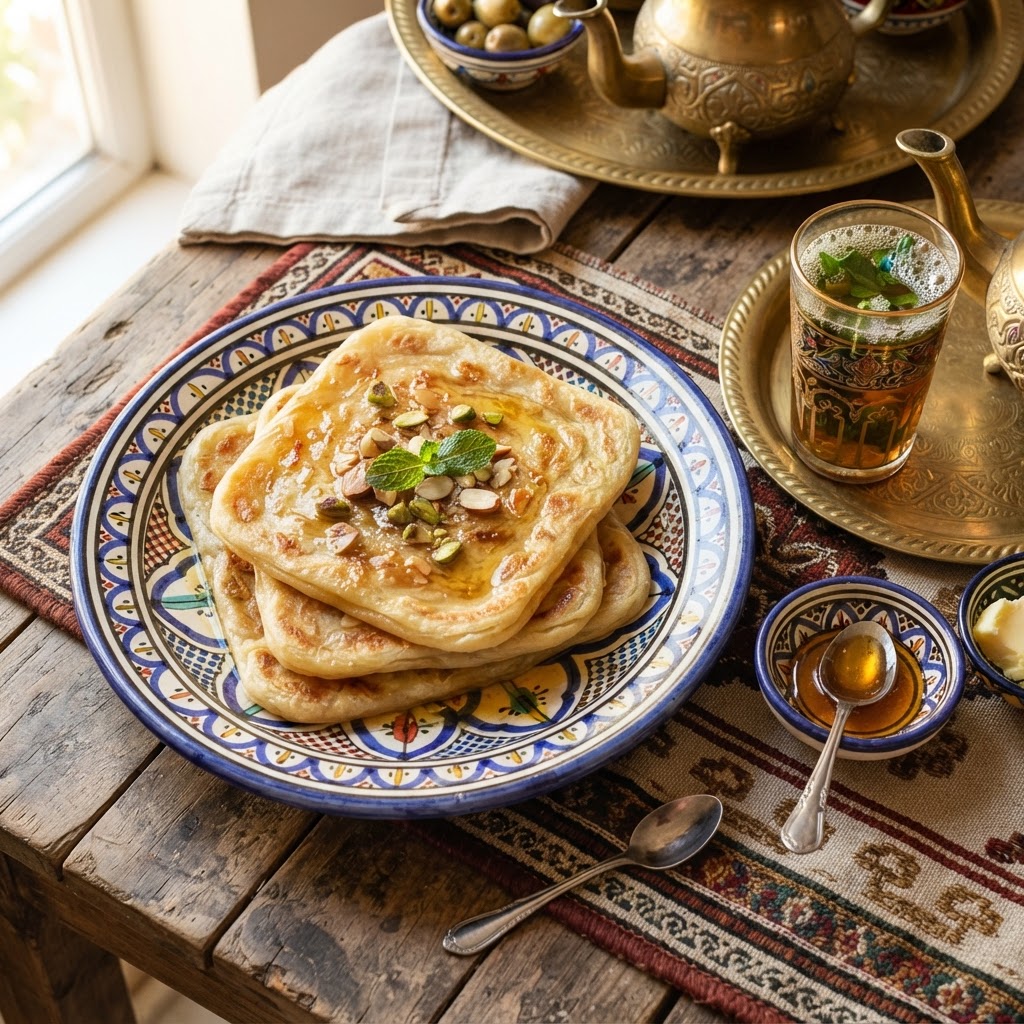
Msemen — also known as rghaif — is Morocco's most popular breakfast bread: a flaky, layered, square flatbread that's crispy on the outside and soft and chewy on the inside, traditionally served warm with melted butter and honey, alongside a glass of sweet mint tea. It's a bread that exemplifies the art of Moroccan hospitality — the kind of bread that's made for sharing, for lingering over, and for starting the day with generosity and warmth.
Msemen is a traditional flatbread from the Maghreb, commonly found in Algeria and Morocco. The name "msemen" (Arabic: مسمن, also romanized as musamman or msamman) means "smoothed" or "made smooth," referring to the technique of stretching and folding the dough to create its characteristic layers. The alternative name "rghaif" is a more general Berber term for various types of folded, layered flatbreads. The small msemen pancakes are of Berber origin, reflecting the deep indigenous roots of North African cuisine.
The technique behind msemen is what makes it special. The dough — a simple mixture of flour, semolina, yeast, salt, and water — is divided into small balls, each of which is flattened and stretched paper-thin on an oiled surface, then folded into a square with multiple internal layers. The folding creates the characteristic flaky, layered texture — similar to a laminated pastry but much simpler to make. The folded squares are then cooked on a griddle (traditionally a heavy cast-iron or clay griddle) with oil or butter until golden and crispy on both sides.
The key to a great msemen is the stretching. The dough must be stretched very thin — almost translucent — before folding, so that the layers are distinct and the bread is flaky rather than doughy. The stretching is done on an oiled surface (not a floured surface) — the oil prevents sticking and also helps create the layers. The dough is traditionally stretched by hand, using the fingertips to press and pull the dough outward from the center until it's paper-thin. Some cooks use a technique of draping the stretched dough over the backs of their hands, similar to how pizza or strudel dough is stretched. The folded square is then cooked on a griddle with a generous amount of oil or butter until golden and crispy.
Msemen is traditionally served for breakfast in Morocco, alongside other Moroccan breakfast breads like baghrir (honeycomb semolina pancakes) and harcha (semolina flatbread). It's served warm, brushed with melted butter and drizzled with honey, and accompanied by Moroccan mint tea — the sweet, fragrant green tea with fresh mint that is the cornerstone of Moroccan hospitality. The combination of the flaky, buttery bread, the golden honey, and the aromatic mint tea is one of the most famous breakfast experiences in the world.
Msemen can also be stuffed — a variety called "mehadjeb" or "mhadjeb" is filled with a mixture of diced tomatoes, onions, and spices before being cooked. The stuffed version is more of a lunch or dinner dish, while the plain msemen is the traditional breakfast. In Algeria, a similar stuffed version called "mhadjeb" is popular as a street food.
Our Mimosavated version makes classic Moroccan msemen, served warm with melted butter, honey, and Moroccan mint tea.
Ingredients (makes about 8 msemen):
The Dough: - 10.6 oz all-purpose flour - 3 ½ oz durum wheat semolina (fine semolina flour) - 1 teaspoon active dry yeast - 1 teaspoon salt - 1 teaspoon sugar - 1 cup warm water (about 104°F/105°F) - 2 tablespoons vegetable oil
For Stretching and Folding: - ½ cup vegetable oil (for the stretching surface and folding) - 1 ¾ oz fine semolina (for dusting between layers — helps create the flaky texture) - 1 ¾ oz unsalted butter, melted (for brushing)
For Serving: - 3 ½ oz good quality honey (Moroccan, wildflower, or orange blossom honey) - 1 ¾ oz unsalted butter, melted (for serving) - Moroccan mint tea (see below)
The Moroccan Mint Tea: - 2 tablespoons Chinese gunpowder green tea - 1 large bunch fresh spearmint (nana mint if available) - 1 qt boiling water - 3–4 tablespoons sugar (to taste)
Making the Dough: In a large bowl, combine the flour, semolina, yeast, salt, and sugar. Gradually add the warm water, mixing with your hands or a wooden spoon, until a soft, slightly sticky dough forms. Add the 2 tablespoons of oil and knead the dough for 5–7 minutes, until smooth, elastic, and no longer sticky. The dough should be very soft and pliable — softer than bread dough.
Divide the dough into 8 equal pieces and shape each into a ball. Place the balls on an oiled plate, brush them lightly with oil, cover with a damp towel, and let rest for 30–45 minutes. The resting is crucial — it relaxes the gluten and makes the dough easy to stretch.
Stretching and Folding the Msemen: Prepare your work surface: Drizzle a little oil on a clean work surface (or a large baking sheet). Have the semolina and oil nearby.
Take one dough ball and place it on the oiled surface. Using your fingertips, press and stretch the dough outward from the center, working in a circular motion, until the dough is paper-thin and almost translucent — it should be about 25–11 ¾ in (10–12 inches) in diameter. Don't worry about small tears; they'll be hidden in the folds. The dough should be so thin you can almost see through it.
Sprinkle a little semolina over the stretched dough. Fold the dough into a square: fold the left side to the center, then the right side to the center (so the two sides meet in the middle), then fold the top to the center and the bottom to the center — creating a square about 10x3 ⅞ in (4x4 inches). The semolina between the layers helps create the flaky texture. Set the folded square aside on an oiled plate and repeat with the remaining dough balls.
*(The folding technique creates the layers: by folding the paper-thin dough into a square, you create multiple layers of dough separated by oil and semolina, which gives msemen its characteristic flaky texture when cooked.)*
Cooking the Msemen: Heat a heavy griddle or large cast-iron skillet over medium heat. Add a little oil and a small piece of butter. When the oil is hot, place a folded msemen in the skillet. Cook for 2–3 minutes per side, pressing gently with a spatula, until golden brown and crispy on both sides. The msemen should puff up slightly and develop a flaky, golden crust. Add more oil and butter between batches as needed.
*(For extra flakiness, you can cook the msemen for 1–2 minutes per side, then remove from the skillet, gently pull apart the layers with your fingers, and return to the skillet for another minute to crisp the layers. This is a technique some Moroccan cooks use for extra-flaky msemen.)*
Making the Moroccan Mint Tea: Rinse the green tea leaves: place the gunpowder green tea in a teapot, add a cup of boiling water, swirl, and discard the water (this removes the bitterness). Add the fresh mint leaves and sugar to the teapot. Pour in the remaining boiling water. Let steep for 3–5 minutes. Pour the tea into a glass from a height to create a foam on top, then pour it back into the teapot. Repeat 2–3 times to mix the tea and the sugar. Serve in small glasses.
Serving: Brush the warm msemen with melted butter and drizzle generously with honey. Serve immediately, alongside a glass of Moroccan mint tea. To eat, tear off a piece of msemen, dip it in the honey and butter, and enjoy with a sip of mint tea. The combination of the flaky, buttery bread, the golden honey, and the fragrant, sweet mint tea is one of the great breakfast rituals of the world.
The Mimosa Pairing Logic: Msemen is flaky, buttery, and sweet with honey. The ideal mimosa pairing is a classic Prosecco mimosa — orange juice and Prosecco. The bright, acidic citrus cuts through the richness of the butter and the honey, while the Prosecco's effervescence provides a refreshing contrast to the warm, flaky bread. A blood orange mimosa is also excellent — the deeper, slightly bitter flavor of blood orange complements the honey and the mint. Avoid heavy mimosas — msemen is rich and sweet, and you need something bright and acidic to balance it.
Reference Links: - Msemmen on Wikipedia (Moroccan flatbread, Berber origin, Maghreb): Wikipedia - Broiled Mint Msemen With Honey Recipe (Moroccan breakfast bread): Serious Eats - Moroccan Msemen Recipe (Moroccan breakfast bread with honey): Maroc Mama - Homemade Msemen (Crispy Moroccan Pancake, Rghaif) recipe: LinsFood
Make-Ahead: The dough can be made up to 1 day ahead and refrigerated after the initial kneading — let it come to room temperature before dividing and shaping. The shaped, folded msemen can be stored between sheets of oiled parchment paper in an airtight container and refrigerated for up to 1 day, or frozen for up to 1 month — cook directly from refrigerated or frozen. Cooked msemen can be reheated in a dry skillet over medium heat for 1–2 minutes per side to restore the crispness — do not microwave, as it will become soggy. For the best experience, serve msemen warm and freshly cooked, when the layers are at their crispiest and the bread is at its most fragrant.
Pro Tips: Rest the dough — the 30–45 minute rest after dividing is crucial; it relaxes the gluten and makes the dough stretch easily without springing back. Don't skip it. Stretch the dough paper-thin — the thinner you stretch the dough, the more layers you create when folding, and the flakier the msemen will be. Use an oiled surface, not a floured surface — the oil prevents sticking and also helps create the flaky layers; flour would make the dough tough. Use semolina between the layers — the semolina creates a barrier between the dough layers, which helps them separate and become flaky during cooking. Fold carefully — the square fold creates the characteristic shape and the layers; press the folds gently to seal. Cook over medium heat — too high and the outside burns before the inside is cooked; too low and the msemen doesn't get crispy. Press gently while cooking — this helps the msemen cook evenly and develop a good crust. Serve warm with butter and honey — the melted butter and honey are the traditional and perfect accompaniments; the butter soaks into the flaky layers and the honey adds sweetness. The mint tea is essential — the sweet, fragrant mint tea is the traditional companion to msemen and is part of the complete Moroccan breakfast experience; the combination of the warm bread, the honey, and the tea is one of the great breakfast rituals of the world.
Rate this recipe
Be the first to rate this recipe
to submit your rating.
Recent Posts

Couscous Royale: North Africa's Grand Platter of Lamb, Chicken, and Merguez
October 14, 2026

Seattle Cream Cheese Dog Bites: Hadley Long's 1989 Pioneer Square Invention
October 14, 2026

Khao Soi: Chiang Mai's Northern Thai Coconut Curry Noodles
October 13, 2026

Korean Bibimbap: Jeonju's Joseon Dynasty Mixed Rice
October 11, 2026

Spaghetti alla Carbonara: Rome's World War II Pasta of Eggs, Guanciale, and Pecorino
October 9, 2026