Baghrir: The Moroccan Thousand-Hole Semolina Pancakes Soaked in Honey Butter
June 27, 2026
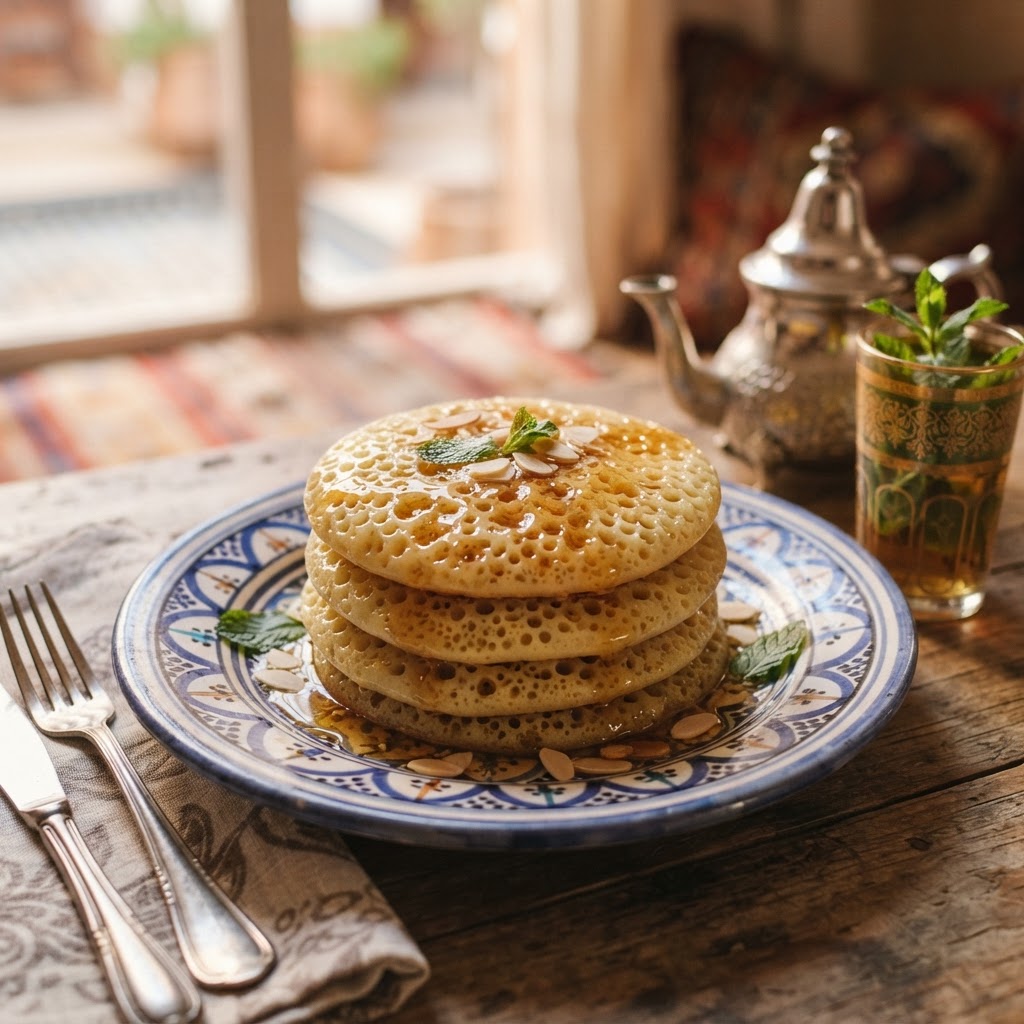
Baghrir — the "thousand-hole pancake" of Morocco — is a spongy, semolina-and-flour pancake cooked only on one side so that hundreds of tiny bubbles rise, burst, and leave a honeycomb of holes across the golden surface, holes whose entire purpose is to drink the honey-butter sauce poured over the top. According to Wikipedia, baghrir (also spelled beghrir) is a small, spongy pancake consumed in Algeria, Morocco, and Tunisia, made with semolina or flour and riddled with tiny holes, cooked on one side only. Caroline's Cooking describes baghrir as "Moroccan semolina pancakes that are wonderfully light and fluffy," noting that the many holes on top are "perfect for holding the traditional honey butter topping" — and that the holes form because the batter is high in leavening and cooked only on one side, so the bubbles pop on the upper surface and set there.
The genius of baghrir is its geometry: the holes are not decoration but function. Pour warm honey-butter over a baghrir and it disappears into the honeycomb, so that every bite is soaked through. The pancakes are blender-batter — semolina, flour, yeast, warm water, a little salt and sugar — whirled smooth, rested until foamy, then poured into a hot pan and left untouched until the top is dry and fully pocked with holes. Eaten warm, stacked, dripping with honey and melted butter, baghrir is the sweet centerpiece of the Moroccan breakfast table, served beside a glass of mint tea.
About the Ingredients
Semolina — fine semolina (smida) is the heart of baghrir; it gives the pancakes their golden color and their tender, slightly gritty crumb. A blend of semolina and all-purpose flour is traditional.
Yeast — active dry yeast, proofed in warm water; the yeast both leavens and, combined with the high water ratio, produces the bubbles that become the holes.
Water — a high ratio of warm water to dry ingredients makes a thin, pourable batter; the thinness is what allows the bubbles to rise and pop.
Honey and butter — the classic topping: equal parts warm honey and melted butter, poured over the cooked pancakes so the holes drink it in.
Ingredients (makes about 10 pancakes): - 1 cup fine semolina - 1/2 cup all-purpose flour - 1 tsp active dry yeast - 1 tsp sugar - 1/2 tsp salt - 1 3/4 cups warm water (more if needed) - For the honey-butter: 3 tbsp unsalted butter, 3 tbsp honey - A pinch of salt for the topping
Instructions: In a blender, combine the semolina, flour, yeast, sugar, salt, and warm water. Blend on high for 1–2 minutes until completely smooth and frothy — the batter should be thin, like crepe batter; add another tablespoon or two of warm water if it seems thick. Pour into a bowl, cover, and let rest in a warm place 20–30 minutes, until foamy on top.
Heat a nonstick skillet over medium heat. Stir the batter gently (do not over-stir; you want the bubbles), then pour about 1/4 cup into the center of the pan and let it spread into a round. Cook on one side only — do not flip — until the surface is dry and covered in hundreds of tiny holes, 2–3 minutes. Slide onto a plate. Repeat with the remaining batter, stacking the cooked pancakes.
For the honey-butter: in a small pan, warm the butter and honey together until melted and smooth; add a pinch of salt. Spoon generously over the warm baghrir so the honey soaks into the holes. Serve at once, with mint tea.
The Mimosa Pairing Logic: The honey-soaked semolina pancake wants a bright, floral drink that echoes the honey and lifts the sweetness. An amalfi lemon mimosa is a beautiful choice — the lemon brightens the honey and cuts the butter, and its floral notes mirror the mint tea. A lavender elderflower mimosa is equally lovely, its floral perfume a beautiful echo of a North African morning. This pairing is, in its way, the brunch equivalent of baghrir and a glass of sweet mint tea — a sparkling toast to Morocco and the thousand-hole pancake.
Reference Links: - Baghrir (spongy semolina pancake, Morocco, Algeria, Tunisia, thousand holes): Wikipedia - Baghrir (Moroccan semolina pancakes) Recipe: Caroline's Cooking
Make-Ahead: The batter can be blended and held at room temperature for up to an hour before cooking; give it a gentle stir if it separates. Cooked baghrir can be stacked (do not let them stick) and gently reheated in a warm pan for a few seconds — but they are best cooked to order, because the holes are softest and most absorbent when fresh. Warm the honey-butter just before serving.
Pro Tips: Blend the batter until genuinely smooth; lumps of semolina block the bubbles and leave bare patches. Let the batter rest until foamy — the yeast needs time to activate, and a batter cooked too soon will not hole. Use a nonstick pan and do not oil it; oil fills the holes and ruins the surface. Cook on one side only and do not touch the pancake once poured; the whole point is for the bubbles to rise and pop undisturbed. Pour the honey-butter while the pancakes are hot, so the holes drink it in — a cold baghrir shrugs off the sauce.
Rate this recipe
Be the first to rate this recipe
to submit your rating.
Recent Posts

Couscous Royale: North Africa's Grand Platter of Lamb, Chicken, and Merguez
October 14, 2026

Seattle Cream Cheese Dog Bites: Hadley Long's 1989 Pioneer Square Invention
October 14, 2026

Khao Soi: Chiang Mai's Northern Thai Coconut Curry Noodles
October 13, 2026

Korean Bibimbap: Jeonju's Joseon Dynasty Mixed Rice
October 11, 2026

Spaghetti alla Carbonara: Rome's World War II Pasta of Eggs, Guanciale, and Pecorino
October 9, 2026