Monkey Bread (Aranygaluska): The Hungarian Coffee Cake That Conquered America
February 12, 2026
Monkey bread — those sticky, caramel-coated balls of soft, pull-apart dough — is one of the most popular breakfast treats in America. But despite its all-American reputation, monkey bread actually originated in Hungary, where it's called aranygaluska, meaning "golden dumplings." The story of how a Hungarian Jewish pastry became an American brunch staple is a tale of immigration, adaptation, and the enduring appeal of sweet, sticky, pull-apart bread.
The origins of monkey bread trace back to the 1880s in Hungary, where aranygaluska was a traditional dessert made of small balls of yeasted dough, dipped in melted butter, rolled in sugar and chopped walnuts, and baked together in a pan. The balls were then pulled apart by hand — no knife needed — and eaten warm, often with a cup of coffee or a dollop of apricot jam. The dish was particularly popular among Hungarian Jewish communities, who brought it with them when they immigrated to the United States in the late 19th and early 20th centuries.
Hungarian immigrants introduced aranygaluska to America in the 1880s, and the pastry was particularly associated with Hungarian Jewish communities in New York and other cities. The name "monkey bread" is a 20th-century American invention — its exact origin is debated, but one theory suggests it comes from 1940s Southern slang where "monkey food" referred to snack food you eat with your hands. Another theory suggests the pull-apart nature of the bread, resembling something a monkey would eat with its hands, gave it the name. The name "monkey bread" first appeared in American cookbooks in the 1940s and 1950s.
The dish gained widespread popularity in the 1970s and 1980s, when it became a staple of American brunches and holiday breakfasts. The modern American version typically uses canned biscuit dough (a convenience that made it accessible to home cooks), rolled in cinnamon sugar, layered with pecans or walnuts, and baked in a Bundt pan with a caramel-brown sugar glaze. While the convenience version is delicious, the original Hungarian aranygaluska — made with real yeasted dough — is on another level entirely: softer, more fragrant, and more complex.
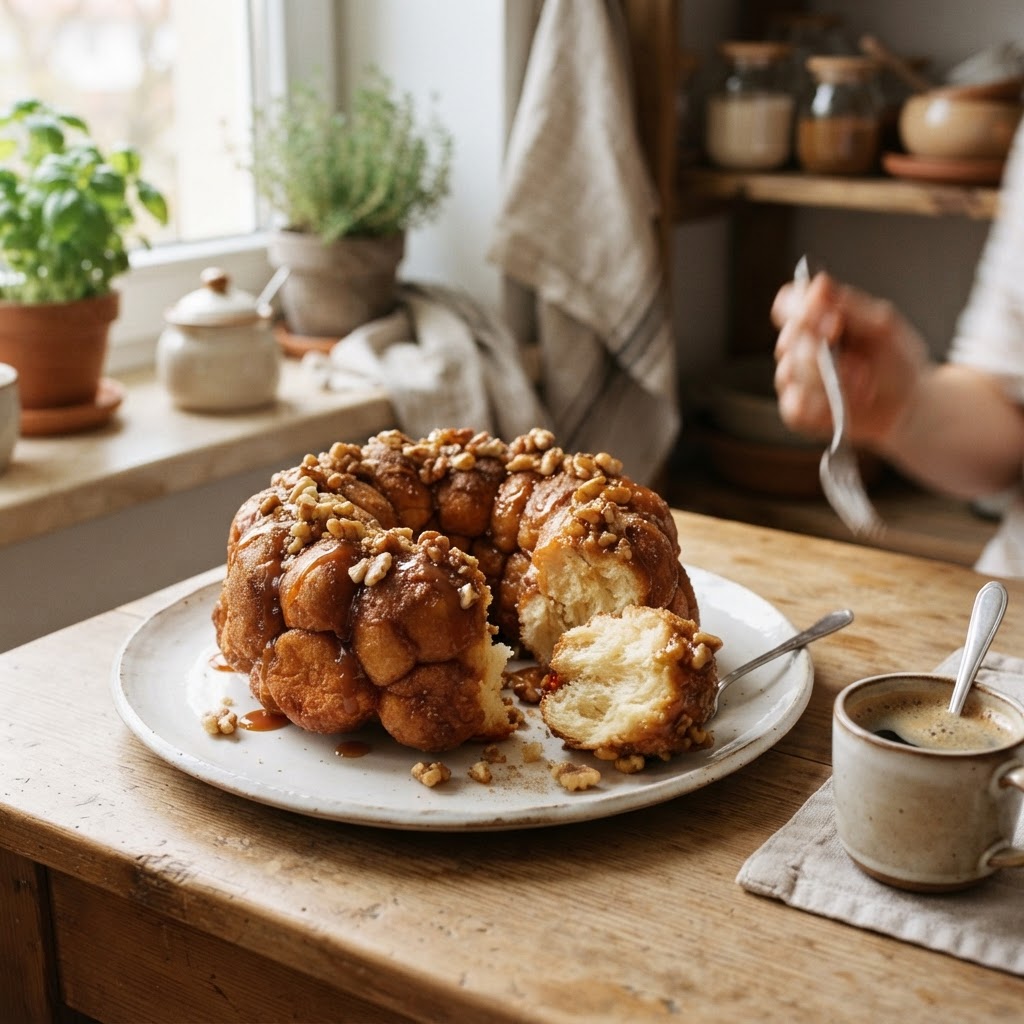
Our Mimosavated version stays true to the original Hungarian aranygaluska, using a real yeasted dough, walnuts, and apricot jam, with a caramel-brown sugar glaze. The mimosa pairing is a bright, fruity mimosa that complements the sweet, sticky bread.
Ingredients (serves 8):
The Dough: - 1 lb 2 oz all-purpose flour - ¼ oz active dry yeast (1 packet) - 2 ⅞ oz granulated sugar - 1 teaspoon salt - ½ cup warm milk - 2 ⅛ oz unsalted butter, melted - 2 large eggs, room temperature - 1 teaspoon vanilla extract - Zest of 1 lemon (optional)
The Coating: - 5 ¼ oz unsalted butter, melted - 7 oz brown sugar - 3 ½ oz walnuts, chopped - 3 ½ oz granulated sugar - 2 teaspoons ground cinnamon - 3 ½ oz apricot jam (for layering)
The Caramel Glaze: - 3 ½ oz brown sugar - 3 ½ oz unsalted butter - ¼ cup heavy cream - 1 teaspoon vanilla extract - A pinch of salt
Making the Dough: In a small bowl, combine the warm milk, yeast, and 1 teaspoon of the sugar. Let sit for 5 minutes, until foamy. In a large bowl, whisk together the flour, remaining sugar, and salt. Add the yeast mixture, melted butter, eggs, vanilla, and lemon zest. Mix until a dough forms, then knead for 8–10 minutes (by hand or in a stand mixer with a dough hook) until smooth and elastic.
Place the dough in a greased bowl, cover with a damp cloth, and let rise in a warm spot for 1–1.5 hours, until doubled in size.
Preparing the Coating: In one shallow dish, place the melted butter. In another, combine the brown sugar, granulated sugar, cinnamon, and chopped walnuts. Have the apricot jam ready.
Assembling: Punch down the dough and turn it out onto a lightly floured surface. Divide the dough into about 40–50 small balls (about ¾ in/1 inch each). Dip each ball in the melted butter, then roll in the sugar-walnut mixture. Layer the coated balls in a greased Bundt pan or tube pan, dotting with small spoonfuls of apricot jam between layers. Cover and let rise for 30–45 minutes, until puffed.
Baking: Preheat the oven to 347°F (350°F). Bake for 30–35 minutes, until deep golden brown and the top sounds hollow when tapped. Let cool in the pan for 5 minutes.
Making the Caramel Glaze: While the bread is baking, combine the brown sugar, butter, and cream in a saucepan. Bring to a boil over medium heat, stirring constantly. Reduce heat and simmer for 2 minutes. Remove from heat and stir in the vanilla and salt.
Serving: Invert the monkey bread onto a serving plate. Drizzle with the warm caramel glaze. Serve warm, pulling apart the balls by hand — no knife needed. The sticky, caramel-coated, walnut-studded balls are best eaten warm, straight from the pan.
The Mimosa Pairing Logic: Monkey bread is sweet, sticky, and rich with caramel and walnuts. The ideal mimosa pairing is a classic Prosecco mimosa — orange juice and Prosecco. The bright citrus cuts through the sweetness and the richness of the caramel, while the Prosecco's bubbles provide a refreshing contrast. A peach bellini mimosa is also excellent — the peach complements the apricot jam in the bread. Avoid heavy or dry mimosas — the bread is sweet and rich, and you need something bright and fruity to balance it.
Reference Links: - Monkey bread on Wikipedia (Hungarian origins, aranygaluska): Wikipedia - Monkey Bread's Journey from Hungary to Hollywood: Smithsonian Folklife Magazine - Aranygaluska (Hungarian golden pull-apart cake): Jewish Women's Archive - American Cakes: Monkey Bread (Hungarian Jewish origins): Tori Avey - This Hungarian Coffee Cake Is Even Better Than Babka: My Jewish Learning
Make-Ahead: The dough can be made the night before and refrigerated after the first rise — let it come to room temperature before shaping. The assembled, unbaked monkey bread can be refrigerated overnight and baked fresh in the morning — add 5–10 minutes to the baking time if baking from cold. The caramel glaze can be made up to 3 days ahead and reheated. Monkey bread is best served warm, the day it's made. Reheat leftovers in a 302°F/300°F oven for 5 minutes. Do not freeze — the texture of the dough and the caramel suffers.
Pro Tips: Use real yeasted dough, not canned biscuits — the flavor and texture are incomparably better. It takes longer, but the result is a softer, more fragrant, more complex bread. Don't skip the apricot jam — it's a traditional Hungarian element that adds a lovely fruitiness between the layers. Let the dough rise properly — under-risen dough will be dense and heavy. The dough should double in size during the first rise and puff noticeably during the second rise. Don't overbake — the bread should be deep golden brown but still soft. The caramel glaze should be poured while warm — it sets as it cools and becomes difficult to pour. Serve warm and pull apart by hand — that's the entire experience of monkey bread. Don't try to slice it — it's meant to be pulled apart, and that's what makes it fun.
Rate this recipe
Be the first to rate this recipe
to submit your rating.
Recent Posts

Couscous Royale: North Africa's Grand Platter of Lamb, Chicken, and Merguez
October 14, 2026

Seattle Cream Cheese Dog Bites: Hadley Long's 1989 Pioneer Square Invention
October 14, 2026

Khao Soi: Chiang Mai's Northern Thai Coconut Curry Noodles
October 13, 2026

Korean Bibimbap: Jeonju's Joseon Dynasty Mixed Rice
October 11, 2026

Spaghetti alla Carbonara: Rome's World War II Pasta of Eggs, Guanciale, and Pecorino
October 9, 2026