Maine Wild Blueberry Pancakes: The Lowbush Berries the Wabanaki Have Harvested for Ten Thousand Years
October 2, 2026
The wild blueberry of Maine is one of only three commercially grown crops native to North America, and the Wabanaki Confederacy, the Maliseet, Mi'kmaq, Passamaquoddy, and Penobscot Nations, have lived in Maine cultivating and curating these berries for over ten thousand years on the glacial outwash plains that formed at the end of the last ice age. According to the University of Maine Cooperative Extension, Maine's lowbush blueberry (*Vaccinium angustifolium*) is native to northern New England and Atlantic Canada, is not planted but inhabits large fields on mountaintops and in glacial outwash plains, and any given field can contain as many as 1,500 genetically distinct wild blueberry plants that create a patchwork of berry flavor, shapes, and colors. The Wabanaki were the first to burn-prune and harvest these fields, a practice that continues today, and by the 1600s English settlers had arrived on the coast of Maine and blueberry fields were picked as a public privilege. During the Civil War, wild blueberries were sent by sea to the Union Army, and by 1886 the berries were first canned, with 21 canning factories operating by the 1950s. The Wild Blueberry Heritage Center traces the Wabanaki cultivation of these berries across millennia, from fresh eating and drying to the modern industry that produces 99 percent of the nation's wild blueberry crop.
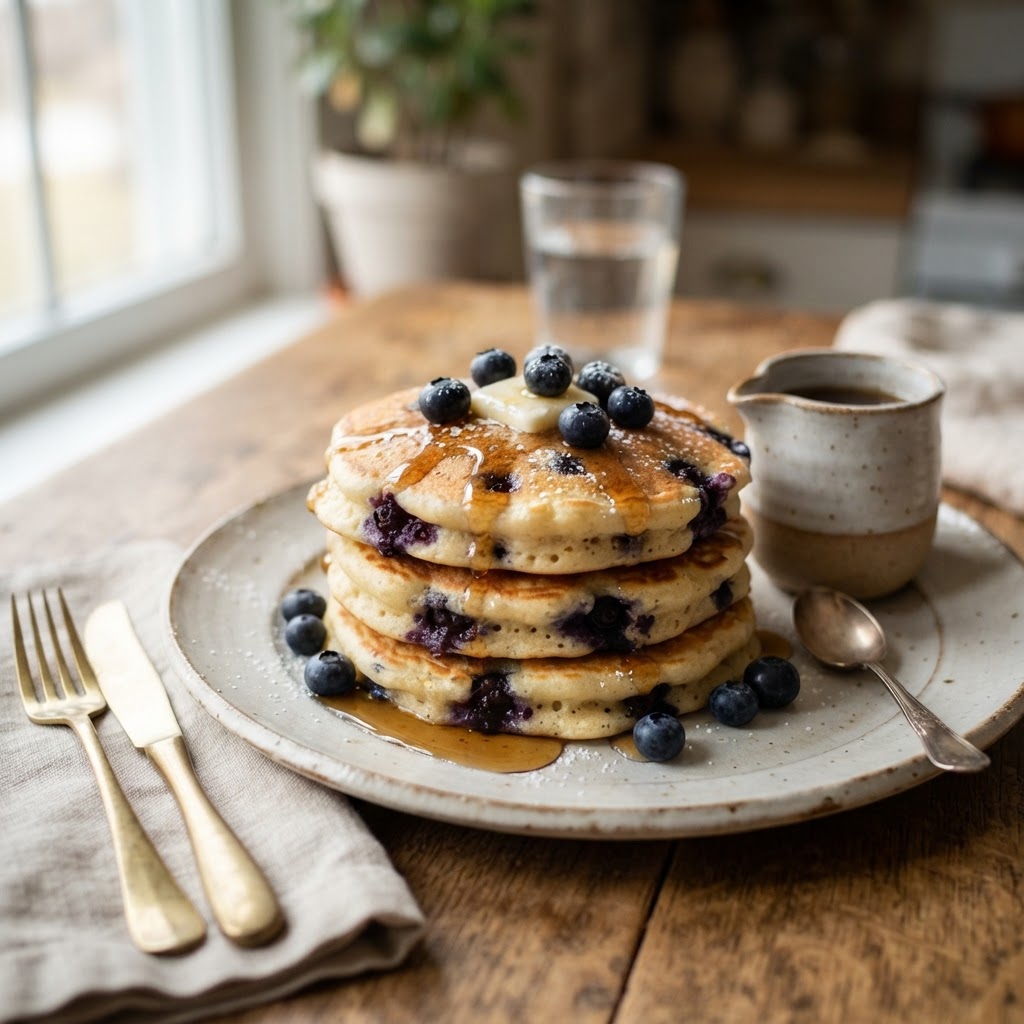
The difference between a wild blueberry and a cultivated highbush blueberry is the difference between a strawberry and a strawberry candy. Wild blueberries are roughly a third the size of cultivated berries, which means a cup of wild berries contains far more berries, more skin, more surface area, and more of the concentrated, complex flavor that comes from a plant that has adapted to a harsh northern climate over ten thousand years. Folded into a pancake batter, they burst and bleed their intense blue-violet juice through the cake in a way cultivated blueberries never do, turning each pancake into a tie-dyed map of Maine's glacial barrens. Eaten hot off the griddle with maple syrup, they are the most complete expression of the Down East morning that a cook can make.
About the Ingredients
Wild blueberries — fresh Maine wild lowbush blueberries when in season (July through early September), or frozen wild blueberries, which are available year-round and are harvested at peak ripeness. Frozen wild berries go straight into the batter without thawing; thawing makes them bleed too much. Do not substitute cultivated highbush berries if you can avoid it. The wild berry is the entire point.
Flour — all-purpose flour, sifted. A portion of the flour can be replaced with whole wheat or buckwheat for a heartier, more rustic cake.
Buttermilk — full-fat buttermilk, which gives the pancakes their tender crumb and slight tang. Regular milk with a tablespoon of lemon juice or white vinegar, let stand 5 minutes, works as a substitute.
Leavening — baking powder and a pinch of baking soda, the soda reacting with the buttermilk to give the pancakes extra lift.
Eggs — two large eggs, separated, with the whites whipped to soft peaks and folded in at the end for the lightest, fluffiest texture.
Fat — melted butter in the batter and more butter on the griddle.
Sweetener — a modest amount of sugar in the batter, and pure Maine maple syrup to finish.
Ingredients (serves 4, makes about 12 pancakes): - 2 cups fresh or frozen Maine wild blueberries (do not thaw if frozen) - 1 3/4 cups all-purpose flour - 1/4 cup granulated sugar - 2 tsp baking powder - 1/2 tsp baking soda - 1/2 tsp salt - 2 cups buttermilk, well shaken - 2 large eggs, separated - 1/4 cup (1/2 stick) unsalted butter, melted and cooled slightly, plus more for the griddle - 1 tsp vanilla extract - Pure Maine maple syrup, for serving - Additional butter, for serving
Instructions: In a large bowl, whisk together the flour, sugar, baking powder, baking soda, and salt. In a separate bowl, whisk the buttermilk, egg yolks, melted butter, and vanilla until smooth.
In a clean, dry bowl, beat the egg whites with an electric mixer or whisk until they hold soft peaks.
Pour the wet ingredients into the dry ingredients and stir gently until just combined. A few lumps are fine. Gently fold the egg whites into the batter in three additions, folding gently to preserve the air. Fold in the wild blueberries in the last addition, stirring as little as possible.
Heat a griddle or large skillet over medium heat and lightly butter the surface. Ladle 1/4 cup of batter per pancake onto the griddle. Cook until bubbles form on the surface and the edges look set, 2 to 3 minutes. Flip and cook until golden brown on the bottom, 1 to 2 minutes more.
Serve immediately with butter and warm maple syrup, or keep warm on a baking sheet in a 200°F oven while cooking the remaining batter.
The Mimosa Pairing Logic: The intense, jammy sweetness of wild blueberries wants a bright, dry sparkling wine that can stand up to the fruit without overwhelming it. A classic Champagne mimosa is the natural match, the orange juice echoing the citrus-berry brightness and the bubbles lifting the pancake batter into something lighter still. A blueberry lavender mimosa doubles down on the blueberry theme, its floral lavender a gentle counterpoint to the intense wild fruit. This pairing is the sparkling toast to the Wabanaki harvesters and the glacial barrens of Down East Maine.
Reference Links: - Maine Wild Blueberries (native to North America, Wabanaki cultivation, Civil War, 1886 canning): University of Maine Cooperative Extension - Wild Blueberry Heritage Center (Wabanaki Confederacy, 10,000 years of cultivation): Wild Blueberry Heritage Center
Rate this recipe
Be the first to rate this recipe
to submit your rating.
Recent Posts

Couscous Royale: North Africa's Grand Platter of Lamb, Chicken, and Merguez
October 14, 2026

Seattle Cream Cheese Dog Bites: Hadley Long's 1989 Pioneer Square Invention
October 14, 2026

Khao Soi: Chiang Mai's Northern Thai Coconut Curry Noodles
October 13, 2026

Korean Bibimbap: Jeonju's Joseon Dynasty Mixed Rice
October 11, 2026

Spaghetti alla Carbonara: Rome's World War II Pasta of Eggs, Guanciale, and Pecorino
October 9, 2026