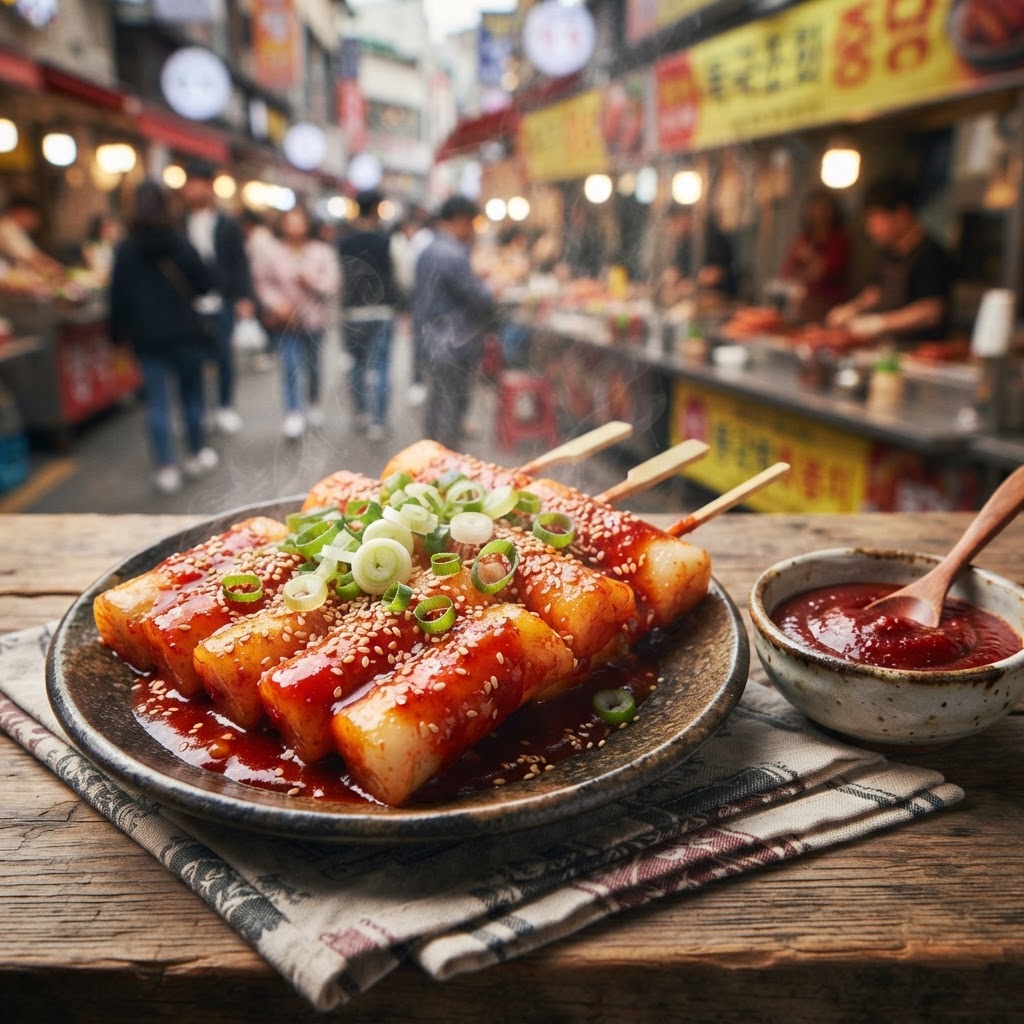
Korean Tteokbokki Spicy Rice Cake Skewers
May 30, 2026
Tteokbokki — chewy cylindrical rice cakes simmered in a glossy, vividly red gochujang sauce — is one of Korea's most popular snacks, and a dish whose history mirrors the country's own. The original was a royal court dish, recorded in the 19th-century Korean cookbook Siuijeonseo as a soy sauce-based, non-spicy preparation called gungjung (palace) tteokbokki, made with rice cakes, beef, sesame oil, and pine nuts. Chili peppers did not arrive on the Korean peninsula until the late 16th century, and for centuries the dish carried no heat at all. The transformation into the fiery, red, gochujang-laced street food we know today came only in 1953, just after the Korean War, when a woman named Ma Bok-rim — running a stall in Seoul's Sindang-dong — reportedly dropped a piece of rice cake into a bowl of jajangmyeon (black bean noodles), found the sauce-coated tteok delicious, and began seasoning rice cakes with gochujang. The spicy version caught on instantly among a war-weary, hungry populace and spread across Korea's pojangmacha (street stalls), becoming the national comfort food. Sindang-dong is now known as Tteokbokki Town, a neighborhood of dedicated tteokbokki restaurants that still operates today.
For a party, tteokbokki becomes a skewer: thread the chewy rice cakes onto picks, glaze them in the rich gochujang sauce, and finish with sesame seeds and green onion. It is a vivid, playful, deeply satisfying bite.
Ingredients (makes 24 skewers, serves 8–12):
The Rice Cakes: - 2 pounds cylindrical Korean rice cakes (garaetteok), fresh or frozen — if frozen, soak in warm water 20 minutes to soften before using - 1 tablespoon toasted sesame oil (to keep them from sticking)
The Gochujang Sauce: - ½ cup gochujang (Korean chili paste — the essential ingredient) - 3 tablespoons gochugaru (Korean chili flakes, for extra color and gentle heat — adjust to taste) - 3 tablespoons soy sauce - 2 tablespoons sugar or honey (balances the gochujang's heat and fermention tang) - 1 tablespoon sesame oil - 1 tablespoon minced garlic - 1 teaspoon minced ginger - 1½ cups water or anchovy-kelp stock (the traditional base, for depth) - 1 tablespoon cornstarch mixed with 2 tablespoons water (optional, to thicken to a glaze)
The Glaze Finish: - 2 tablespoons toasted sesame seeds - 4 green onions, thinly sliced on the bias - A few sheets of roasted seaweed (gim), cut into thin strips, for garnish
Preparing the Rice Cakes: If using fresh rice cakes, rinse under warm water and drain. Toss with sesame oil to prevent sticking. If the rice cakes are very hard, briefly boil them 2–3 minutes until pliable, then drain.
Making the Sauce: In a large, wide skillet or saucepan, combine the gochujang, gochugaru, soy sauce, sugar, sesame oil, garlic, ginger, and stock. Bring to a gentle simmer over medium heat, stirring to dissolve the gochujang. Add the rice cakes in a single layer. Simmer 10–15 minutes, stirring occasionally and gently, until the sauce thickens, clings to the rice cakes, and turns a deep, glossy red, and the rice cakes are tender with a chewy, bouncy bite. If the sauce is too thin, stir in the cornstarch slurry and cook 1 minute more. If it is too thick, add a splash of stock.
Skewering: Thread 3–4 rice cakes onto each bamboo skewer (soak the skewers in water first to prevent burning if you re-glaze them briefly over heat). Spoon the remaining sauce generously over the skewers, coating every cake. Alternatively, return the skewers to the pan and roll them in the sauce for a final, glossy coat.
Service: Arrange the skewers on a platter and scatter with sesame seeds, green onion, and seaweed strips. Serve immediately — tteokbokki is at its peak when the rice cakes are still warm and chewy and the sauce is glossy. As they cool, the rice cakes firm up and lose their signature bounce.
The Mimosa Pairing Logic: The sweet-spicy, deeply savory, gochujang-rich character of tteokbokki calls for a mimosa with sweetness to balance the heat and a fruit profile that complements the chili's fermented depth. A tropical mango mimosa is the most natural pairing — the mango's lush sweetness tames the gochujang's heat and the tropical character echoes the dish's Asian roots. A yuzu honey mimosa is inspired — the yuzu's bright, floral citrus cuts the chili and the honey's sweetness mirrors the sugar in the sauce. For a refreshing, cooling pairing, a cucumber mint mimosa provides a clean, herbal counterpoint to the warm, spicy rice cakes. Avoid heavy, oaky mimosas — they fight with the gochujang's bright, fermented character.
Reference Links: - Tteokbokki — from royal court to street food: Wikipedia - From Royal Court to Street Food: The Evolution of Korean Tteokbokki (Ma Bok-rim, Sindang-dong, 1953): Taste Korean Food
Make-Ahead: The sauce can be made 3 days ahead, refrigerated. The rice cakes can be pre-cooked in the sauce up to the point of skewering, then held; reheat gently with a splash of stock to loosen the sauce before skewering. Once skewered, the tteokbokki is best served within 30 minutes — the rice cakes firm up and lose their chew as they cool. For a party, keep the sauce warm in a small pot and skewer the rice cakes just before service.
Pro Tips: Fresh garaetteok gives the best, chewiest texture — frozen works but should be fully thawed and soaked until pliable, or it will stay hard in the center even after simmering. The sauce must reduce and cling, not stay soupy — tteokbokki is a coated dish, not a broth; let the sauce thicken until it sheaths each rice cake in a glossy, red glaze. Stir gently — rice cakes are delicate and break apart if manhandled. The balance of gochujang (heat and depth), sugar (sweetness), and soy sauce (salt) is the soul of the dish; taste and adjust until no single element dominates. And eat them fast — the magic of tteokbokki is the contrast between the chewy, bouncy rice cake and the warm, glossy sauce, and that contrast fades as the cakes cool.
Rate this recipe
Be the first to rate this recipe
to submit your rating.
Recent Posts

Couscous Royale: North Africa's Grand Platter of Lamb, Chicken, and Merguez
October 14, 2026

Seattle Cream Cheese Dog Bites: Hadley Long's 1989 Pioneer Square Invention
October 14, 2026

Khao Soi: Chiang Mai's Northern Thai Coconut Curry Noodles
October 13, 2026

Korean Bibimbap: Jeonju's Joseon Dynasty Mixed Rice
October 11, 2026

Spaghetti alla Carbonara: Rome's World War II Pasta of Eggs, Guanciale, and Pecorino
October 9, 2026