Hong Kong Egg Tarts: The Cantonese Custard Tart of the Cha Chaan Teng
August 22, 2026
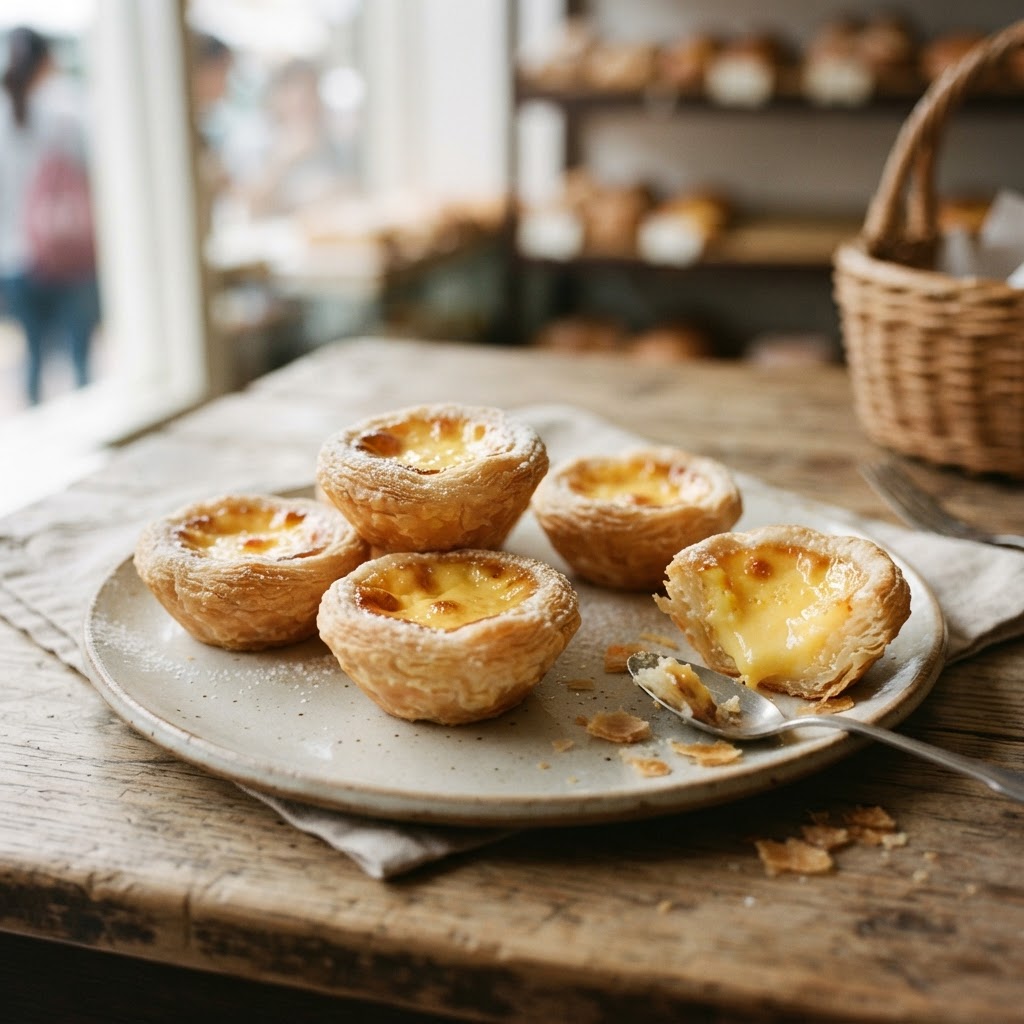
The Hong Kong egg tart — *daan taat* — is the most popular pastry of the Cantonese teahouse and the Hong Kong *cha chaan teng*, the local diner: a small, flaky pastry shell filled with a wobbly, bright yellow egg custard baked until just set and glossy, eaten warm in two bites alongside a cup of strong milk tea, a pastry that is the descendant of the English custard tart, transformed by Cantonese bakers into something entirely their own. According to Wikipedia, the egg tart is a kind of tart found in Cantonese cuisine, derived from the English custard tart and the Portuguese *pastel de nata*; it started being sold in the early 20th century in Guangzhou (Canton), inspired by the English custard tarts brought by Western traders, and was introduced to Hong Kong via Guangzhou in the 1940s, initially only in higher-end Western-style restaurants, before the *cha chaan tengs* began serving them in the 1960s and popularized the pastry with the working-class Hong Kong population. The Wikipedia entry notes that in June 2014, the technique of egg tart production was formally included in the Intangible Cultural Heritage Inventory of Hong Kong.
There are two schools of Hong Kong egg tart: the cookie-crusted, with a short, buttery, pie-like pastry shell, and the puff-pastry, with hundreds of flaky, shattering layers. Both are filled with a simple custard of eggs, sugar, milk, and water (or evaporated milk), baked until the top is glossy and the center just set, trembling like a crème brûlée without the burnt sugar. Eaten warm, the contrast of the crisp shell and the soft, eggy, barely-sweet custard is one of the great two-bite pastries in the world.
About the Ingredients
Pastry — two styles: a buttery short-crust (cookie) pastry, or a laminated puff pastry with hundreds of layers; the puff pastry is the more traditional, more labor-intensive, and more beautiful.
Eggs — the freshest eggs for the brightest yellow custard and the cleanest flavor; the color comes from the yolks.
Sugar and water — a simple sugar syrup, cooled, sweetens the custard without graininess; dissolving the sugar first gives the smoothest texture.
Milk or evaporated milk — a little milk or evaporated milk for richness and a creamy custard; evaporated milk is the *cha chaan teng* tradition.
Vanilla and a pinch of salt — a whisper of vanilla and salt to round the custard.
Ingredients (makes 12 small tarts): For the pastry (short-crust version): - 1 1/4 cups all-purpose flour - 1/2 cup powdered sugar - 1/2 cup (1 stick) cold unsalted butter, cubed - 1 large egg - Pinch of salt For the custard: - 1/2 cup granulated sugar - 1/2 cup hot water - 3 large eggs - 1/4 cup milk or evaporated milk - 1/2 tsp vanilla extract - Pinch of salt
Instructions: For the pastry: in a bowl, cut the cold butter into the flour, powdered sugar, and salt until the mixture resembles coarse crumbs. Stir in the egg and bring together into a dough; do not overwork. Chill 30 minutes. Roll out and cut into circles to line 12 small tart molds (or a muffin tin), pressing the dough up the sides.
For the custard: stir the sugar into the hot water until dissolved; let cool completely. Whisk the eggs lightly, then whisk in the cooled sugar syrup, milk, vanilla, and salt. Strain through a fine sieve for the smoothest custard. Pour into the pastry shells, filling about 80% full — do not overfill, or the custard boils over.
Bake at 400°F for 15 minutes, then reduce to 350°F and bake 10–12 minutes more, until the crust is golden and the custard is puffed and just set, still with a slight wobble in the center. Cool in the molds 5 minutes before unmolding. Serve warm.
The Mimosa Pairing Logic: The delicate, eggy custard and the buttery shell want a bright, clean drink that cuts the richness and echoes the Cantonese tea-house morning. A classic Champagne mimosa is the natural choice — the citrus acidity balances the rich custard and the bubbles lift the pastry, the way a cup of milk tea does. A passionfruit mimosa is equally lovely, its tropical acidity a bright counter to the egg and a nod to the Asian tea house. This is the brunch equivalent of a warm egg tart and a cup of Hong Kong milk tea — a sparkling toast to the cha chaan teng and the pastry that became a heritage of Hong Kong.
Reference Links: - Egg tart (Cantonese cuisine, English custard tart origin, Guangzhou, Hong Kong cha chaan teng, Intangible Cultural Heritage): Wikipedia
Make-Ahead: The pastry can be made and chilled a day ahead, or frozen for a month. The custard mixture can be made a day ahead and held refrigerated; strain again before pouring. The tarts are best the day they are baked, eaten warm, when the crust is crisp and the custard at its most delicate; they soften overnight. Reheat briefly in a 300°F oven to re-crisp the shell. Fill the shells only 80% full; the custard puffs dramatically and over-filled tarts boil over and stick.
Pro Tips: Strain the custard through a fine sieve; the smoothest custard is the mark of a good egg tart, and unstrained custard has flecks of egg white that mar the texture. Cool the sugar syrup completely before adding the eggs; hot syrup cooks the eggs and makes a scrambled custard. Fill the shells only 80% full; the custard puffs in the oven and over-filling causes boil-over. Bake hot first, then lower the temperature; the high heat sets the crust and puffs the custard, and the lower heat finishes it gently without curdling. Do not overbake; the custard should still wobble slightly in the center when you pull the tarts, and it will set as it cools into the perfect trembling texture. Eat warm; a cold egg tart is a lesser thing, and a warm one is sublime.
Rate this recipe
Be the first to rate this recipe
to submit your rating.
Recent Posts

Couscous Royale: North Africa's Grand Platter of Lamb, Chicken, and Merguez
October 14, 2026

Seattle Cream Cheese Dog Bites: Hadley Long's 1989 Pioneer Square Invention
October 14, 2026

Khao Soi: Chiang Mai's Northern Thai Coconut Curry Noodles
October 13, 2026

Korean Bibimbap: Jeonju's Joseon Dynasty Mixed Rice
October 11, 2026

Spaghetti alla Carbonara: Rome's World War II Pasta of Eggs, Guanciale, and Pecorino
October 9, 2026