Gulab Jamun: India's Syrup-Soaked Fried Milk Dumpling
June 14, 2026
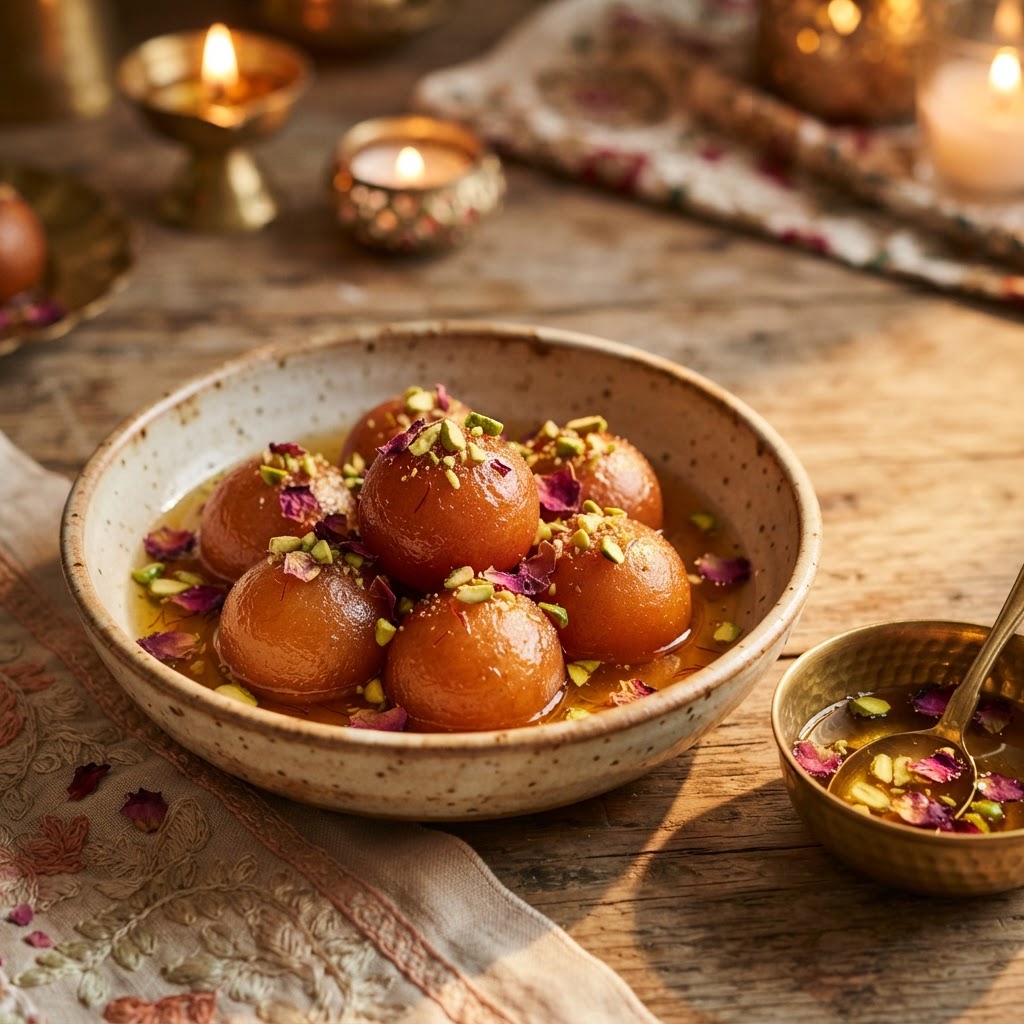
Gulab jamun is the most popular sweet of the Indian subcontinent — small, golden-brown dumplings of fried milk-solid dough, soaked until glistening in a warm, fragrant syrup scented with rosewater, cardamom, and saffron, served warm and garnished with chopped pistachios and dried rose petals, a confection eaten at every festival, wedding, and celebration from Delhi to Dhaka. It is the dessert of India, the sweet that ends every feast, and its name — *gulab* (rose) and *jamun* (a deep purple Indian fruit) — describes both the syrup's rose perfume and the dumpling's dark, glossy, fruit-like color. According to Wikipedia, gulab jamun is a sweet dessert or *mithai* which originated in the Indian subcontinent and is popular in India, Bangladesh, Nepal, Pakistan, and Burma; it is made of milk solids (traditionally *khoya* — milk slowly reduced to a dense dough), formed into balls, deep-fried, and soaked in a sugar syrup flavored with rose, cardamom, and saffron.
The origins of gulab jamun are debated. One legend holds that it was accidentally created in the imperial kitchens of the Mughal emperor Shah Jahan, where a chef, experimenting with *khoya*, dropped a ball of the milk dough into hot oil and then, to salvage it, soaked it in syrup. Whether accidental or invented, the confection is a direct descendant of the Persian and Central Asian tradition of fried dough soaked in syrup (*luqmat al-qadi*), carried to India by the Mughals and transformed by the use of *khoya* — the dense, slow-reduced milk solids that give the dumpling its distinctive, fudgy, milky interior.
About the Ingredients
Khoya (or milk powder) — the traditional base is *khoya*, milk reduced slowly until it becomes a dense, doughy solid; for the home cook, milk powder (combined with a little flour and a liquid) is the modern shortcut, and it produces a very close approximation. The milk solids give the dumpling its characteristic fudgy, milky interior that is the soul of the confection.
Flour — a little all-purpose flour (or *maida*) to bind the *khoya* or milk powder into a rollable dough; too much flour makes a tough dumpling, and the ratio is critical.
Milk or yogurt — a little milk or yogurt to bring the dough together; yogurt adds a slight tang and tenderizes the dough.
Ghee or oil — for deep-frying; ghee is traditional and adds a nutty richness, but a neutral oil is common and easier. The dumplings must be fried slowly at a low temperature so they cook through without burning.
Sugar, water, cardamom, rosewater, and saffron — the syrup: a simple sugar syrup, infused with crushed green cardamom pods, a few threads of saffron, and a splash of rosewater, poured warm over the hot fried dumplings so that they soak it up completely. The syrup is the *gulab* — the rose — and the dumpling is the *jamun*.
Pistachios and rose petals — chopped pistachios and dried rose petals for the garnish, the traditional finish.
Ingredients (makes about 16 gulab jamun): For the dumplings: - 1 cup full-fat milk powder - 3 tbsp all-purpose flour - 1/2 tsp baking powder - 1/4 tsp ground cardamom - 2 tbsp ghee or melted butter - 3–4 tbsp whole milk or yogurt (enough to make a soft dough) - Ghee or neutral oil, for frying
For the syrup: - 1 1/2 cups granulated sugar - 1 cup water - 4 green cardamom pods, crushed - A few threads of saffron - 1 tbsp rosewater
To finish: - 2 tbsp chopped pistachios - 1 tbsp dried rose petals (optional)
Instructions: For the syrup: in a saucepan, combine the sugar, water, cardamom, and saffron. Bring to a simmer, stirring until the sugar dissolves, and simmer 5 minutes until slightly syrupy. Remove from the heat and stir in the rosewater. Keep warm.
For the dumplings: in a bowl, whisk the milk powder, flour, baking powder, and cardamom. Stir in the ghee, then add the milk a tablespoon at a time, kneading gently, until a soft, smooth dough forms (do not over-knead). Roll into 16 smooth balls, with no cracks.
Heat the ghee or oil in a deep, heavy pot to 325°F (medium-low). Fry the balls in small batches, stirring gently, 5–7 minutes, until they are deep golden brown on all sides and cooked through — the low, slow fry is essential, as a hot fry burns the outside and leaves the inside raw. Lift out with a slotted spoon and drain briefly on paper towels.
Drop the hot dumplings into the warm syrup. Let them soak at least 1 hour, ideally 2–4 hours, until they are glistening, soft, and saturated. Serve warm, garnished with chopped pistachios and rose petals.
The Mimosa Pairing Logic: The warm, milky dumpling and the rose-cardamom syrup want a bright, floral drink that echoes the rose and cuts the richness. A raspberry rose champagne mimosa is the inspired match — the rose is a direct mirror of the syrup and the raspberry is a bright, tart counter to the sweet, fried dough. A lavender elderflower mimosa is equally lovely, its floral perfume an aromatic echo of the cardamom and rose. This is the brunch equivalent of a warm gulab jamun and a cup of masala chai — a sparkling toast to India and the *mithai* that ends every celebration.
Reference Links: - Gulab jamun (Indian subcontinent, khoya, fried, syrup-soaked, Mughal): Wikipedia
Make-Ahead: Gulab jamun is best made ahead — the dumplings must soak in the syrup for at least an hour, ideally several, to fully saturate, and they improve with a rest. They keep 3–4 days refrigerated in the syrup; reheat gently in the microwave or in a warm syrup until warmed through. The syrup can be made a day ahead and held at room temperature; re-warm before adding the dumplings. The dough should be made and fried the same day, as the dough dries out and cracks if held.
Pro Tips: Knead the dough gently and just until smooth; over-kneading makes tough dumplings, and the dough should be soft and barely holding together. Roll the balls smooth with no cracks; a cracked dumpling splits in the fryer and leaks, and a smooth ball fries into a smooth, round jamun. Fry low and slow at 325°F; a hot fry burns the outside and leaves the inside raw and doughy, and the slow, golden fry is what cooks the center. Drop the hot dumplings into warm (not hot) syrup; hot dumplings into hot syrup can make them collapse, and the warm syrup soaks in gradually. Soak at least an hour; an under-soaked jamun is dry inside, and the syrup is the whole point of the confection. Use genuine rosewater, not rose extract; the two are different, and rosewater's delicate perfume is what characterizes the *gulab*. Serve warm; a cold gulab jamun is dense and heavy, and a warm one is soft, glistening, and melting.
Rate this recipe
Be the first to rate this recipe
to submit your rating.
Recent Posts

Couscous Royale: North Africa's Grand Platter of Lamb, Chicken, and Merguez
October 14, 2026

Seattle Cream Cheese Dog Bites: Hadley Long's 1989 Pioneer Square Invention
October 14, 2026

Khao Soi: Chiang Mai's Northern Thai Coconut Curry Noodles
October 13, 2026

Korean Bibimbap: Jeonju's Joseon Dynasty Mixed Rice
October 11, 2026

Spaghetti alla Carbonara: Rome's World War II Pasta of Eggs, Guanciale, and Pecorino
October 9, 2026