Greek Galaktoboureko al Moscato
June 21, 2026
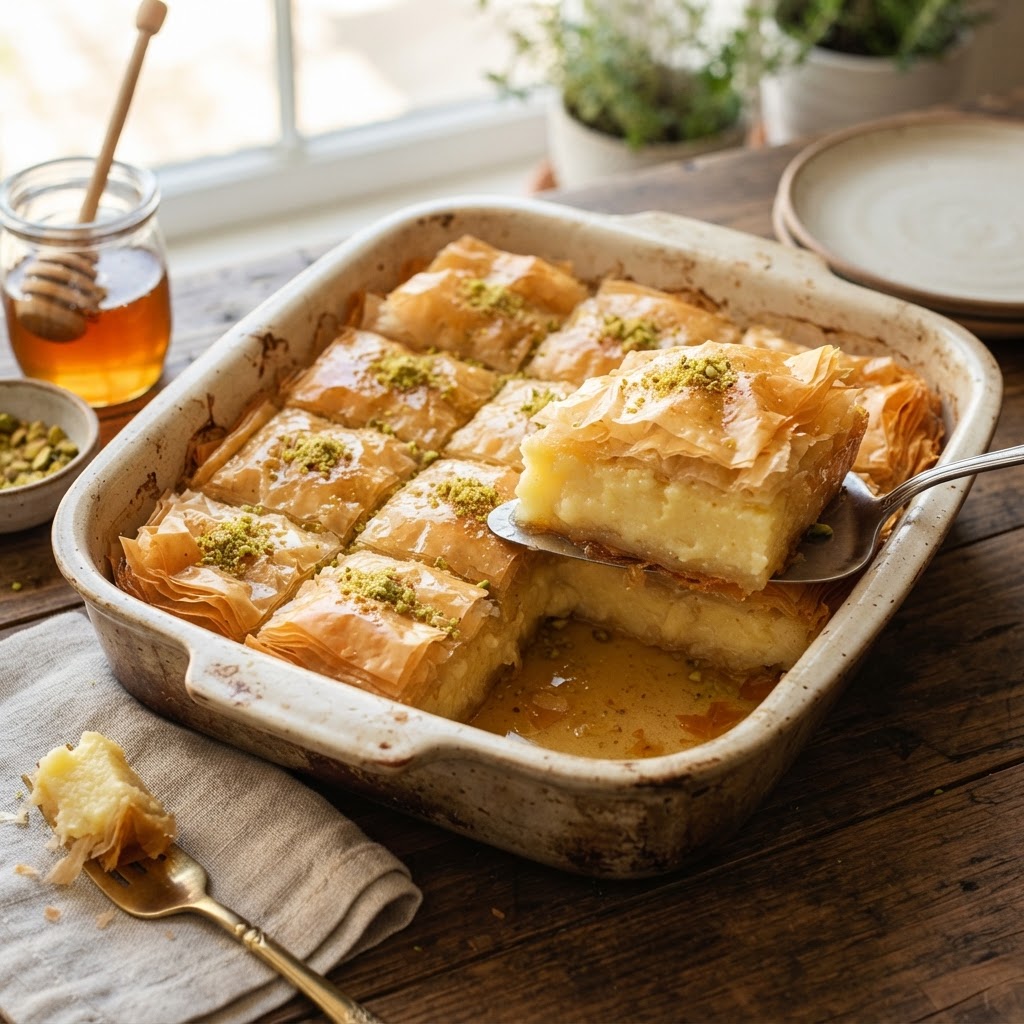
Galaktoboureko — a Greek dessert of creamy semolina custard baked between layers of crispy phyllo and drenched in a scented lemon syrup — is one of the most popular sweets of Greece. Its name comes from the Greek *gala* (milk) and *boureko* (a filled pastry), and it is a masterpiece of contrast: the shatteringly crisp phyllo against the soft, fragrant custard, the sweetness of the syrup against the brightness of the lemon.
As Kopiaste describes, galaktoboureko is a Greek semolina custard dessert, baked between crispy phyllo dough, then drenched in a scented syrup when finished. The custard filling is made with semolina, milk, sugar, eggs, and vanilla, giving it a rich and indulgent flavor. The phyllo dough is brushed generously with butter, and the whole thing is baked until the top is golden and crisp, then soaked with a warm lemon-cinnamon syrup the moment it comes out of the oven. Miakouppa calls galaktoboureko a Greek classic dessert made with phyllo and a custard filling, soaked with a sweet syrup — one of the pillars of Greek pastry alongside baklava.
Galaktoboureko belongs to the great family of Greek syrup-soaked pastries (*sirópia*) that also includes baklava, kataifi, and revani. The technique of soaking a hot, freshly baked pastry in a warm syrup is central to Greek pâtisserie — the hot pastry absorbs the warm syrup, creating a dessert that is simultaneously crisp and syrup-soaked, neither soggy nor dry. The semolina in the custard is the defining ingredient — it gives the custard a slightly grainy, substantial texture that distinguishes it from a French crème pâtissière and helps it hold its shape when sliced. The syrup is perfumed with lemon zest and sometimes cinnamon or clove, and it must be warm when poured over the hot pastry (or the pastry hot and the syrup warm) — this temperature matching is what allows the absorption without sogginess.
Our Mimosavated version adds a splash of Moscato d'Asti to the lemon syrup — the fragrant, lightly sparkling sweet wine with peach, orange blossom, and honeysuckle aromas adds a delicate floral note that complements the lemon.
Ingredients (serves 12):
The Semolina Custard: - 1 qt whole milk - 5 ¼ oz semolina (fine or medium) - 7 oz granulated sugar - 4 large eggs - 1 ¾ oz unsalted butter, melted - 1 teaspoon vanilla extract - ½ teaspoon ground cinnamon (optional) - A pinch of salt
The Phyllo Layers: - 1 package (about 15 ⅞ oz) phyllo pastry, thawed if frozen - 7 oz unsalted butter, melted (for brushing)
The Moscato Lemon Syrup: - 14 ⅛ oz granulated sugar - 1 ¼ cups water - 3 ⅓ tbsp Moscato d'Asti - 1 strip lemon peel - 1 cinnamon stick - 1 tablespoon lemon juice
Making the Semolina Custard: In a saucepan, bring the milk to a gentle simmer over medium heat. Gradually whisk in the semolina, stirring constantly to prevent lumps. Cook over low heat, whisking constantly, for 8–10 minutes, until the mixture thickens to a custard-like consistency. Remove from heat and stir in 3 ½ oz of the sugar, the melted butter, vanilla, cinnamon (if using), and salt. Let cool slightly.
In a bowl, whisk the eggs with the remaining 3 ½ oz of sugar until light and pale. Gradually temper the eggs by whisking in a few ladles of the warm semolina mixture, then pour the egg mixture back into the saucepan, whisking constantly. The custard should be smooth and pourable. Cover with plastic wrap directly on the surface and keep warm (not hot) while you prepare the phyllo.
Assembling and Baking: Preheat the oven to 356°F (350°F). Butter a 9 in x 13 in (9x13-inch) baking dish.
Lay a sheet of phyllo in the dish, letting the edges overhang. Brush generously with melted butter. Repeat with 7–8 more sheets, brushing each with butter, to form the bottom crust. Pour the warm semolina custard evenly over the phyllo. Fold the overhanging phyllo edges over the custard. Top with the remaining 7–8 sheets of phyllo, brushing each with butter and tucking the top layers neatly. Score the top layers of phyllo into diamonds or squares with a sharp knife — cut through the top phyllo only, not all the way through, or the custard will leak.
Bake for 45–50 minutes, until the top is deep golden brown and crisp. Remove from the oven.
Making the Moscato Lemon Syrup: While the galaktoboureko is baking, combine the sugar, water, lemon peel, and cinnamon stick in a saucepan. Bring to a boil, then reduce to a simmer and cook for 10 minutes, until slightly syrupy. Remove from heat and stir in the Moscato and lemon juice. The syrup should be warm when the pastry comes out of the oven.
Finishing: The moment the galaktoboureko comes out of the oven, pour the warm syrup evenly over the hot pastry — it should sizzle and be absorbed. Let it sit for at least 1 hour to absorb the syrup and set before slicing.
Serving: Slice along the scored lines with a sharp knife. Serve at room temperature, dusted with a little ground cinnamon if desired.
The Mimosa Pairing Logic: Since the syrup contains Moscato d'Asti, pair with a peach bellini mimosa — peach purée and Prosecco. The peach echoes the Moscato and complements the floral, lemony syrup. A lemon mimosa is also excellent — the lemon echoes the syrup and the custard. Avoid heavy or dry mimosas — galaktoboureko is sweet, custardy, and syrup-soaked, and you need something light and bright to balance it.
Reference Links: - Galaktoboureko (Greek semolina custard wrapped in phyllo): Kopiaste - Galaktoboureko, Greek custard dessert: Miakouppa - Moscato d'Asti wine guide: Wine Folly
Make-Ahead: The semolina custard can be made up to 1 day ahead and refrigerated — gently re-warm to a pourable consistency before assembling. The syrup can be made up to 1 week ahead and stored at room temperature — gently re-warm before using. The assembled, unbaked galaktoboureko can be assembled up to 4 hours ahead and kept chilled — bring to room temperature before baking. Once baked and soaked, galaktoboureko keeps for up to 3 days at room temperature and is often better on the second day. Do not refrigerate — refrigeration makes the phyllo soggy. Reheat gently in a 302°F (300°F) oven for 5–8 minutes to restore some crispness before serving.
Pro Tips: Keep the phyllo covered with a damp towel while you work — phyllo dries out and cracks within minutes of exposure to air. Brush every sheet of phyllo generously with melted butter — this is what creates the crisp, flaky layers; skimping on butter gives a soggy, pale result. The custard should be warm (not hot) when poured over the phyllo — hot custard will melt the butter between the layers. Score the top phyllo before baking — this allows the syrup to penetrate and makes the dessert easier to slice, but don't cut all the way through or the custard will leak. The temperature matching is essential — pour warm syrup over the hot pastry; pouring cold syrup over hot pastry (or vice versa) prevents proper absorption and leaves the pastry either soggy or dry. Let the galaktoboureko rest for at least an hour after soaking before slicing — the syrup needs time to absorb and the custard needs time to set. The semolina gives the custard its characteristic texture — don't substitute cornstarch or flour, or you lose the substance that makes galaktoboureko distinctive.
Rate this recipe
Be the first to rate this recipe
to submit your rating.
Perfect Mimosa Pairings
Mimosas that pair perfectly with this dish
Recent Posts

Couscous Royale: North Africa's Grand Platter of Lamb, Chicken, and Merguez
October 14, 2026

Seattle Cream Cheese Dog Bites: Hadley Long's 1989 Pioneer Square Invention
October 14, 2026

Khao Soi: Chiang Mai's Northern Thai Coconut Curry Noodles
October 13, 2026

Korean Bibimbap: Jeonju's Joseon Dynasty Mixed Rice
October 11, 2026

Spaghetti alla Carbonara: Rome's World War II Pasta of Eggs, Guanciale, and Pecorino
October 9, 2026