Greek Bougatsa: The Byzantine Custard Pie of Thessaloniki That Became Greece's Favorite Breakfast
September 13, 2026
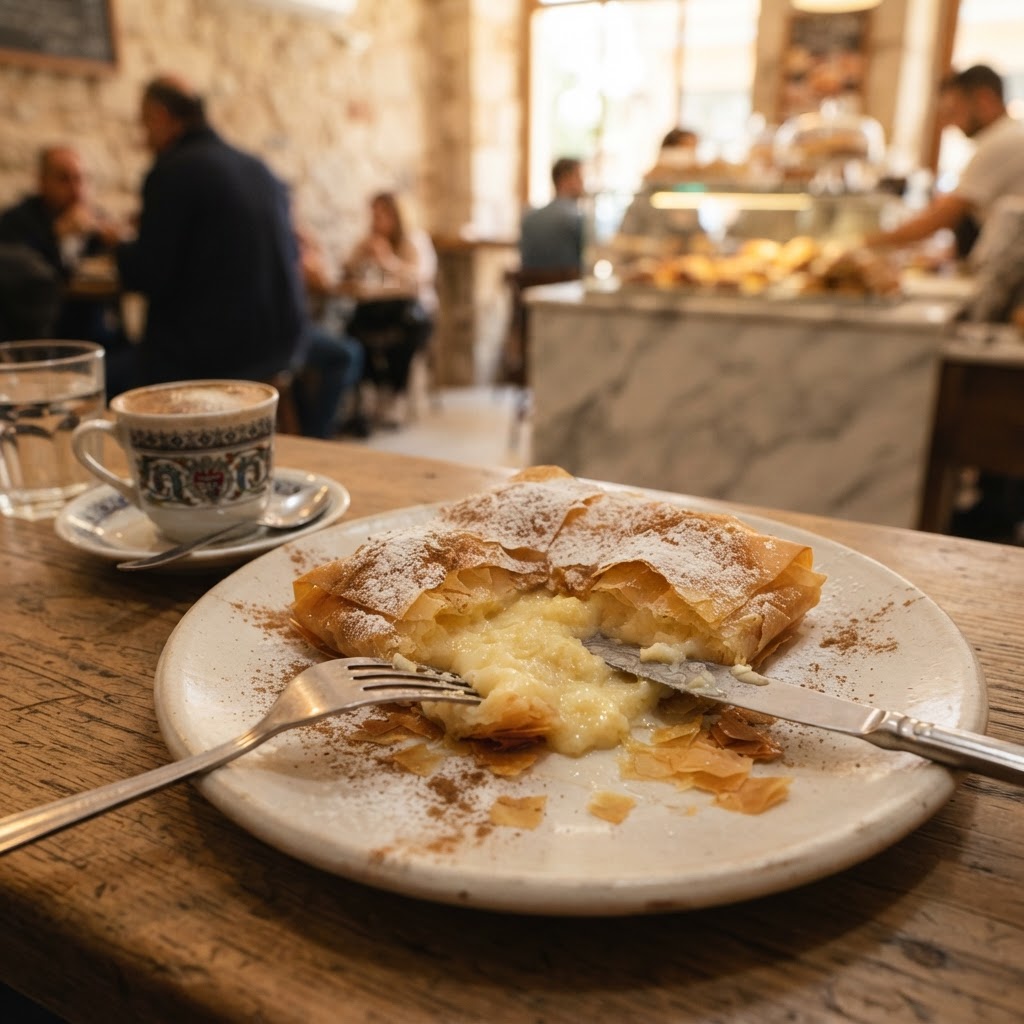
Bougatsa is a Greek breakfast pastry of crisp, golden phyllo wrapped around a warm semolina custard, dusted with powdered sugar and cinnamon, sold before dawn in the bakeries of Thessaloniki and eaten standing at the counter with a small cup of strong Greek coffee. According to Wikipedia, bougatsa is a Greek breakfast food, sweet or savory, with origins stretching back to the Byzantine period, when Constantinople was a Greek city and the pastry began as a simple dough stuffed with numerous sweet and savory fillings. After the population exchange between Greece and Turkey in 1923, Greek refugees from Asia Minor brought their bougatsa traditions to northern Greece, especially Thessaloniki and Serres, where the pastry became the signature morning food of the city. Culinary Backstreets traces bougatsa's long history from Byzantine Constantinople to the modern bakeries of Thessaloniki, where the custard-filled version is the most popular and where the pastry is so identified with the city that a Thessalonian breakfast without bougatsa is barely a breakfast at all.
The genius of bougatsa is the contrast between the crisp, shattering phyllo and the soft, warm, faintly sweet custard within. The semolina gives the custard a slightly granular, toasty texture that plain starch custards lack, and the cinnamon and powdered sugar on top add a warm, festive finish. Eaten hot from the bakery, cut into generous squares, it is the most complete expression of the Greek morning, a Byzantine survival that has outlasted empires and is still served every day before sunrise.
About the Ingredients
Phyllo dough — store-bought phyllo, thawed if frozen. The phyllo must be brushed generously with melted butter between each layer, as the butter is what makes the pastry crisp and golden.
Semolina — fine semolina flour, which gives the custard its characteristic texture and a faint toasted flavor. All-purpose flour can be substituted but the result will be smoother and less interesting.
Milk — whole milk, heated, for the custard.
Eggs — whole eggs and extra yolks, for richness and setting.
Sugar — granulated sugar, modestly sweetened, as the powdered sugar on top adds more sweetness.
Butter — unsalted butter, melted, for brushing the phyllo. This is not a pastry to skimp on butter.
Flavorings — vanilla extract, a strip of lemon or orange zest, and a pinch of ground cinnamon.
Topping — powdered sugar and ground cinnamon, dusted generously over the hot pastry.
Ingredients (serves 8): - 1 package (14 sheets) phyllo dough, thawed if frozen - 1 cup (2 sticks) unsalted butter, melted - 3/4 cup fine semolina - 1/2 cup granulated sugar - 4 cups whole milk - 3 large eggs - 2 large egg yolks - 1 tsp vanilla extract - Strip of lemon or orange zest - 1/2 tsp ground cinnamon, plus more for dusting - Pinch of salt - Powdered sugar, for dusting
Instructions: First, make the custard. In a heavy saucepan, heat 3 1/2 cups of the milk with the citrus zest over medium heat until steaming but not boiling. In a bowl, whisk the semolina, sugar, and salt. In another bowl, whisk the remaining 1/2 cup milk with the eggs and yolks until smooth, then whisk in the semolina mixture.
Remove the zest from the hot milk. Whisking constantly, pour the semolina-egg mixture into the hot milk in a steady stream. Cook over medium-low heat, whisking constantly, until the custard thickens to the consistency of pudding, 5 to 7 minutes. Remove from heat, whisk in the vanilla and cinnamon, and cover the surface directly with plastic wrap to prevent a skin. Let cool to room temperature.
Preheat the oven to 375°F. Brush a 9x13-inch baking pan with melted butter. Lay 7 sheets of phyllo in the pan, brushing each sheet generously with melted butter before adding the next, letting the edges hang over the sides.
Spread the cooled custard evenly over the phyllo. Fold the overhanging edges over the custard. Lay the remaining 7 sheets on top, brushing each with butter. Tuck the top edges under the pastry to seal.
Score the top layers into squares (do not cut all the way through) with a sharp knife. Bake until deep golden brown, 35 to 45 minutes.
Dust generously with powdered sugar and cinnamon while still hot. Cut through the scored lines and serve warm.
The Mimosa Pairing Logic: The warm, cinnamon-dusted custard of bougatsa wants a bright, citrus-forward sparkling drink that can cut the richness and echo the pastry's aromatic spices. A classic Champagne mimosa is the natural match, the orange juice a bright counter to the semolina custard and the bubbles lifting the buttery phyllo. A peach bellini mimosa is equally lovely, its stone-fruit sweetness a gentle companion to the warm custard. This pairing is a sparkling toast to the Byzantine bakers of Constantinople and the morning bakeries of Thessaloniki.
Reference Links: - Bougatsa (Greek breakfast, Byzantine origins, Thessaloniki, Serres): Wikipedia - Bougatsa in Thessaloniki (Byzantine history, northern Greece, Asia Minor refugees): Culinary Backstreets
Rate this recipe
Be the first to rate this recipe
to submit your rating.
Recent Posts

Couscous Royale: North Africa's Grand Platter of Lamb, Chicken, and Merguez
October 14, 2026

Seattle Cream Cheese Dog Bites: Hadley Long's 1989 Pioneer Square Invention
October 14, 2026

Khao Soi: Chiang Mai's Northern Thai Coconut Curry Noodles
October 13, 2026

Korean Bibimbap: Jeonju's Joseon Dynasty Mixed Rice
October 11, 2026

Spaghetti alla Carbonara: Rome's World War II Pasta of Eggs, Guanciale, and Pecorino
October 9, 2026