Galbi Jjim (Korean Braised Beef Short Ribs with Asian Pear and Shiitake)
May 25, 2026
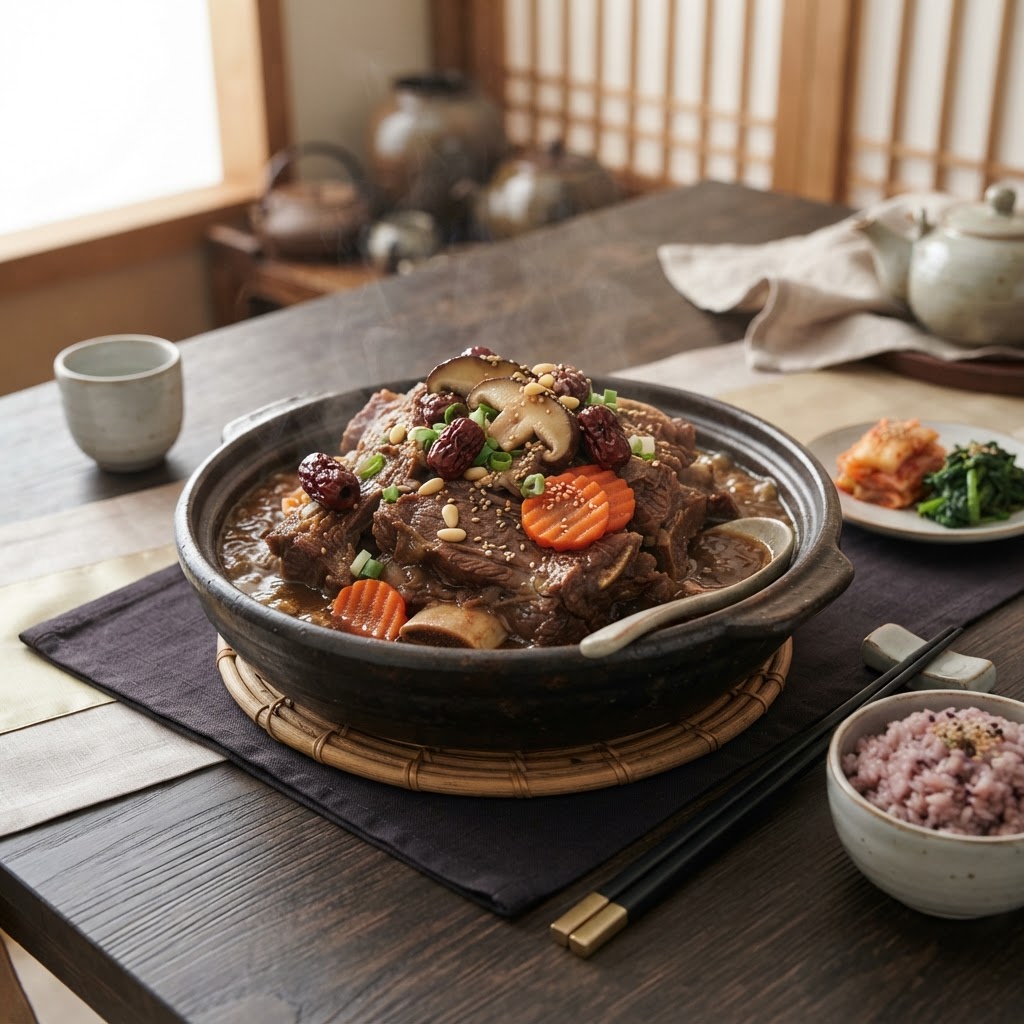
Galbi jjim — braised beef short ribs — is one of the most widely known and popular dishes in Korean cuisine, a special-occasion preparation of fall-off-the-bone tender short ribs in a glossy, sweet-savory sauce of soy, garlic, ginger, sesame, and Asian pear. The dish is a fixture of Korean holiday feasts (particularly Seollal, the lunar new year, and Chuseok, the harvest festival), weddings, and celebrations — a luxurious, deeply satisfying dish that has been the centerpiece of Korean festive cooking for centuries.
Galbi jjim descends from the royal court cuisine of the Joseon Dynasty (1392–1910), where braised short ribs were a delicacy reserved for the king and the royal family. The dish was later adapted for the aristocratic yangban class and eventually became a popular celebration dish for ordinary Koreans. The modern version, with its sweet-savory soy glaze and the tenderizing effect of Asian pear (which contains enzymes that break down the meat's proteins), developed in the 20th century and has become the definitive preparation.
The key to a great galbi jjim is the long, slow braise that transforms the tough, sinewy short ribs into meltingly tender morsels, and the carefully balanced sauce — the soy provides umami depth, the ginger and garlic add aromatic warmth, the sesame oil adds nutty richness, the Asian pear adds sweetness and tenderizes the meat, and the rice wine (or water) provides the braising liquid. The dish is finished with shiitake mushrooms, jujube dates, carrots, and sometimes chestnuts or ginkgo nuts, which add texture and a touch of sweetness. The finished dish is glossy, deeply caramelized, and deeply savory — one of the most satisfying braises in world cuisine.
Ingredients (serves 6 as a main course):
The Short Ribs: - 3 lbs beef short ribs (English cut, bone-in, about 2 inches thick — or flanken cut for a faster braise) - 1 Asian pear (also called Korean pear or nashi pear), grated with its juice (or substitute 1 Bartlett pear) - 1 large onion, grated - 8 garlic cloves, minced - 1 tablespoon fresh ginger, grated
The Braising Liquid: - 1 cup soy sauce (use a Korean soy sauce like Sempio or a Japanese usukuchi for a lighter color) - ½ cup water or Korean rice wine (cheongju — or substitute dry sherry) - ¼ cup brown sugar, packed (or 3 tablespoons honey) - 2 tablespoons sesame oil - 1 tablespoon toasted sesame seeds - 1 tablespoon rice vinegar (optional, for balance) - 1 cinnamon stick - 2 bay leaves - 1 dried shiitake mushroom (adds umami depth to the broth)
The Vegetables and Garnish: - 7 oz fresh shiitake mushrooms, stemmed and halved - 2 large carrots, cut into 1-inch rounds - 10 jujube dates (Korean daechu), pitted (or substitute dried dates) - 1 tablespoon vegetable oil (for sautéing the vegetables) - 1 tablespoon cornstarch mixed with 2 tablespoons water (optional, for thickening) - 2 scallions, finely sliced (for garnish) - 1 tablespoon toasted sesame seeds (for garnish)
Preparing the Short Ribs: Soak the short ribs in cold water for 1–2 hours to draw out the excess blood — this produces a clearer broth and a cleaner flavor. Drain. Place the ribs in a large pot, cover with cold water, and bring to a boil. Boil 10 minutes to remove the impurities and scum. Drain and rinse the ribs under cold water. This blanching step is essential for a clear, clean-tasting broth.
The Braise: In a large Dutch oven or heavy pot, combine the blanched short ribs, grated Asian pear (with its juice), grated onion, minced garlic, grated ginger, soy sauce, water or rice wine, brown sugar, sesame oil, sesame seeds, cinnamon stick, bay leaves, and the dried shiitake mushroom. Add enough water to just barely cover the ribs. Bring to a simmer over medium heat. Cover, reduce heat to low, and braise 1 hour 30 minutes. The ribs should be becoming tender but not yet falling apart.
Adding the Vegetables: Add the fresh shiitake mushrooms, carrot rounds, and jujube dates. Continue braising, covered, 30–45 minutes more until the ribs are falling-off-the-bone tender and the sauce is thick and glossy. If the sauce is too thin, uncover and increase the heat to reduce, or add the cornstarch slurry and simmer 3 minutes. If the sauce is too thick, add a splash of water. Remove the cinnamon stick and bay leaves.
Finishing: Taste the sauce and adjust — it should be deeply savory, sweet, and aromatic, with a glossy sheen. Stir in the rice vinegar (if using) for balance. Garnish with the sliced scallions and toasted sesame seeds just before serving.
Service: Serve the galbi jjim in shallow bowls over steamed rice, making sure each portion has ribs, mushrooms, carrots, and dates, and plenty of the glossy sauce. The sauce is the soul of the dish — spoon it generously over the rice. Garnish with scallions and sesame seeds. Serve with traditional Korean banchan (side dishes) — kimchi, pickled radishes, and seasoned vegetables.
The Mimosa Pairing Logic: The sweet-savory, soy-glossed character of galbi jjim calls for a mimosa with fruit that complements the Asian pear and bright acidity that cuts through the richness. A peach bellini mimosa is the most natural pairing — the peach echoes the sweetness of the Asian pear and the prosecco's fruitiness complements the soy glaze. A yuzu honey mimosa is inspired — the yuzu is a citrus staple in both Korean and Japanese cuisine and creates a beautiful resonance with the dish. For a more structured pairing, a strawberry mimosa provides a bright, fruity counterpoint that refreshes the palate between bites of the rich ribs. Avoid very dry or tannic mimosas — they clash with the sweet, savory character of the dish.
Reference Links: - Galbi jjim history and recipe: Korean Bapsang - Korean braised short ribs: Food52 - Korean royal court cuisine: Wikipedia - Asian pear in Korean cooking: The Spruce Eats
Make-Ahead: Galbi jjim is better on the second day — the flavors deepen and the meat absorbs more of the sauce overnight. Make it 1–3 days ahead, refrigerate, and reheat gently. The vegetables should be added on the day of service so they retain their texture. The rice should be made à la minute.
Pro Tips: The blanching step is essential for a clear, clean-tasting broth — skipping it produces a cloudy sauce with a muddy flavor. The Asian pear is the authentic and essential tenderizer — its enzymes break down the meat's proteins and its sweetness balances the soy. Do not substitute with sugar alone. The English-cut short ribs (bone-in, thick) are the authentic choice — flanken cut (cross-cut, thin) is a faster but less traditional option. The braise must be gentle — a hard boil toughens the meat and produces a grainy texture. The sauce should be glossy and thick enough to coat the ribs — if it is thin, reduce it uncovered or add the cornstarch slurry. The jujube dates are traditional and add a subtle, date-like sweetness and a soft, yielding texture — they are worth seeking out at Korean markets.
Rate this recipe
Be the first to rate this recipe
to submit your rating.
Recent Posts

Couscous Royale: North Africa's Grand Platter of Lamb, Chicken, and Merguez
October 14, 2026

Seattle Cream Cheese Dog Bites: Hadley Long's 1989 Pioneer Square Invention
October 14, 2026

Khao Soi: Chiang Mai's Northern Thai Coconut Curry Noodles
October 13, 2026

Korean Bibimbap: Jeonju's Joseon Dynasty Mixed Rice
October 11, 2026

Spaghetti alla Carbonara: Rome's World War II Pasta of Eggs, Guanciale, and Pecorino
October 9, 2026