Dutch Bitterballen Beef Croquettes with Mustard
May 1, 2026
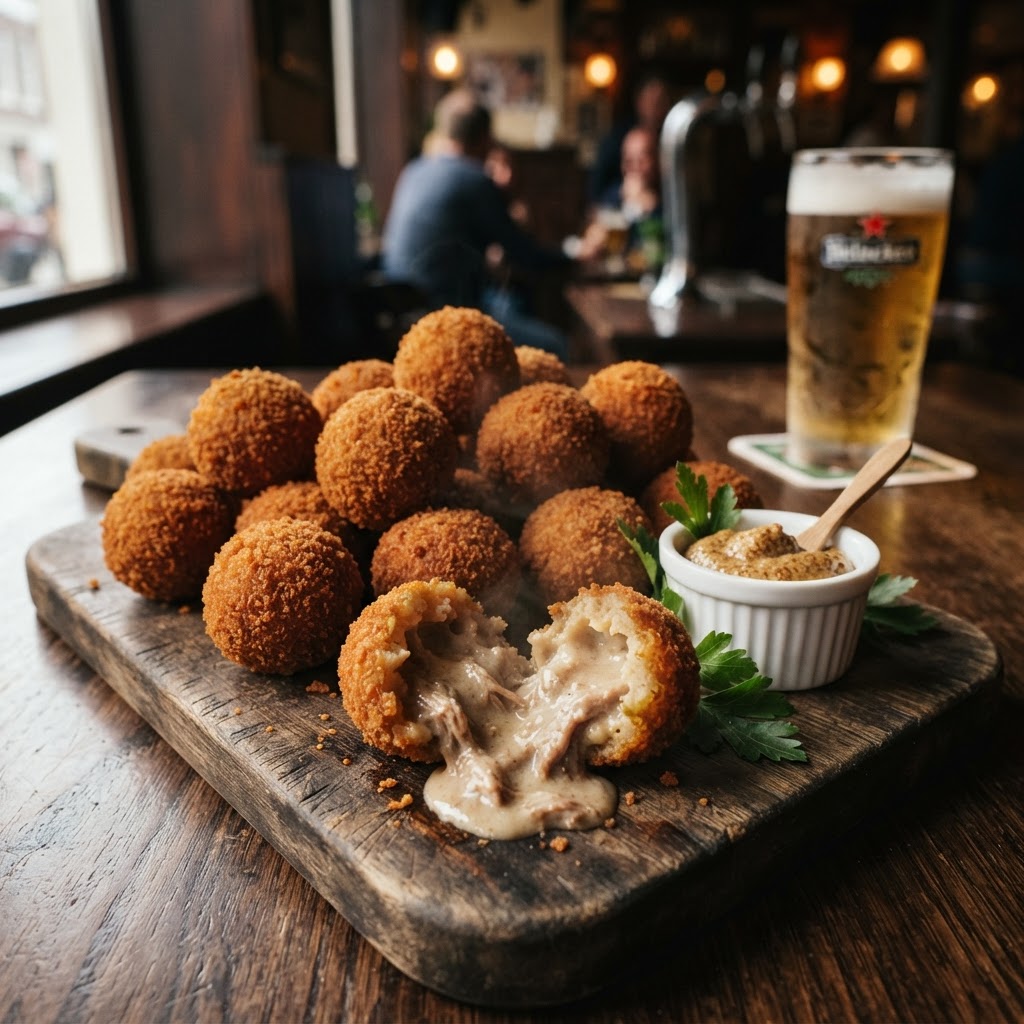
There is a particular kind of contentment that settles over a Dutch *bruin café* — a brown café, all aged wood and nicotine-stained walls and the gentle clink of glasses — when a small plate of bitterballen arrives, golden and crackling, with a ramekin of sharp mustard and a stack of toothpicks. This is the Netherlands' most popular snack: a little round croquette of beef ragout, deep-fried to a deep amber, with a shell that shatters and a filling so creamy it almost flows when hot. You eat them standing, or perched on a barstool, with a beer in one hand and a toothpick in the other, and the whole ritual is what the Dutch call a *bittergarnituur* — the savoury spread that accompanies drinks.
The name is a small piece of charming misdirection. Bitterballen are not bitter at all. They take their name from the *bitters* — the herb-flavoured liqueurs and *jonge jenever* (Dutch gin) they were historically served alongside, as Wikipedia's entry on bitterballen notes. The snack itself is gentle, rich, and deeply savoury. Their exact origin is the subject of affectionate national debate: one popular legend places their invention in the 17th century, when, during the Spanish occupation, an Amsterdam publican's wife supposedly rolled leftover beef stew into balls and fried it so her husband's customers would have something to eat with their *bittertje*; a more practical theory holds that 19th-century Dutch cooks created them as a way to use up Sunday's leftover beef stew. Either way, the technique — a thick ragout bound with roux, chilled firm, rolled, crumbed, and fried — is centuries old.
The genius of the bitterbal is the contrast. The shell is audibly crisp; the inside is a soft, spoonable ragout, bound just firmly enough to hold its shape but loose enough to ooze when you bite. The ragout itself is the heart of the thing: beef braised for hours until it shreds, folded into a roux-thickened gravy perfumed with nutmeg, bay, and parsley, and a splash of sherry or Madeira if you're so inclined. Then everything is chilled until cold — this step is non-negotiable, because cold ragout is the only ragout you can roll into a ball — dipped in flour, egg, and fresh breadcrumbs (a second pass through egg and crumbs gives the extra-crisp shell that characterizes the best bitterballen), and fried golden. Served with sharp brown *mosterd* for dipping, they are, quite simply, the ultimate Dutch party snack.
About the Ingredients
Beef should be stewing beef — chuck or brisket, a tough, flavourful cut that becomes meltingly tender through long, slow braising. The beef is braised until it shreds, then combined with the thickened braising liquid to form the ragout. Olivia's Cuisine provides an authentic recipe, and The Spruce Eats offers a reliable classic beef version.
The ragout base is a thick béchamel-like sauce made with butter, flour, and beef broth, enriched with the shredded braised beef and seasoned with nutmeg, bay, parsley, and a splash of sherry or Madeira. The sauce must be very thick — thicker than mashed potatoes, almost like a soft dough — so that it can be shaped into balls and hold its form when fried. Jo Cooks offers an excellent recipe with detailed instructions.
The coating is a classic three-step breading: flour, beaten egg, fresh breadcrumbs — and for extra crunch, a second dip in egg and breadcrumbs. Fresh breadcrumbs (made from day-old white bread, pulsed in a food processor) give a lighter, crisper coating than dried breadcrumbs; panko is a perfectly good modern substitute if you're short on time.
Sharp brown mustard — Dutch *mosterd* or a good Dijon — is the traditional dipping sauce. The sharpness of the mustard cuts through the rich, creamy ragout.
Ingredients (makes approximately 24 bitterballen):
Beef Ragout: - 1 lb stewing beef (chuck or brisket), cut into 2-inch cubes - 4 cups beef broth - 1 onion, quartered - 2 bay leaves - 1 tablespoon butter - 1/4 cup all-purpose flour - 1/4 cup heavy cream - 1/2 teaspoon ground nutmeg - 1 tablespoon chopped fresh parsley - 1 tablespoon sherry or Madeira (optional) - Salt and white pepper to taste
For coating and frying: - 1 cup all-purpose flour - 2 eggs, beaten with 2 tablespoons water - 2 cups fresh white breadcrumbs (made from day-old bread) - Vegetable oil for deep frying
For serving: - Sharp brown mustard (Dutch mosterd or Dijon)
Instructions: Prepare the beef: in a heavy pot, combine the beef, beef broth, quartered onion, and bay leaves. Bring to a boil, then reduce to a simmer, cover, and cook for 2–3 hours until the beef is fork-tender and shreds easily with a fork. Remove the beef and shred it. Strain the broth and reserve — you will need it for the ragout.
Prepare the ragout: in the same pot, melt the butter over medium heat. Whisk in the flour and cook for 2 minutes to make a roux. Gradually whisk in 2 cups of the reserved beef broth, whisking constantly to prevent lumps. Cook, stirring, until the sauce is very thick — thicker than mashed potatoes, almost like a dough. This may take 10–15 minutes. Remove from heat and stir in the shredded beef, cream, nutmeg, parsley, sherry, salt, and white pepper. Taste and adjust seasoning.
Spread the ragout in a shallow dish, cover with plastic wrap pressed directly against the surface (to prevent a skin from forming), and refrigerate for at least 4 hours or overnight. The ragout must be completely cold and firm before shaping.
Shape the bitterballen: with wet hands (to prevent sticking), roll tablespoon-sized portions of the cold ragout into balls about 1.5 inches in diameter. Roll each ball in flour, then dip in the beaten egg, then roll in fresh breadcrumbs. For an extra-crispy coating, repeat the egg and breadcrumb steps for a double coating.
Heat the oil in a deep pot or Dutch oven to 350°F (347°F). Fry the bitterballen in batches of 6–8 for 3–4 minutes until deep golden brown and crispy. Drain on paper towels. Serve immediately with sharp brown mustard for dipping.
The Mimosa Pairing Logic: There is a lovely logic to swapping the traditional Dutch beer for a mimosa at a brunch. The rich, creamy, deeply savoury beef ragout and the crisp fried shell want a bright, refreshing drink that can cut through the richness and wake the palate back up. A classic Champagne mimosa or a grapefruit rosemary mimosa is ideal — the citrus acidity balances the creamy, meaty ragout, and the wine's effervescence sweeps the fried coating clean away. The gentle bitterness of grapefruit is especially good against the richness of the beef and the bite of the mustard, echoing the sharp-savoury counterpoint that makes the whole bittergarnituur tradition sing. It is, in its way, the brunch equivalent of bitterballen and a bittertje — a sparkling toast to a centuries-old Dutch habit of pairing something cold and bright with something hot and golden.
Reference Links: - Bitterballen overview and history: Wikipedia - Dutch Classic Beef Bitterballen recipe: The Spruce Eats - Bitterballen recipe with step-by-step photos: Olivia's Cuisine - Dutch meatballs (bitterballen) recipe: Jo Cooks
Make-Ahead: The ragout can be made up to 3 days ahead and refrigerated — it must be completely cold before shaping. The shaped, coated bitterballen can be frozen on a baking sheet, then transferred to a freezer bag for up to 2 months. Fry from frozen, adding 1–2 minutes to the frying time. Do not refrigerate the coated bitterballen for more than a few hours — the breadcrumbs will absorb moisture and the coating will not be crisp. Bitterballen must be fried just before serving; they do not reheat well.
Pro Tips: The ragout must be extremely thick — if it is too loose, the bitterballen will collapse in the fryer. If the ragout is too thin after cooking, return it to the stove and cook longer to reduce further. The ragout must be completely cold before shaping — warm ragout will not hold its shape. Wet your hands when shaping to prevent sticking. Do not overcrowd the fryer — fry in small batches so the oil temperature does not drop. The oil must be at 350°F (347°F); if it is too cool, the bitterballen will absorb oil and be greasy; if too hot, the outside will burn before the inside is hot. Serve immediately — bitterballen are at their best for only a few minutes after frying.
Rate this recipe
Be the first to rate this recipe
to submit your rating.
Perfect Mimosa Pairings
Mimosas that pair perfectly with this dish
Recent Posts

Couscous Royale: North Africa's Grand Platter of Lamb, Chicken, and Merguez
October 14, 2026

Seattle Cream Cheese Dog Bites: Hadley Long's 1989 Pioneer Square Invention
October 14, 2026

Khao Soi: Chiang Mai's Northern Thai Coconut Curry Noodles
October 13, 2026

Korean Bibimbap: Jeonju's Joseon Dynasty Mixed Rice
October 11, 2026

Spaghetti alla Carbonara: Rome's World War II Pasta of Eggs, Guanciale, and Pecorino
October 9, 2026