Deviled Eggs Four Ways
May 20, 2026
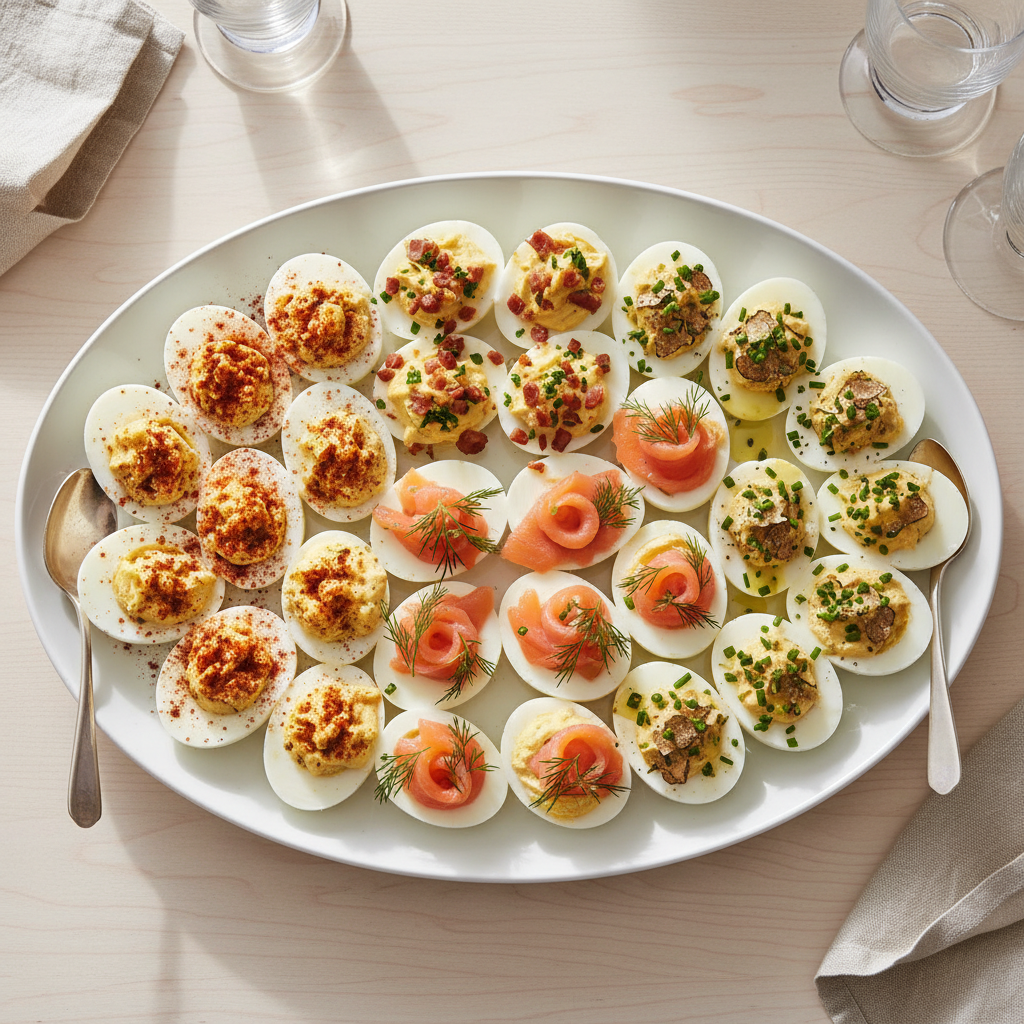
Deviled eggs are the classic American party food and, when properly made, one of the most crowd-pleasing appetizers on any table. The key to a great deviled egg is a flawlessly smooth yolk filling — pushed through a fine sieve, not merely mashed — and a well-seasoned base that goes beyond the classic mayo-and-mustard formula. This presentation serves four distinct variations on a single platter, creating a beautiful array that allows guests to try multiple flavor profiles.
The four variations — Classic with smoked paprika, Smoked Salmon & Dill, Crispy Bacon & Chive, and Truffle & Chive — range from the everyday to the luxurious, covering every palate at the table. Each shares the same silky base; only the toppings and minor finishing additions differ.
Ingredients (makes 48 deviled egg halves — 12 each variation): - 24 large eggs, preferably at least 1 week old (older eggs peel more cleanly)
Base Yolk Filling: - All 24 cooked yolks - 6 tablespoons good-quality mayonnaise (Duke's or Hellmann's) - 2 tablespoons Dijon mustard - 2 teaspoons apple cider or white wine vinegar - 2 tablespoons heavy cream (to adjust to piping consistency) - 1 teaspoon fine sea salt - ½ teaspoon white pepper
Variation 1 — Classic: - Smoked paprika for dusting - 1 teaspoon hot sauce stirred into the base - Cornichon slice garnish
Variation 2 — Smoked Salmon & Dill: - 3 oz cold-smoked salmon, torn into small pieces - Fresh dill fronds - Capers for garnish - Lemon zest
Variation 3 — Crispy Bacon & Chive: - 4 strips thick-cut bacon, cooked until crispy and finely crumbled - Fresh chives, finely snipped - Smoked paprika - Cracked black pepper
Variation 4 — Truffle & Chive: - 1 teaspoon white truffle oil stirred into ¼ of the base filling - Fresh chives, finely snipped - Flaky sea salt - Micro arugula (optional)
Cooking the Eggs: Place eggs in a single layer in a large saucepan. Cover with cold water by 1 inch. Bring to a rolling boil over high heat. Remove from heat, cover, and let stand exactly 11 minutes. Transfer to an ice bath and cool for 12 minutes. Peel under cold running water. Halve lengthwise. Remove yolks.
Filling: Push all yolks through a fine sieve into a bowl — this produces a perfectly smooth, lump-free filling. Add mayonnaise, Dijon, vinegar, cream, salt, and white pepper. Mix until completely smooth and silky. The filling should be just soft enough to pipe. Taste and adjust seasoning. Divide the filling into four portions.
For Variation 4: stir truffle oil into one portion. For other variations: keep plain.
Assembly: Set up a clean platter or deviled egg dish. Transfer each portion to a piping bag fitted with a star or round tip. Pipe each filling into the corresponding egg whites. Garnish each variation immediately: - Classic: dust with smoked paprika, add a cornichon slice - Smoked Salmon: arrange a small piece of salmon, a dill frond, a caper - Bacon & Chive: scatter crumbled bacon and chives, dust with smoked paprika - Truffle: scatter chives, finish with a grain of flaky salt
Arrange the platter in quadrants so each variation occupies its own section — the visual organization is part of the presentation.
The Mimosa Pairing Logic: The creamy, tangy yolk filling of deviled eggs pairs with every citrus-forward mimosa. The truffle variation pairs particularly beautifully with a blood orange mimosa or classic orange mimosa — the citrus cuts through the truffle oil's richness. The smoked salmon variation echoes the pairing logic of smoked fish and Champagne — a timeless combination. The bacon variation is exceptional alongside a grapefruit rosemary mimosa — the smoke and salt of the bacon make the grapefruit's bitterness taste sweeter.
Reference Links: - Perfect deviled egg technique: Serious Eats - Duke's mayonnaise: Duke's Mayonnaise - Hard boiled egg timing guide: The Kitchn
Make-Ahead: Eggs can be boiled and peeled up to 2 days ahead; refrigerate covered in water. Filling can be made and refrigerated 4 hours ahead. Assemble and garnish no more than 1 hour before service.
Pro Tips: The sieve step for the yolks is non-negotiable — it eliminates every trace of lumpiness and produces a filling of professional quality. Eggs at least 1 week old peel significantly more cleanly than fresh eggs — the air pocket between the membrane and shell is larger in older eggs. Use a piping bag for elegant presentation — a spoon produces an uneven, home-style result.
Rate this recipe
Be the first to rate this recipe
to submit your rating.
Recent Posts

Couscous Royale: North Africa's Grand Platter of Lamb, Chicken, and Merguez
October 14, 2026

Seattle Cream Cheese Dog Bites: Hadley Long's 1989 Pioneer Square Invention
October 14, 2026

Khao Soi: Chiang Mai's Northern Thai Coconut Curry Noodles
October 13, 2026

Korean Bibimbap: Jeonju's Joseon Dynasty Mixed Rice
October 11, 2026

Spaghetti alla Carbonara: Rome's World War II Pasta of Eggs, Guanciale, and Pecorino
October 9, 2026