Croquembouche: The French Wedding Tower of Choux and Caramel
May 10, 2026
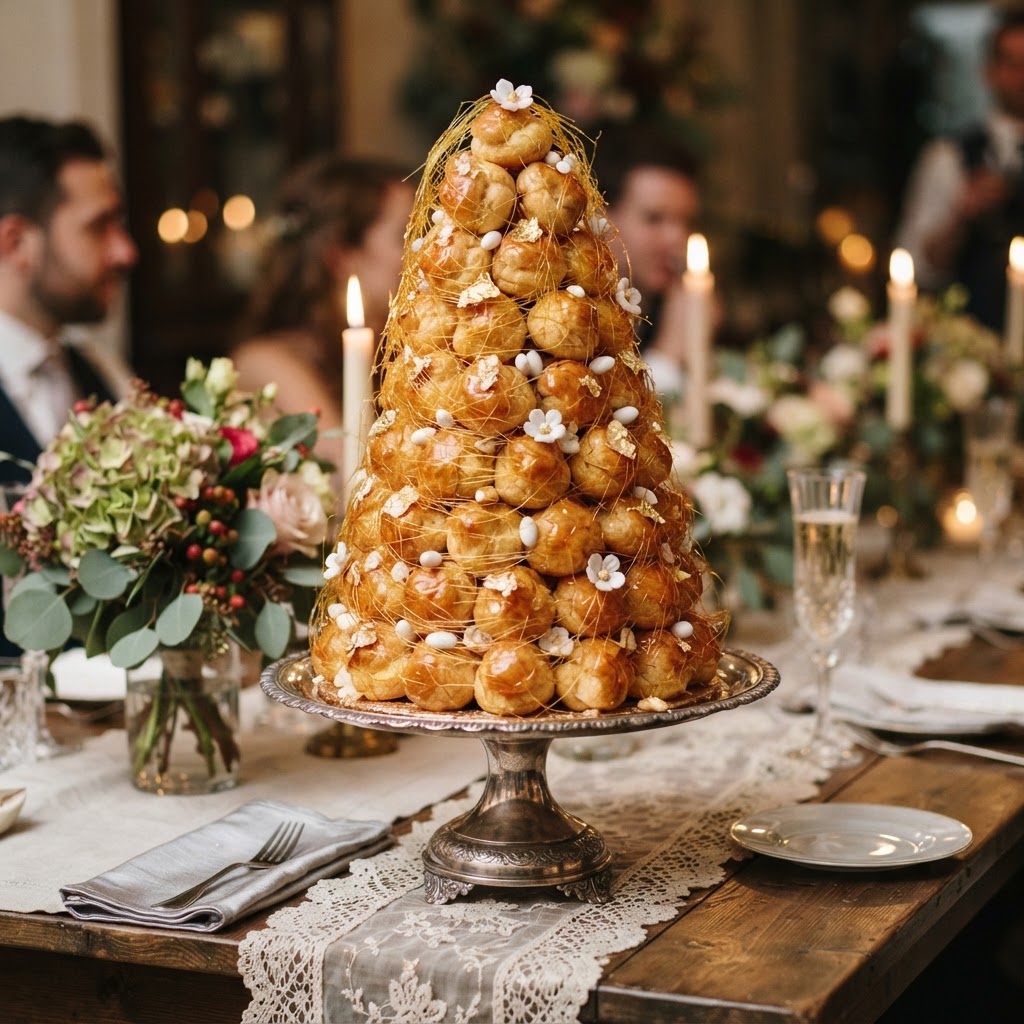
The croquembouche is the great celebration dessert of France — a tall, conical tower of small, cream-filled choux puffs, bound together with threads of golden caramel and wreathed in spun sugar, the traditional wedding cake of France, a spectacular *pièce montée* whose name means "crunch in the mouth." It is the most theatrical of French pâtisserie, a centerpiece built for weddings, baptisms, and first communions, and it is credited to the legendary chef Antonin Carême, who refined the art of the *pièce montée* in the late 18th and early 19th centuries. According to Wikipedia, a croquembouche (or *croque-en-bouche*) is a French dessert consisting of choux pastry puffs piled into a cone and bound with threads of caramel; in France and Italy, it is traditionally served at weddings and at baptisms and first communions, and the tradition is attributed to the legendary chef Antonin Carême, who refined the art of the *pièce montée*. The Spruce Eats describes the croquembouche as a cone-shaped tower of cream puffs bound together by caramel, French for "crunch in the mouth," and notes that it is the traditional French wedding cake, a spectacular centerpiece for any celebration.
The genius of the croquembouche is the caramel. Each choux puff is filled with a vanilla cream, then dipped in hot caramel, which both glazes the puff and acts as the glue that binds the tower together. The caramel sets hard and shiny, so that the puffs adhere to one another and the whole cone holds its shape, and the spun sugar — fine threads of caramel pulled around a oiled wooden spoon handle and draped over the tower — gives the final, glittering, gossamer finish. To serve, the guests pull the puffs from the tower, each one cracking with the "croque" — the crunch — that gives the dessert its name.
About the Ingredients
Choux pastry — *pâte à choux*, the delicate butter-water-flour-egg dough of cream puffs and éclairs, piped into small rounds and baked until puffed, hollow, and golden. The puffs must be crisp and hollow so they can be filled.
Crème pâtissière — vanilla pastry cream, the filling; a rich, vanilla-scented custard of milk, egg yolks, sugar, and cornstarch, piped into the baked puffs through a small hole. Vanilla, or a flavored cream (chocolate, coffee, praline, rose), is traditional.
Caramel — sugar, cooked to a deep amber, the glue and the glaze; the hot caramel is what binds the puffs together and gives the tower its glossy, golden, crunching shell. The caramel must be cooked to the right stage (hard-crack, around 320–340°F) so it sets hard and holds the tower.
Spun sugar — fine threads of caramel, made by dipping a fork or whisk into the hot caramel and flicking it rapidly around an oiled wooden spoon handle (or the back of a ladle), then gathering the threads and draping them over the tower, the final, gossamer finish.
Ingredients (makes one tower, about 40 puffs, serves 12–15): For the choux puffs: - 1 cup water - 1/2 cup (1 stick) unsalted butter, cubed - 1 cup all-purpose flour - 4 large eggs - 1/2 tsp salt
For the crème pâtissière: - 2 cups whole milk - 6 large egg yolks - 1/2 cup granulated sugar - 1/4 cup cornstarch - 1 tsp vanilla extract - 2 tbsp unsalted butter
For the caramel and spun sugar: - 3 cups granulated sugar - 3/4 cup water - A little cream of tartar (optional, to prevent crystallization)
Instructions: For the choux: preheat the oven to 400°F. In a saucepan, bring the water, butter, and salt to a boil. Off the heat, add the flour all at once and stir vigorously until the dough pulls away from the sides into a ball. Return to low heat and cook, stirring, 2 minutes to dry. Transfer to a bowl and beat in the eggs one at a time, beating well after each, until the dough is smooth, glossy, and falls in a ribbon. Pipe small rounds (about 1 inch) onto parchment-lined sheets. Bake 15 minutes at 400°F, then reduce to 350°F and bake 10 minutes more until golden and hollow. Cool on a rack.
For the crème pâtissière: in a saucepan, heat the milk until steaming. In a bowl, whisk the yolks, sugar, and cornstarch until smooth. Slowly whisk in the hot milk, then return to the pan and cook, whisking, until thickened and just boiling. Off the heat, whisk in the vanilla and butter. Press plastic wrap against the surface and chill. Pipe the cooled cream into each puff through a small hole poked in the bottom.
To assemble: make a cone form (a styrofoam cone, or a greaseproof-paper cone, oiled). In a heavy saucepan, cook the sugar and water to a deep amber, 320–340°F (hard-crack). Dip the top of each filled puff into the caramel and press it onto the cone, starting at the bottom and working up in rings. Reheat the caramel as needed. When the tower is built, spin the sugar: dip a fork into the hot caramel and flick it rapidly around an oiled wooden spoon handle to create fine threads; gather and drape over the tower.
The Mimosa Pairing Logic: The vanilla cream, the crisp choux, and the brittle caramel want a bright, aromatic drink that cuts the richness and echoes the celebration. A classic Champagne mimosa is the natural choice — the citrus acidity balances the sweet cream and caramel and the bubbles lift the pastry, and the croquembouche is itself a Champagne-toast dessert. A limoncello prosecco spritz is equally festive, its bright citrus a counter to the caramel. This is the brunch equivalent of a French wedding — a sparkling toast to Carême and the spectacular dessert that has crowned French celebrations for two centuries.
Reference Links: - Croquembouche (French, choux puffs, caramel, weddings, Carême): Wikipedia - Classic French Croquembouche Recipe (cone-shaped tower, "crunch in the mouth"): The Spruce Eats
Make-Ahead: The choux puffs can be baked a day ahead and held in an airtight container; re-crisp in a 300°F oven for 5 minutes before filling. The crème pâtissière can be made 2 days ahead and held chilled, covered. The puffs can be filled a few hours ahead and held chilled. The croquembouche itself must be assembled the day of serving — the caramel softens in humidity and the puffs soften over time, and the tower is best within hours of construction. The spun sugar must be done at the last minute; it dissolves in any humidity within hours. Work in a dry kitchen; caramel and spun sugar are enemies of humidity, and a humid day makes the tower weep and collapse.
Pro Tips: Bake the choux until truly hollow and golden; an underbaked puff collapses and is dense, and a fully baked one holds its shape. Cook the caramel to a deep amber, hard-crack stage (320–340°F); too light and it stays soft and the tower collapses, too dark and it burns bitter. Work quickly when dipping; the caramel sets in seconds, and a slow dip makes a thick, ugly blob rather than a thin, glossy glaze. Dip the top of the puff, not the whole thing; the bottom is left unglazed so the cream doesn't melt out, and the dipped top is the glue. Build the tower on an oiled cone or form; a freeform tower slides and collapses, and a form gives the proper cone. Spin the sugar at the very last minute; the threads dissolve in humidity within hours, and the gossamer veil is the point. Keep the kitchen dry; humidity is the enemy of caramel and spun sugar, and a humid day is not the day to make a croquembouche.
Rate this recipe
Be the first to rate this recipe
to submit your rating.
Recent Posts

Couscous Royale: North Africa's Grand Platter of Lamb, Chicken, and Merguez
October 14, 2026

Seattle Cream Cheese Dog Bites: Hadley Long's 1989 Pioneer Square Invention
October 14, 2026

Khao Soi: Chiang Mai's Northern Thai Coconut Curry Noodles
October 13, 2026

Korean Bibimbap: Jeonju's Joseon Dynasty Mixed Rice
October 11, 2026

Spaghetti alla Carbonara: Rome's World War II Pasta of Eggs, Guanciale, and Pecorino
October 9, 2026