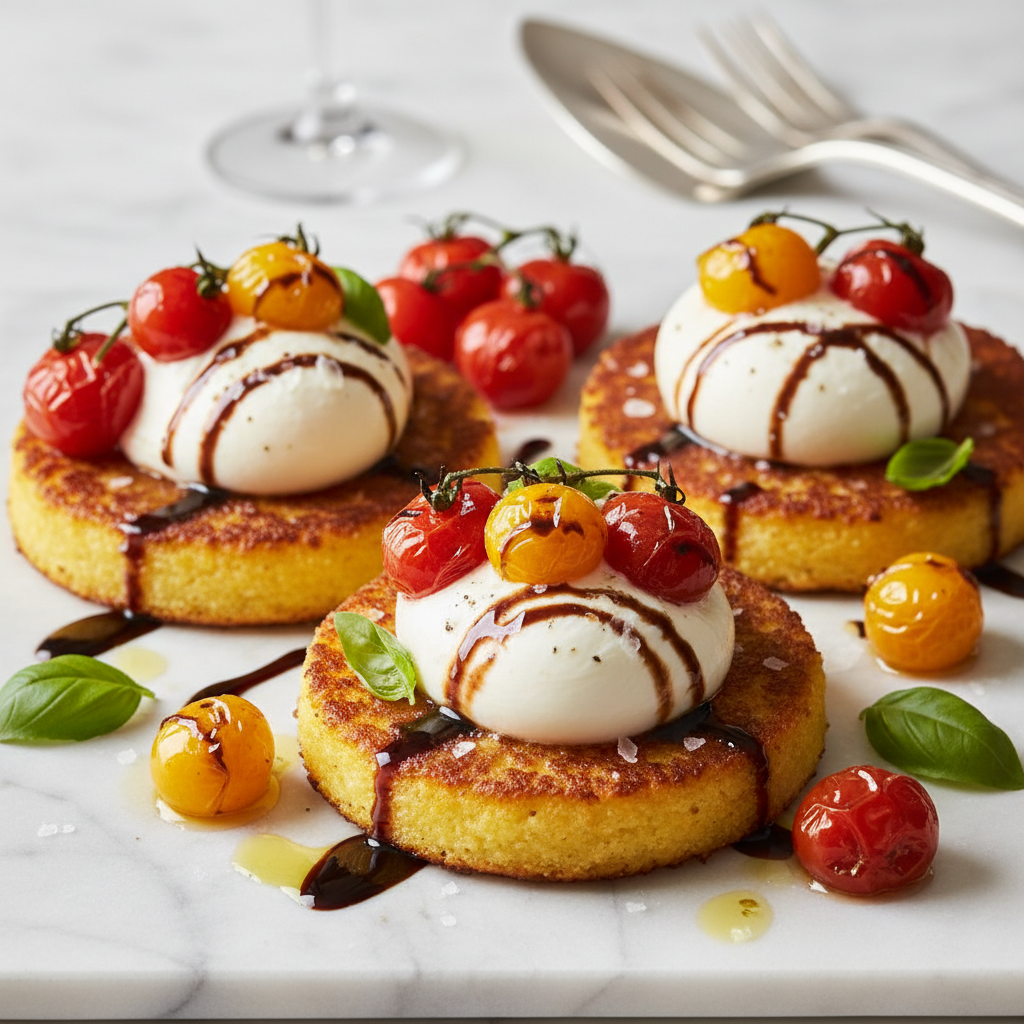
Crispy Polenta Cakes with Burrata & Burst Tomatoes
February 18, 2026
Crispy polenta cakes are the Italian answer to a crostini base that can support heavier toppings without collapsing. Cut from a set polenta slab, pan-fried in olive oil until golden and crisp on both sides, they provide a sturdy, yielding foundation for fresh burrata and blistered heirloom cherry tomatoes — a party appetizer that reads like a composed restaurant dish despite being assembable in large quantities.
Polenta's appeal for an appetizer base is structural: it can be made two days ahead, cut into any shape, and holds together completely during frying with no tendency to crumble. Unlike bread-based bases, it adds substance that guests appreciate — it is simultaneously a lighter and a more satisfying bite than a crostini.
The Origin of the Combination
Polenta (coarsely ground yellow corn) has been a staple of northern Italian cooking — particularly in Veneto, Lombardy, and Friuli — since corn arrived in Europe from the Americas in the 16th century. Before corn, polenta was made from spelt, barley, or millet; the corn version supplanted all predecessors within a century and became one of the most culturally central preparations in the Alpine north of Italy.
The pairing with fresh cheese — burrata here, but also mozzarella, Taleggio, or Gorgonzola in different traditions — is natural: the polenta's mild corn sweetness and yielding texture are the ideal vehicle for fresh, milky cheese and acidic tomatoes.
Ingredients (makes 24 polenta cakes):
Polenta Slab (make 1–2 days ahead): - 4 cups water + 2 cups whole milk - 1½ cups coarse yellow polenta (not instant — Anson Mills or Bob's Red Mill) - 1 teaspoon fine sea salt - 2 tablespoons unsalted butter - 2 ⅛ oz Parmigiano-Reggiano, finely grated - ½ teaspoon cracked black pepper - Pinch of nutmeg
For Pan-Frying: - 4 tablespoons extra virgin olive oil + 2 tablespoons unsalted butter
Burst Tomatoes: - 14 ⅛ oz mixed heirloom cherry tomatoes (red, yellow, orange — a colorful mix) - 3 garlic cloves, minced - 3 tablespoons extra virgin olive oil - 1 teaspoon sugar - ½ teaspoon red pepper flakes - 1 tablespoon fresh thyme leaves - Pinch of flaky salt
Topping: - 3 balls fresh burrata (4 ⅓ oz each), at room temperature - 3 tablespoons aged balsamic glaze - Large fresh basil leaves - Excellent extra virgin olive oil for finishing - Flaky sea salt and cracked black pepper
Polenta Slab: Bring water and milk to a boil in a large, heavy-bottomed saucepan. Add salt. Whisk in polenta gradually in a thin, steady stream, whisking constantly to prevent lumps. Reduce heat to the lowest setting. Cook, stirring with a wooden spoon every 3–4 minutes, for 35–40 minutes until the polenta is thick, creamy, and pulls cleanly away from the sides of the pan. It should be the consistency of very thick porridge.
Remove from heat. Stir in butter, Parmigiano, black pepper, and nutmeg. Taste and adjust salt.
Pour the hot polenta into a parchment-lined 9×13-inch baking dish, spreading to a uniform ¾-inch thickness. Cover with plastic wrap pressed directly onto the surface. Refrigerate until completely set and cold, a minimum of 4 hours or overnight. (Can be made 2 days ahead.)
Cutting: Using a sharp knife or round cutter, cut the cold polenta slab into 24 uniform shapes — 2-inch rounds or 1½×2½-inch rectangles both work beautifully.
Burst Tomatoes: Heat olive oil in a wide skillet over medium-high heat. Add tomatoes in a single layer. Cook undisturbed for 2 minutes until the skins begin to blister and char slightly. Add garlic, sugar, red pepper flakes, and thyme. Toss and cook 3–4 more minutes until the tomatoes have burst and their juices have created a light, jammy sauce. Season with flaky salt. Cool to room temperature. (Can be made 3 hours ahead.)
Pan-Frying the Polenta Cakes: Heat olive oil and butter together in a large non-stick or stainless steel skillet over medium-high heat until the butter foams. Working in batches, fry polenta cakes for 3–4 minutes per side without moving until deeply golden-brown, crisp, and caramelized. Remove to a wire rack. Season with flaky salt immediately.
Assembly: Place warm polenta cakes on a serving platter. Spoon 3–4 burst tomatoes with their juices onto each cake. Tear a generous piece of burrata and place alongside the tomatoes — the room-temperature burrata's inner cream will pool immediately. Drizzle aged balsamic glaze across the assembled cakes. Tuck a fresh basil leaf. Finish with excellent olive oil, flaky salt, and cracked pepper.
Serve immediately — warm polenta cakes with room-temperature burrata are the ideal; cold polenta and refrigerated burrata lose all their textural appeal.
The Mimosa Pairing Logic: The combination of creamy burrata, sweet-tart tomatoes, and crispy polenta is classically Italian and pairs with Italian-origin sparkling wines most harmoniously. A Prosecco-based mimosa, a Cava blood orange mimosa, or an Aperol sunrise mimosa all work beautifully. A classic orange or blood orange mimosa is the most universally flattering choice — the citrus acidity cuts through the burrata's fat while the tomato's acidity creates a direct flavor bridge to the juice component.
Reference Links: - Polenta history and varieties: Serious Eats - Anson Mills stone-ground polenta: Anson Mills - Burrata sourcing and freshness guide: Di Bruno Bros - Heirloom tomato varieties: Specialty Produce
Make-Ahead: Polenta slab (2 days, refrigerated); burst tomatoes (3 hours, room temperature). Pan-fry the polenta and assemble no more than 15 minutes before service.
Variations: - Top with wilted spinach and a soft-poached quail egg for a more substantial version - Replace burrata with fresh ricotta and a drizzle of truffle honey for an autumnal variation - Add a thin slice of prosciutto beneath the burrata for a more savory, meaty bite
Pro Tips: Coarse, stone-ground polenta (not instant) is essential for this preparation — instant polenta produces a gummy, textureless slab that does not develop proper crust when fried. The cold slab must be completely firm before cutting and frying. The frying pan must not be overcrowded — space is needed for the steam to escape and the crust to form; a crowded pan produces steamed, soft cakes rather than crispy ones.
Rate this recipe
Be the first to rate this recipe
to submit your rating.
Recent Posts

Couscous Royale: North Africa's Grand Platter of Lamb, Chicken, and Merguez
October 14, 2026

Seattle Cream Cheese Dog Bites: Hadley Long's 1989 Pioneer Square Invention
October 14, 2026

Khao Soi: Chiang Mai's Northern Thai Coconut Curry Noodles
October 13, 2026

Korean Bibimbap: Jeonju's Joseon Dynasty Mixed Rice
October 11, 2026

Spaghetti alla Carbonara: Rome's World War II Pasta of Eggs, Guanciale, and Pecorino
October 9, 2026