The Concord Grape Champagne Mimosa
August 7, 2026
In 1849, on a farm outside the village of Concord, Massachusetts, the Boston-born horticulturist Ephraim Wales Bull propagated a grape from the seeds of native New England wild vines, and in 1853 his creation won a prize at the Massachusetts Horticultural Society exhibition. He had planted some twenty-two thousand seedlings before he arrived at the ideal grape: early ripening, to escape the killing northern frosts, with a rich, full-bodied flavor that thrived where European cuttings had failed. Bull named the variety for his adopted town, but he died a relatively poor man; his tombstone reads, "He sowed — others reaped." The credit and the fortune went to Thomas Welch, the Vineland, New Jersey dentist who, in 1869, pasteurized Bull's grapes into the first processed unfermented grape juice in the United States.
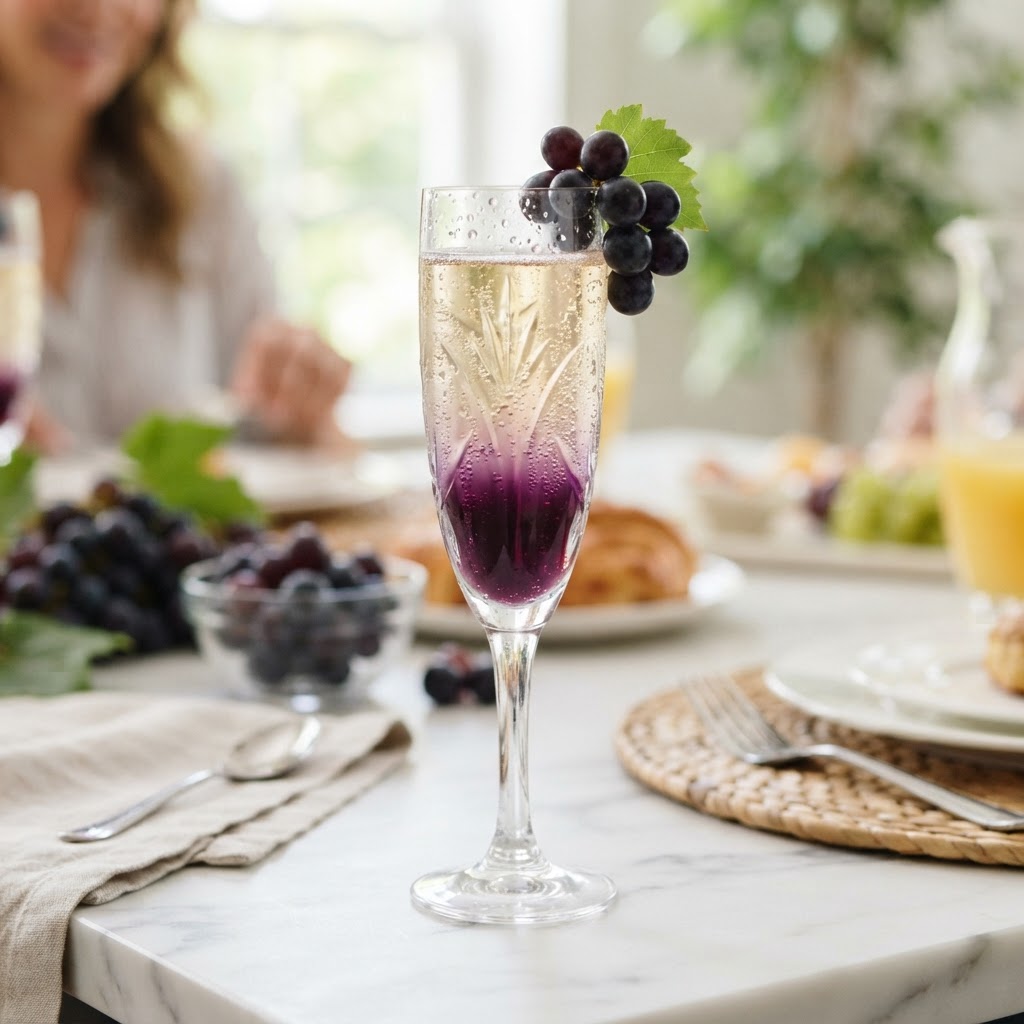
The Concord grape (Vitis labrusca) carries a flavor unlike any European grape: a deep, musky, foxy sweetness that comes from methyl anthranilate, a compound European vinifera grapes lack almost entirely. It is this distinctive, perfumed character that makes a Concord grape mimosa so singular — the grape's musky depth fills the glass in a way that ordinary orange juice never can, and its deep purple-violet stain blooms through pale Champagne in dramatic, jewel-toned gradients.
About Concord Grapes
Concord grapes are a cultivar of Vitis labrusca, a species native to eastern North America. Unlike the thin-skinned, tight-clustered European wine grapes, Concords are slip-skin berries that grow in loose clusters and carry an intense, aromatic flavor. Their season is short (late August through October in New England), and fresh Concords appear in markets for only a few weeks each year. For a mimosa made outside that window, Welch's 100% Concord grape juice (the direct descendant of Dr. Welch's 1869 process) is the closest equivalent and produces an excellent drink. Reference: Concord Grape Association — History
Concord Grape Purée: - 2 cups fresh Concord grapes, rinsed and stemmed (or 1 cup Welch's 100% Concord grape juice) - 1 tablespoon fresh lemon juice - 1 teaspoon honey (only if the grapes are tart)
If using fresh grapes, simmer them in a saucepan over medium-low heat for 8–10 minutes until the skins burst and the juices release. Press through a fine-mesh sieve or food mill, discarding the skins and seeds, to yield a smooth, deeply purple purée. Stir in lemon juice and honey to taste. Chill thoroughly. The purée should be a vivid, opaque violet. Use within 3 days.
Ingredients (serves 6): - 1 cup Concord grape purée (above) - 1 bottle (25 oz chilled Champagne Brut NV or Blanc de Noirs (Blanc de Noirs — such as Bollinger Special Cuvée — provides a fuller, fruitier body that stands up to the grape's musky depth; Champagne Brut NV provides structure. Reference: Champagne — official) - A small cluster of fresh Concord grapes for garnish - Optional: ½ oz of crème de cassis (blackcurrant liqueur) per serving for a Kir Royale–Concord hybrid of added berry depth
Instructions: Chill Champagne flutes for 5 minutes. Pour 1½ oz of the chilled Concord grape purée into each flute. Add crème de cassis if using. Top slowly with chilled Champagne, pouring gently down the side of the glass. The deep violet purée will bloom upward through the pale wine in dramatic purple gradients. Do not stir. Garnish with a small cluster of fresh Concord grapes hung from the rim.
For a Mimosa Bar (serves 12): - 2 cups Concord grape purée - 3 oz crème de cassis (optional) - 2 bottles Champagne Brut or Blanc de Noirs, chilled - Fresh Concord grape clusters for garnish
Variations: - Replace Champagne with sparkling rosé for a deeper magenta-violet hue. - Add ½ oz of bourbon (Woodford Reserve) per serving for a Concord Grape Bourbon Champagne Mimosa with autumnal American warmth. - Float ¼ oz of St-Germain elderflower liqueur per serving for a floral counterpoint that lightens the grape's musky depth.
Mimosa Pairing Logic: The Concord grape's musky, foxy character and deep purple sweetness find their ideal match in a structured Champagne whose toasty, bready depth mirrors the grape's intensity. The bubbles lift the grape's heavy perfume, while the wine's acidity keeps the drink from cloying. For a related pour, the Pomegranate Mimosa shares the same dark-jewel-juice-over-Champagne logic, and the Cranberry Holiday Mimosa is the natural autumn-to-winter cousin.
Reference Links: - History of the Concord grape (Ephraim Wales Bull, 1849, Concord, MA): Concord Grape Association - Ephraim Wales Bull: Wikipedia - Champagne official: Comité Champagne
Make-Ahead: Concord grape purée (3 days, refrigerated). The fully assembled mimosa does not hold — assemble per glass just before serving. Fresh Concord grapes for garnish keep refrigerated for up to 1 week.
Pro Tips: Fresh Concord grapes are worth seeking out in season, for their musky, foxy character is dramatically more complex than bottled juice, and the color is more vivid. If using bottled juice, use only 100% Concord grape juice (Welch's), never grape "drink" or blends, which are sweetened and diluted. The lemon juice is essential: it brightens the grape's heavy sweetness and prevents the drink from tasting like childhood juice. Pour the Champagne very slowly down the side of the glass; the dense purée sinks and blooms upward on its own, and stirring muddies the gradient. Blanc de Noirs Champagne is the better choice over Blanc de Blancs here, as its fuller, red-fruit-forward body stands up to the grape's intensity where a leaner Blanc de Blancs would be overpowered.
Rate this recipe
Be the first to rate this recipe
to submit your rating.
Recent Posts

Couscous Royale: North Africa's Grand Platter of Lamb, Chicken, and Merguez
October 14, 2026

Seattle Cream Cheese Dog Bites: Hadley Long's 1989 Pioneer Square Invention
October 14, 2026

Khao Soi: Chiang Mai's Northern Thai Coconut Curry Noodles
October 13, 2026

Korean Bibimbap: Jeonju's Joseon Dynasty Mixed Rice
October 11, 2026

Spaghetti alla Carbonara: Rome's World War II Pasta of Eggs, Guanciale, and Pecorino
October 9, 2026