Belgian Liège Waffles al Prosecco
June 10, 2026
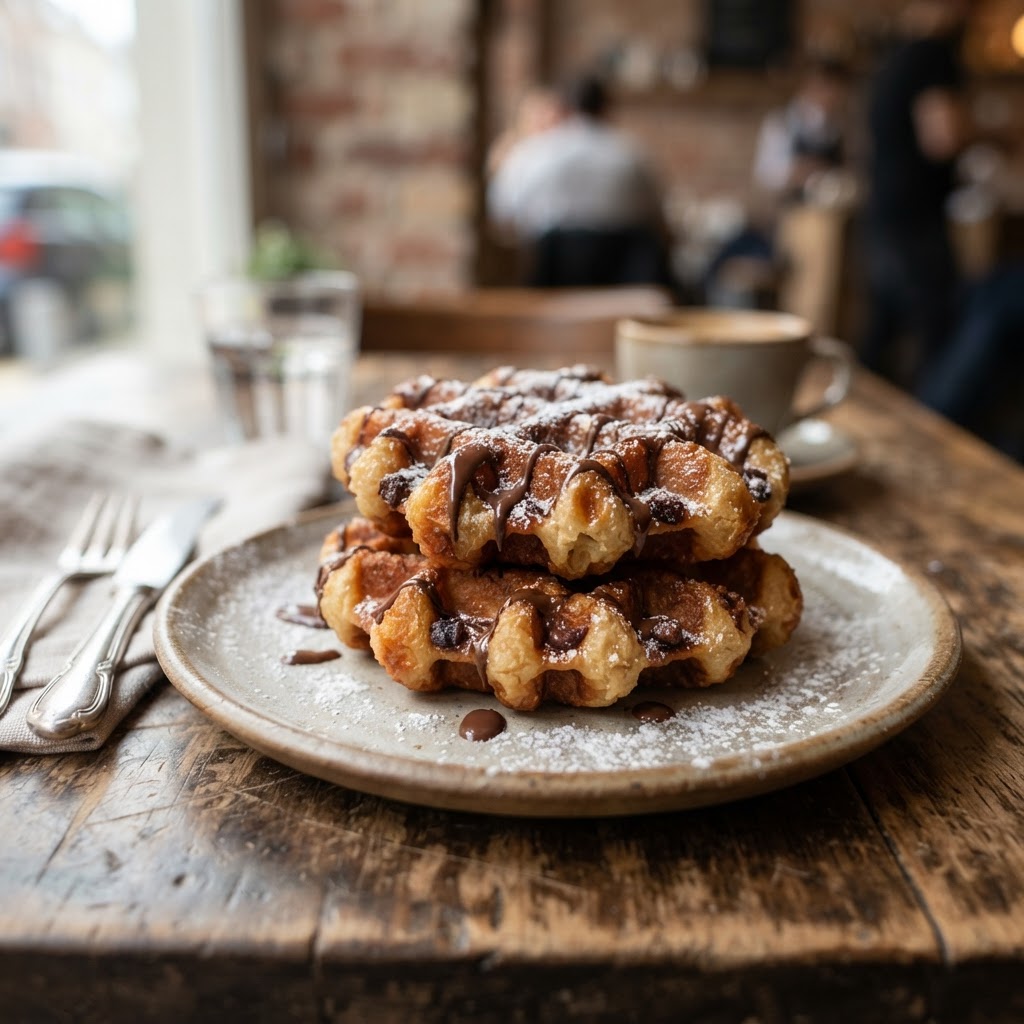
Liège waffles — dense, chewy, brioche-like waffles studded with caramelized pearl sugar that forms a crunchy, sweet crust as it cooks — are the sweeter, richer cousin of the lighter Brussels waffle, and one of Belgium's most popular street foods. Their origin is a royal one, dating to the 18th century and the court of the Prince-Bishop of Liège.
According to Wikipedia, the Liège waffle's dough is a dense and heavy brioche that contains pearl sugar, and the waffle was invented in the 18th century by the chef to the Prince-Bishopric of Liège. As Taste of Belgium recounts, according to tradition, the personal cook of the Prince-Bishop of Liège created the Liège waffle in the 18th century, offering a sweeter variation of the typical waffle for the royal court — the result was a dense, rich waffle made from brioche-like dough studded with pearl sugar. The pearl sugar is what makes a Liège waffle distinctive: unlike the Brussels waffle (made from a pourable yeast batter), the Liège waffle is made from a thick, enriched brioche dough with chunks of pearl sugar kneaded in; as the waffle cooks in the iron, the sugar caramelizes, forming a crunchy, sweet, irregular crust. The waffles are round and irregular in shape (rather than the neat squares of a Brussels waffle), dense and chewy in texture, and traditionally served plain or dusted with powdered sugar as a hand-held street snack.
Liège waffles are distinct from the Brussels waffles that most Americans know as "Belgian waffles." As Taste of Belgium explains, the Brussels waffle made its official debut in the United States at the 1964 New York World's Fair when Maurice Vermersch introduced it — originally called the "Brussels waffle," he renamed it the "Belgian waffle" to attract a broader American audience. The Liège waffle eventually followed, becoming a staple in cities like Cincinnati (where Taste of Belgium popularized it) and beyond. The two waffles are quite different: the Brussels waffle is light, crisp, and rectangular with deep pockets for toppings; the Liège waffle is dense, chewy, round, and self-sweetened by the caramelized pearl sugar — it needs no syrup, just perhaps a dusting of powdered sugar.
Our Mimosavated version adds a splash of Prosecco di Valdobbiadene to the brioche dough — the bright, slightly acidic wine adds a subtle fruity note and tenderizes the dough slightly.
Ingredients (makes about 8 waffles):
The Brioche Dough: - 1 lb 2 oz all-purpose flour (or bread flour) - 1 packet (¼ oz) active dry yeast - ½ cup warm milk - ⅓ cup Prosecco di Valdobbiadene - 2 large eggs - 2 ⅞ oz granulated sugar - 1 teaspoon salt - 1 teaspoon vanilla extract - 5 ¼ oz unsalted butter, room temperature, cut into pieces - 7 oz Belgian pearl sugar (this is essential — do not substitute regular sugar)
Making the Dough: In a small bowl, sprinkle the yeast over the warm milk and let stand for 5 minutes until frothy. In the bowl of a stand mixer, combine the flour, sugar, and salt. Add the yeast mixture, Prosecco, eggs, and vanilla. Mix with a dough hook on low speed until a shaggy dough forms. Increase the speed slightly and knead for about 5 minutes, until the dough begins to come together.
With the mixer running, add the softened butter, a few pieces at a time, and continue kneading for 8–10 minutes, until the dough is smooth, elastic, and pulls away from the sides of the bowl — this is a sticky, enriched dough, so be patient; it will come together. Cover the bowl with plastic wrap and let the dough rise in a warm place for 1–1.5 hours, until doubled in size.
Adding the Pearl Sugar: Gently deflate the dough and turn it out onto a lightly floured surface. Knead in the Belgian pearl sugar, a handful at a time, until it is evenly distributed — work gently so you don't crush the sugar lumps. Divide the dough into 8 equal portions (about 3 ⅛ oz each) and roll each into a ball. Place the balls on a parchment-lined tray, cover loosely, and let rest for 15–20 minutes to relax.
Cooking the Waffles: Preheat a Belgian waffle iron (a standard waffle iron works, but a deeper-grid iron gives better results). Lightly grease the iron. Place a ball of dough in the center of each waffle section (do not press down — the iron will press it as it closes). Cook according to your iron's instructions, about 4–6 minutes, until the waffles are deep golden brown and the pearl sugar has caramelized into a crunchy crust. The caramelized sugar is extremely hot — let the waffles cool for a minute before handling.
Serving: Serve warm, as soon as possible after cooking — the caramelized sugar crust is best fresh. Dust with powdered sugar if desired, or serve with a drizzle of melted chocolate, whipped cream, or fresh fruit. Liège waffles are also wonderful eaten plain, hand-held, as the Belgians do on the street.
The Mimosa Pairing Logic: Since the brioche dough contains Prosecco di Valdobbiadene, pair with a classic Prosecco mimosa — orange juice and Prosecco. The bright citrus complements the buttery brioche and the caramelized sugar. A peach bellini mimosa is also excellent — the peach echoes the Prosecco and complements the waffle's brunch character. Avoid heavy or dry mimosas — Liège waffles are sweet, buttery, and caramelized, and you need something light and bright to balance them.
Reference Links: - Liège waffle (18th century, Prince-Bishop of Liège, brioche, pearl sugar): Wikipedia - The History of Belgian Waffles: From Liège to Cincinnati (Prince-Bishop's cook, Brussels vs. Liège, 1964 World's Fair, Maurice Vermersch): Taste of Belgium - Belgian Liège Waffles (brioche dough, pearl sugar, recipe): Ana's Baking Chronicles - Prosecco di Valdobbiadene: Wikipedia
Make-Ahead: The brioche dough can be made up to 1 day ahead and refrigerated after the first rise — bring to room temperature before adding the pearl sugar. The dough balls (with pearl sugar) can be shaped and refrigerated for up to 12 hours before cooking; let them come to room temperature for 15 minutes before cooking. The cooked waffles are best eaten immediately — the caramelized sugar crust softens as they sit. If you must, reheat cooked waffles in a toaster or a 356°F (350°F) oven for 3–4 minutes to partially restore the crispness. The shaped, uncooked dough balls can be frozen for up to 1 month; thaw in the refrigerator overnight and cook from chilled.
Pro Tips: You must use Belgian pearl sugar — small, hard lumps of sugar that caramelize as the waffle cooks; regular granulated sugar will dissolve and not give the signature crunchy crust (pearl sugar is available online and at specialty stores). The dough is a sticky, enriched brioche — be patient while kneading and don't add too much extra flour; the butter needs to incorporate fully. Let the dough rise fully — this gives the light, chewy interior that contrasts with the caramelized crust. Don't press the dough balls flat in the iron — place the ball and let the iron close on it; this gives the round, irregular shape that is the signature of a Liège waffle. Cook until deep golden brown — the pearl sugar needs to caramelize, and undercooked waffles will be pale and soft rather than crunchy. The caramelized sugar is extremely hot when the waffle comes out — let it cool for a minute before biting in, or you'll burn your mouth. Eat the waffles as soon as possible after cooking — the caramelized crust is at its best fresh from the iron and softens as it sits; this is a made-to-order treat, not a make-ahead one.
Rate this recipe
Be the first to rate this recipe
to submit your rating.
Perfect Mimosa Pairings
Mimosas that pair perfectly with this dish
Recent Posts

Couscous Royale: North Africa's Grand Platter of Lamb, Chicken, and Merguez
October 14, 2026

Seattle Cream Cheese Dog Bites: Hadley Long's 1989 Pioneer Square Invention
October 14, 2026

Khao Soi: Chiang Mai's Northern Thai Coconut Curry Noodles
October 13, 2026

Korean Bibimbap: Jeonju's Joseon Dynasty Mixed Rice
October 11, 2026

Spaghetti alla Carbonara: Rome's World War II Pasta of Eggs, Guanciale, and Pecorino
October 9, 2026