Beef Empanadas with Chimichurri Sauce
July 8, 2026
The empanada was first recorded in Galicia, in northwestern Spain, where Visigothic-era rules for its preparation were decreed in the seventh century, and where a reference to an *empãada* appears in the *Cantigas de Santa Maria* around 1282. A Catalan cookbook of 1520, the *Llibre del Coch* by Robert de Nola, gives recipes for empanadas filled with seafood. The name comes from the Spanish *empanar*, to wrap or coat in bread, and the original was a large, two-crust communal pie, baked for festivals and pilgrimages and carried on the road because its sealed crust kept the dust out. Spanish colonizers carried the empanada to Latin America in the sixteenth century, and every country they touched, Argentina, Chile, Peru, Colombia, Mexico, and the Philippines, developed its own variation.
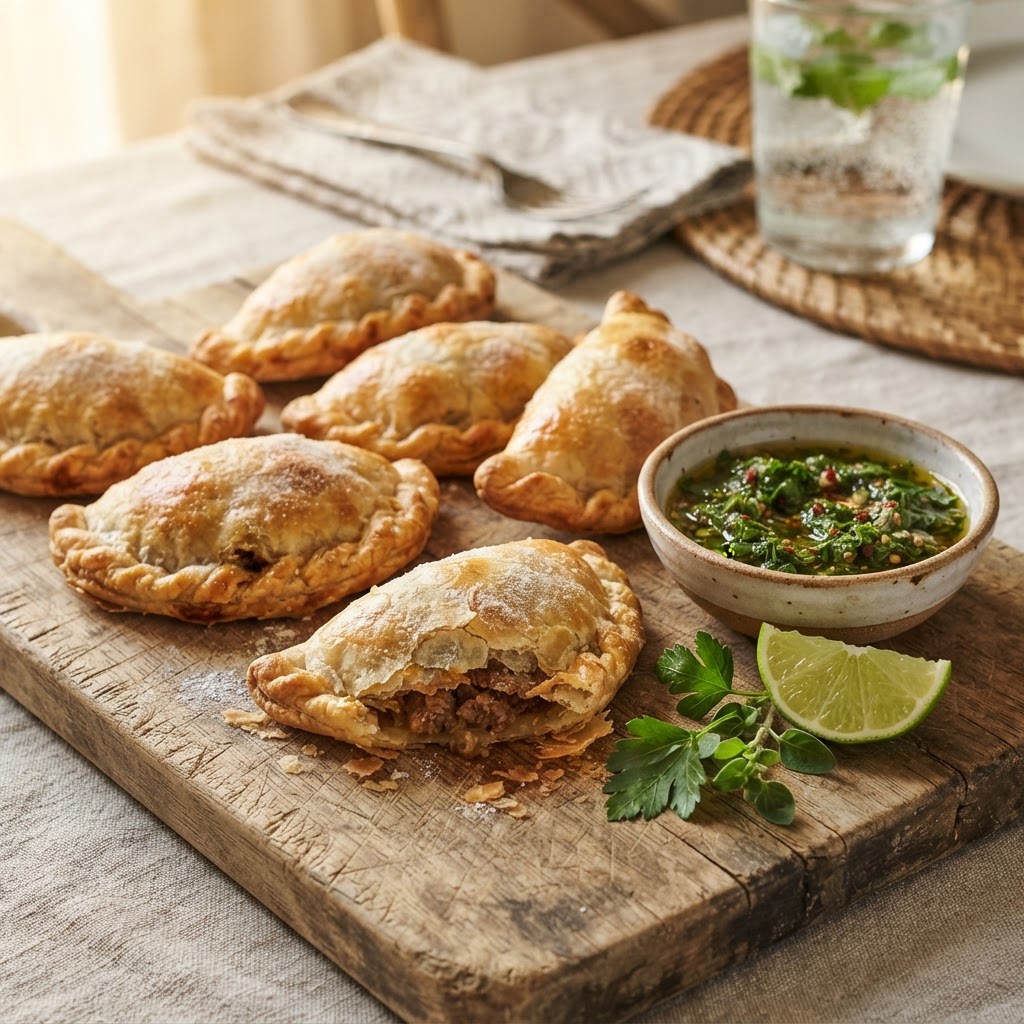
The Argentine beef empanada is the version most taken as the standard: seasoned ground beef with onions, hard-boiled egg, olives, and raisins, flavored with cumin and paprika, baked rather than fried in a flaky, butter-rich dough. The essential accompaniment is chimichurri, the uncooked emulsion of parsley, garlic, olive oil, vinegar, oregano, and red pepper flakes that Argentina uses principally on grilled meats. Its bright, herbaceous, garlicky character cuts the richness of the beef and the pastry, and makes each bite read fresh.
Ingredients (makes 24 empanadas, serves 8–10):
Empanada Dough: - 1 lb 2 oz all-purpose flour - 1 teaspoon salt - 5 ¼ oz unsalted butter, cold, cut into cubes - 2 large eggs (1 for dough, 1 for egg wash) - ½ cup cold water - 1 tablespoon white vinegar (the secret to a tender, flaky crust)
Beef Filling: - 1 lb 2 oz ground beef (80/20 — lean beef is dry and tasteless) - 2 tablespoons olive oil - 1 large onion, finely diced - 3 garlic cloves, minced - 1 red bell pepper, finely diced - 1 teaspoon ground cumin - 1 teaspoon smoked paprika - ½ teaspoon dried oregano (preferably Argentine or Mexican) - ½ teaspoon red pepper flakes (optional) - 2 tablespoons tomato paste - ½ cup beef stock - 2 hard-boiled eggs, chopped - 1 ¾ oz green olives, pitted and chopped (Manzanilla or Queen olives) - 2 tablespoons raisins, soaked in warm water and drained - 1 tablespoon fresh parsley, chopped - Salt and pepper
Chimichurri Sauce: - 1 large bunch fresh flat-leaf parsley (about 2 ⅞ oz), stems removed - 4 garlic cloves - 3 tablespoons red wine vinegar - 1 teaspoon dried oregano - ½ teaspoon red pepper flakes - ⅔ cup extra-virgin olive oil - Salt and pepper - 1 tablespoon fresh lemon juice
Garnish: - Fresh parsley - Flaky sea salt - Lime wedges
Making the Dough: In a food processor, combine flour and salt. Add cold butter cubes and pulse until the mixture resembles coarse breadcrumbs. In a small bowl, whisk together 1 egg, cold water, and vinegar. With the motor running, pour the liquid through the feed tube and pulse just until the dough comes together in a ball. Turn onto a floured surface, knead briefly, wrap in plastic, and refrigerate at least 1 hour (or overnight).
Making the Filling: Heat olive oil in a large skillet over medium-high heat. Add onion and red bell pepper; cook 4–5 minutes until softened. Add garlic and cook 1 minute. Add ground beef, breaking it up with a wooden spoon, and cook until browned. Drain excess fat. Add cumin, smoked paprika, oregano, and red pepper flakes; cook 1 minute until fragrant. Stir in tomato paste and cook 1 minute. Add beef stock, bring to a simmer, and cook 5 minutes until most of the liquid has evaporated — the filling should be moist but not wet. Remove from heat and cool to room temperature. Stir in chopped eggs, olives, raisins, and parsley. Season generously with salt and pepper. (Filling can be made 2 days ahead; refrigerate.)
Chimichurri Sauce: Finely chop the parsley and garlic by hand (do not use a food processor — it pulverizes the herbs and makes a paste rather than a textured sauce). Transfer to a bowl. Add red wine vinegar, oregano, red pepper flakes, olive oil, lemon juice, salt, and pepper. Stir well. Taste and adjust — it should be bright, garlicky, herbaceous, and slightly tangy. Let sit at least 30 minutes before serving for the flavors to meld. (Can be made 3 days ahead; refrigerate. Bring to room temperature before serving.)
Assembling the Empanadas: Preheat oven to 400°F. Line two baking sheets with parchment paper. On a floured surface, roll the dough to about 3mm thick. Cut out 4-inch circles (use a bowl or cutter). Place a generous tablespoon of filling in the center of each circle. Fold the dough over to form a half-moon and press the edges together. Crimp the edges with a fork to seal, or fold and roll the edge over itself for the traditional Argentine "repulgue" pattern. Place on baking sheets. Brush with beaten egg wash. Cut a small slit in the top of each empanada to allow steam to escape.
Baking: Bake 20–25 minutes until deeply golden and the pastry is crisp. Cool 5 minutes before serving. Serve with chimichurri sauce alongside for dipping.
The Mimosa Pairing Logic: The savory, spiced, beefy character of empanadas calls for a mimosa with bright citrus that cuts through the richness of the pastry and the filling. A classic orange mimosa is the most natural pairing — the citrus refreshes the palate and the champagne's acidity balances the richness. A blood orange mimosa is exceptional — the slight bitterness of the blood orange complements the cumin and smoked paprika in the filling. For a more adventurous pairing, a tangerine cardamom mimosa creates a beautiful aromatic bridge with the spice profile. The chimichurri's herbaceous, garlicky character also pairs beautifully with a cucumber mint mimosa, whose cooling, fresh character echoes the parsley in the sauce.
Reference Links: - History of empanadas: El Sur SF - Empanada Wikipedia: Wikipedia - Chimichurri sauce guide: The Spruce Eats - Argentine empanada recipe: Serious Eats
Make-Ahead: Filling (2 days, refrigerated). Chimichurri (3 days, refrigerated — flavor improves overnight). Dough (overnight, refrigerated). Assembled, unbaked empanadas can be frozen on a baking sheet, then transferred to a freezer bag for up to 2 months. Bake from frozen, adding 5–8 minutes to the baking time. Baked empanadas can be reheated in a 350°F oven for 5–7 minutes.
Pro Tips: The vinegar in the dough is the professional secret — it inhibits gluten development, producing a more tender, flaky crust. The filling must be cool before assembling — warm filling softens the butter in the dough and causes the empanadas to leak. The filling should be moist but not wet — excess liquid produces soggy empanadas that burst during baking. Cutting a steam vent in the top of each empanada is essential — without it, steam builds up and splits the seam. Chimichurri should be hand-chopped, not processed — a food processor bruises the herbs and produces a flat, monochromatic paste rather than a bright, textured sauce. The chimichurri must rest for at least 30 minutes — the garlic and vinegar need time to mellow and the herbs need time to release their oils into the olive oil.
Rate this recipe
Be the first to rate this recipe
to submit your rating.
Recent Posts

Couscous Royale: North Africa's Grand Platter of Lamb, Chicken, and Merguez
October 14, 2026

Seattle Cream Cheese Dog Bites: Hadley Long's 1989 Pioneer Square Invention
October 14, 2026

Khao Soi: Chiang Mai's Northern Thai Coconut Curry Noodles
October 13, 2026

Korean Bibimbap: Jeonju's Joseon Dynasty Mixed Rice
October 11, 2026

Spaghetti alla Carbonara: Rome's World War II Pasta of Eggs, Guanciale, and Pecorino
October 9, 2026