Argentine Empanadas Mendocinas with Beef and Olives
February 11, 2026
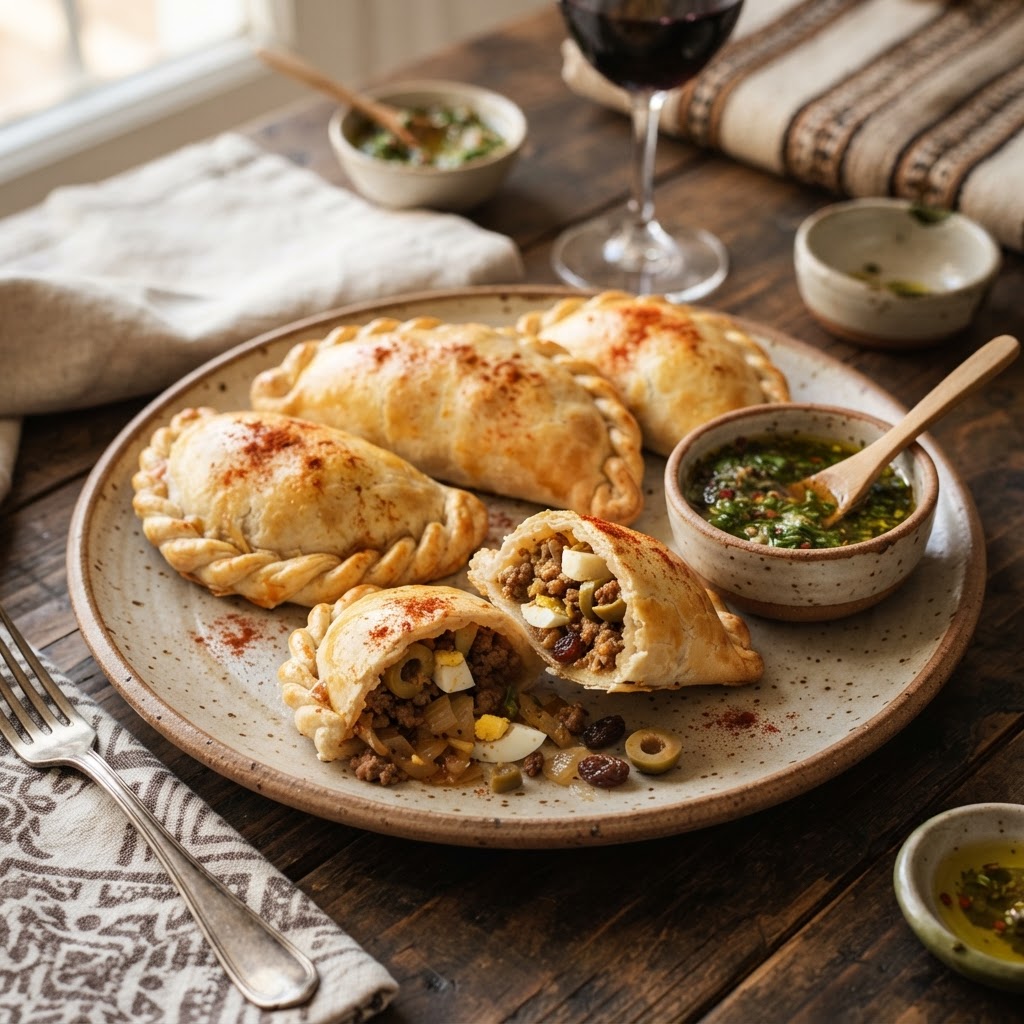
Empanadas mendocinas are the signature empanada of Mendoza, Argentina — the wine country province at the foot of the Andes. What distinguishes them from other Argentine empanadas is the filling: a beef picadillo (ground beef mixture) seasoned with smoked paprika and chili powder, which give the meat its distinctive bright red color, along with cumin, oregano, hard-boiled eggs, and green olives. Unlike many other Argentine empanadas, mendocinas do not contain raisins. The dough is also unique — it is made with milk, which gives it a creaminess and softness that the standard empanada dough does not have.
Empanadas arrived in Argentina from Spain, where they in turn originated from the Arabic savory pastries of Al-Andalus. The word "empanada" comes from the Spanish verb *empanar*, meaning "to bread" or "to wrap in bread." In Argentina, every region has its own variation — salteñas (from Salta, juicier and with potatoes), tucumanas (from Tucumán, often fried), and mendocinas (from Mendoza, baked with the distinctive red-tinted beef). The empanada is the most universal food in Argentina, eaten at parties, as a quick lunch, at family gatherings, and as a pre-dinner snack with wine.
About the Ingredients
Ground beef should be lean ground beef (80/20 or 85/15). In Argentina, empanadas can be filled with either ground beef (*picadillo*) or hand-chopped beef (*cuchillo*). The ground beef version is more common for mendocinas. Laylita Recipes provides an authoritative recipe.
Smoked paprika (pimentón dulce) is the key spice that gives mendocinas their signature red color and smoky depth. Use Spanish smoked paprika if available. The chili powder or hot pepper adds heat — adjust to taste.
Green olives — specifically sliced green olives stuffed with pimento — are a traditional addition that provides a briny, salty contrast to the rich beef. The combination of beef, egg, and olive is the classic mendocina trinity.
The dough for mendocinas is made with warm milk instead of water, which gives it a distinctive softness. Kevin is Cooking offers an excellent dough recipe. Store-bought empanada discs (available at Latin markets) are an acceptable shortcut.
Ingredients (makes approximately 20 empanadas):
Dough: - 3 cups all-purpose flour - 1 egg yolk - 1/2 cup lard or unsalted butter, softened - 3/4 to 1 cup warm milk - 1/2 teaspoon salt
Beef Picadillo Filling: - 1 lb ground beef - 2 large white onions, diced (about 3 cups) - 1/4 cup lard or butter - 2 tablespoons smoked paprika - 2 teaspoons chili powder (adjust to taste) - 1 tablespoon finely chopped fresh oregano - 1/2 tablespoon ground cumin - 1 bunch green onions, finely chopped - 3 hard-boiled eggs, sliced - 1/4 cup sliced green olives (pimento-stuffed) - Salt and black pepper to taste - 1 egg, lightly beaten (for egg wash)
Instructions: Prepare the dough: in a food processor, combine the flour and salt. Add the lard or butter and pulse until crumbly. Add the egg yolk and the warm milk in small amounts, pulsing until the dough forms clumps. Turn out, knead briefly into a smooth ball, flatten into disks, wrap in plastic, and chill for 30 minutes.
Prepare the filling: in a large bowl, combine the ground beef, smoked paprika, chili powder, cumin, salt, and pepper. Mix well and chill until ready to use.
In a large frying pan, melt the lard or butter over medium heat. Add the diced onions and a pinch of salt. Cook until the onions are very soft and translucent, about 8 minutes. Add the seasoned beef mixture and cook over medium heat, stirring frequently to break up the meat, until browned and cooked through. Remove from heat and stir in the chopped green onions. Let the filling cool to room temperature, then fold in the sliced hard-boiled eggs and green olives.
Assemble the empanadas: roll out the chilled dough on a lightly floured surface to about 1/8 inch thick. Cut into 5-inch rounds. Place a generous tablespoon of filling on one half of each round. Fold the dough over to form a half-moon and seal the edges by pressing firmly. Fold or crimp the sealed edge to create the traditional *repulgue* (braided seal) — or simply press with the tines of a fork. Place on a parchment-lined baking sheet. Brush with beaten egg.
Preheat the oven to 400°F (392°F). Bake the empanadas for 20–25 minutes until golden brown. Serve warm, with chimichurri sauce on the side.
The Mimosa Pairing Logic: The smoky, spiced beef filling and the briny olives in mendocinas pair beautifully with a bright, acidic mimosa. A classic Champagne mimosa or a blood orange mimosa is ideal — the citrus cuts through the rich, paprika-laden beef while the bubbles refresh the palate. The orange in the mimosa echoes the Spanish and South American tradition of citrus with beef, while the wine's effervescence complements the flaky pastry. The slight sweetness of the orange juice balances the smoky heat of the chili powder, creating a harmonious pairing that transports the table to a Mendoza vineyard.
Reference Links: - Empanadas mendocinas recipe: Laylita Recipes - Empanadas mendocinas: Kevin is Cooking - Argentine empanadas: Cooking Secrets for Men - Empanadas with Malbec pairing: Savored Journeys
Make-Ahead: The beef picadillo can be made up to 2 days ahead and refrigerated — it improves as the flavors meld. The dough can be made 1 day ahead and refrigerated. The assembled, unbaked empanadas can be frozen on a baking sheet, then transferred to a freezer bag for up to 3 months. Bake from frozen, adding 5–10 minutes to the baking time. Baked empanadas can be reheated in a 350°F (347°F) oven for 8–10 minutes.
Pro Tips: The filling must be completely cool before assembling — warm filling will soften the dough and cause the empanadas to leak. Do not overfill — a generous tablespoon is plenty; overfilled empanadas will burst in the oven. The smoked paprika is what gives mendocinas their distinctive red color; do not substitute regular paprika or you will lose the signature look. Seal the edges thoroughly — a poorly sealed empanada will open during baking and lose its filling. The repulgue (braided edge) takes practice but gives the most authentic appearance; a fork-crimped edge is perfectly acceptable and equally secure.
Rate this recipe
Be the first to rate this recipe
to submit your rating.
Perfect Mimosa Pairings
Mimosas that pair perfectly with this dish
Recent Posts

Couscous Royale: North Africa's Grand Platter of Lamb, Chicken, and Merguez
October 14, 2026

Seattle Cream Cheese Dog Bites: Hadley Long's 1989 Pioneer Square Invention
October 14, 2026

Khao Soi: Chiang Mai's Northern Thai Coconut Curry Noodles
October 13, 2026

Korean Bibimbap: Jeonju's Joseon Dynasty Mixed Rice
October 11, 2026

Spaghetti alla Carbonara: Rome's World War II Pasta of Eggs, Guanciale, and Pecorino
October 9, 2026